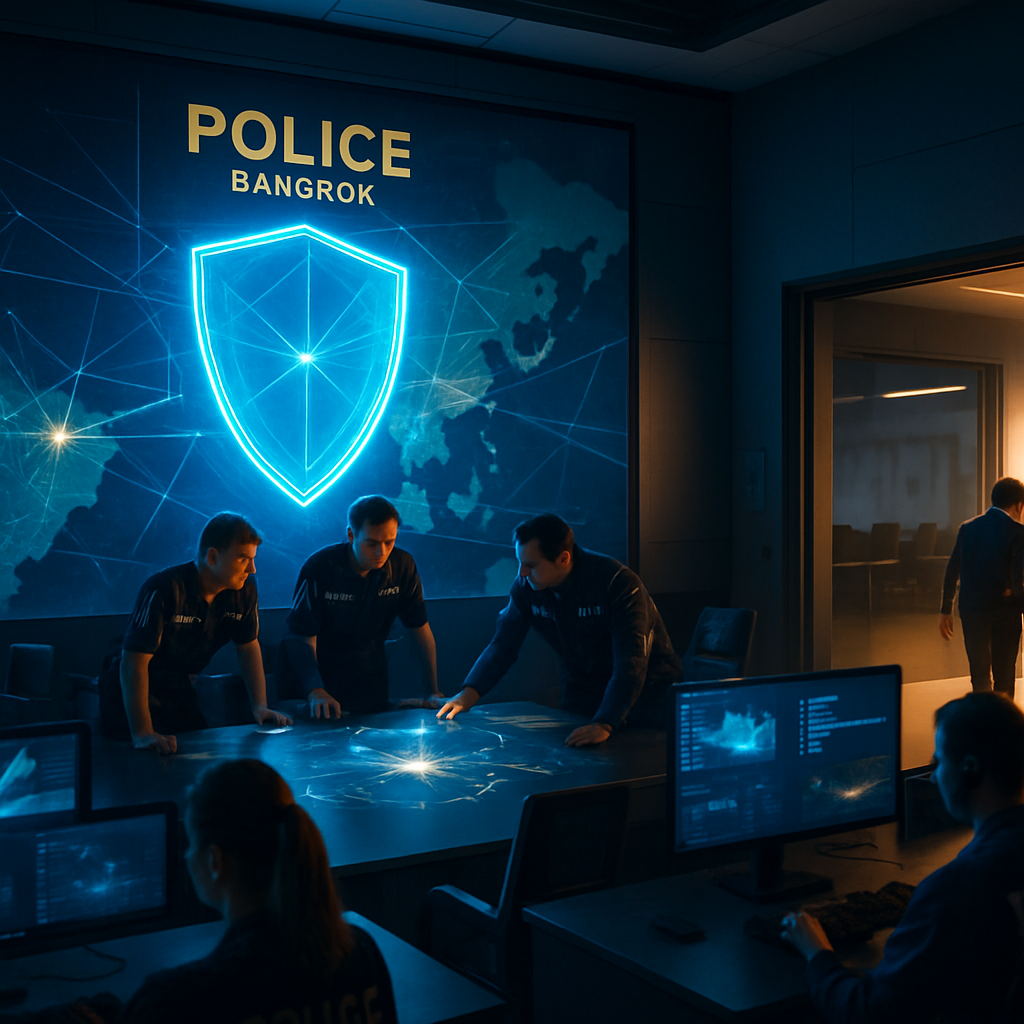
When law enforcement from 18 countries gathered at the Royal Thai Police headquarters in Bangkok on January 13, the meeting didn’t feel like your average roundtable. It was a full-throttle pushback against a modern hybrid threat: human trafficking tangled with forced criminality inside overseas call centre cyber scams. Chaired by Police General Thatchai Pitaneelabutr, deputy national police chief and director of the Anti-Human Trafficking Centre, the session aimed to turn scattered intelligence into coordinated action.
Who showed up — and why it matters
Representatives from a wide swath of nations attended, including South Korea, China, Japan, Nepal, Brunei, Bangladesh, the Philippines, Malaysia, Myanmar, Laos, Vietnam, Sri Lanka, the United Kingdom, Singapore, Australia, India, Indonesia — and of course Thailand. International partners such as the FBI and the United Nations Office on Drugs and Crime (UNODC) were also present, underscoring how these crimes refuse to respect borders.
The common thread discussed was chillingly modern: victims trafficked into forced roles inside call centre operations that engineer sophisticated scams against foreigners. These criminal networks, law enforcement warned, often run hubs in neighbouring countries like Myanmar and Cambodia and target citizens of developed nations — from the United States and Europe to the UAE and Singapore.
Meet SHIELD — a digital boost for cross-border policing
The meeting’s technological headline was SHIELD: the Scam and Human Trafficking Information Exchange and Linked Database. Thai police unveiled SHIELD as a centralized platform to record, map, analyse and share data on trafficking and cybercrime incidents. Think of it as a crime-fighting dashboard that brings together fragmented reports, links related cases, and issues cross-border alerts — all while preserving security and chain-of-evidence integrity.
Key SHIELD capabilities discussed included:
- Consolidated incident logging and victim profiles to spot patterns faster.
- Visualization tools that map networks — linking call centres, recruiters, financial flows and locations across countries.
- Secure channels for international partners to exchange intelligence and coordinate operations in real time.
- Analytic modules to prioritize leads and identify likely victims before they can be re-trafficked.
Officials described SHIELD not as a silver bullet but as a force multiplier: better data leads to faster prevention, sharper investigations, and more effective prosecutions.
From boardroom briefings to rescue missions
Participants received updates on ongoing investigations, with Thai authorities highlighting call centre scam networks largely based in Myanmar and Cambodia. These operations frequently coerce or deceive people into working for scam gangs — a cruel blend of labour trafficking and cyber-enabled fraud. As Police General Thatchai put it, stronger data sharing and international cooperation could “prevent people from falling victim” and make it harder for traffickers to hide behind jurisdictional gaps.
This isn’t Thailand’s first step in the fight. Last year the country set up an international coordination centre dedicated to rescuing victims trapped in Myanmar-run scam hubs, helping orchestrate cross-border rescues and victim support. The Bangkok meeting builds on that momentum, pushing tools like SHIELD and formal partnerships toward practical execution.
What comes next — and why you should care
The outcomes of the meeting aim to translate into concrete changes:
- Operationalizing SHIELD with partner agencies and rolling out secure access to trusted international counterparts.
- Regular joint investigations and targeted enforcement actions against identified scam hub operators.
- Enhanced victim identification and rescue protocols, including coordinated extradition and repatriation pathways.
- Public-awareness campaigns in source communities and destination countries to reduce recruitment vulnerabilities.
Cyber scammers and traffickers have adapted quickly to digital ecosystems; the response must be equally nimble. With SHIELD’s data-driven approach, regional cooperation led from Bangkok could make those adaptations a lot harder for criminals and safer for potential victims.
A regional problem demanding a global answer
The Bangkok meeting made one thing clear: these scams and trafficking rings are transnational by design and require a coalition response. When 18 countries and major international agencies sit at the same table, that’s the start of a network that can outpace the criminals who profit from coercion and deception.
Scammers don’t care about passports or borders — but neither do investigators when they’re equipped with shared data, interoperable systems, and a will to act. If SHIELD becomes the hub Thai authorities envision, it could be the difference between an isolated tip and a coordinated rescue; between a stalled case and a conviction. For the victims at the centre of this crisis, that’s not just progress — it’s a lifeline.


















This SHIELD system sounds promising, but I’m worried about privacy and how victim data will be protected across so many jurisdictions. Shared databases can help catch traffickers, yet they can also be abused if governance is weak. Thailand must publish strict rules about access, retention, and oversight before rolling this out widely.
I agree about governance, but isn’t the immediate priority saving people trapped now? Delaying for perfect rules might cost lives. They should run SHIELD with emergency protocols while setting up safeguards in parallel.
Right, emergency actions are vital and I don’t want bureaucracy to slow rescues. Still, history shows sensitive systems without safeguards leak or get misused, especially with cross-border politics involved.
Emergency use plus sunset clauses for elevated access could be a compromise. Make extraordinary access time-limited and auditable, then evaluate outcomes transparently.
As someone whose cousin was scammed through a call centre, I’m glad countries are cooperating. But 18 nations is a start and not enough; trafficking networks adapt fast and need global coverage. Real cooperation means extradition agreements and joint task forces, not just dashboards.
Agreed — dashboards are tools, not solutions. They enable evidence linking but without legal frameworks and local enforcement capacity, it won’t stick. Building trust among police forces takes time and accountability.
Exactly, Inspector Y. We need capacity building in source countries and incentives for corrupt officials to cooperate rather than obstruct. Otherwise traffickers just shift operations.
Why is this mostly in SE Asia being highlighted like it’s their fault? Scammers target foreigners, so rich countries should be asked to do more to stop their citizens from falling for scams. Education matters too.
Blaming victims and poor countries is naive. Traffickers exploit poverty and weak law enforcement; richer countries must stop enabling fraudsters by demanding stronger financial oversight and cooperating on prosecutions.
Mapping financial flows is the key weak point for these syndicates. If SHIELD can integrate suspicious transaction reports and provide secure, timely alerts to banks, that’ll choke off profits quickly. But banks must be willing to act cross-border and not hide behind privacy excuses.
Banks often move slowly because of compliance costs and fear of disrupting legitimate transfers. Maybe public-private taskforces with legal shields for good-faith reporting could help.
Yes, legal shields and incentives for banks to freeze suspected flows temporarily while law enforcement verifies could save victims from being re-trafficked or losing funds.
Good move. Trafficking tied to cybercrime is nasty and multinational work is needed. Hope SHIELD isn’t just another PR project.
From an enforcement view, chain-of-evidence integrity is the hard part. Digital evidence collected in one country often is inadmissible in another without proper procedures. SHIELD must include standardized evidence protocols and training modules.
Training and standardization are critical, but so is cultural competence: rescuing victims often requires trauma-informed approaches and protection from retribution. Police skills need to include care, not just arrests.
Absolutely — rescue without rehabilitation risks re-trafficking. SHIELD’s victim profiles should link survivors to NGOs and services, not just case files.
I work with shelters and we desperately need early-warning leads so we can prepare safe houses. If SHIELD can flag likely victims early, that could stop retrafficking cycles.
Can we trust countries like Myanmar and Cambodia to cooperate transparently? If corrupt officials are involved, data-sharing could be a double-edged sword that alerts traffickers. International oversight is needed.
I know it sounds cynical, but without independent monitors or third-party audits, SHIELD might be weaponized for political ends or cover-ups.
Seems like big government surveillance waiting to happen. People’s data is being collected across borders — who safeguards it when regimes change? Not convinced.
Technically SHIELD could be designed with zero-knowledge proofs or pseudonymized linking to protect identities while allowing pattern detection. The tech exists, but political will to implement it properly is another matter.
Zero-knowledge sounds fancy but courts and prosecutors may reject such evidence if they cannot verify chain-of-custody. Tech needs to align with legal admissibility.
Correct — so a hybrid approach: privacy-preserving analytics for detection and full auditable logs for prosecutions when necessary. It’s doable with proper cryptographic designs.
I worry about mission creep. Today it’s trafficking and scams, tomorrow other crimes get added and oversight weakens. We need sunset reviews and clear legislative boundaries around SHIELD.
Also include civil society in governance boards so NGOs can see how victim data is used and can push back on abusive practices.
This is a human-rights crisis, not just a cyber problem. Any tech solution must center victim consent, privacy, and long-term support. Otherwise it’s policing for the sake of convictions.
Nina’s point is crucial. Victim consent is messy in rescue scenarios, but protocols should exist to minimize harm and ensure survivors are treated with agency.
From a policy perspective, SHIELD’s success will hinge on mutual legal assistance treaties, data protection harmonization, and funding for cross-border prosecutions. Tech alone won’t dismantle networks that exploit legal asymmetries.
Scholars should be invited to evaluate SHIELD’s impact publicly, and pilot programs with clear metrics would be valuable to avoid mission drift.
Public evaluation is a good idea, but will governments accept criticism? Independent audits might be resisted if they expose complicity or failures.
I read this and wonder how many of these victims are migrants or undocumented workers coerced into scams. The root cause is economic desperation, not just criminal masterminds.
If SHIELD works, insurers and payment processors will need to be looped in to stop payouts. Without financial choke points, arrests are like whack-a-mole. Who pays for that integration though?
Also, transparency about who funds SHIELD matters. Private donors could skew priorities toward asset recovery instead of victim care.
Public-private partnerships could underwrite costs, but contracts must prevent private actors from mining data or influencing prosecutions for profit.
This is scary and necessary at once. My nephew fell for a romance scam; we had no idea how to track payments or who to contact. A real-time international alert system might have saved him.
If SHIELD includes a public tip line or portal for families to report patterns, that would be a practical feature for ordinary people like me.
Public-awareness campaigns in source communities are essential. Teaching people how recruiters groom and deceive would reduce supply of coerced workers. Education is cheap compared with rescue ops.
We run such campaigns and they help, but recruiters adapt quickly. Awareness must be sustained and paired with economic alternatives for at-risk populations.
I support tech tools, but let’s not forget that sometimes locals in scam hubs are complicit because it pays better than legal work. Economic policy must be part of the strategy.
As an NGO worker, I welcome SHIELD’s potential to identify victims earlier. But I insist on NGO access to anonymized alerts so we can mobilize shelters and counseling without exposing survivors to more danger.