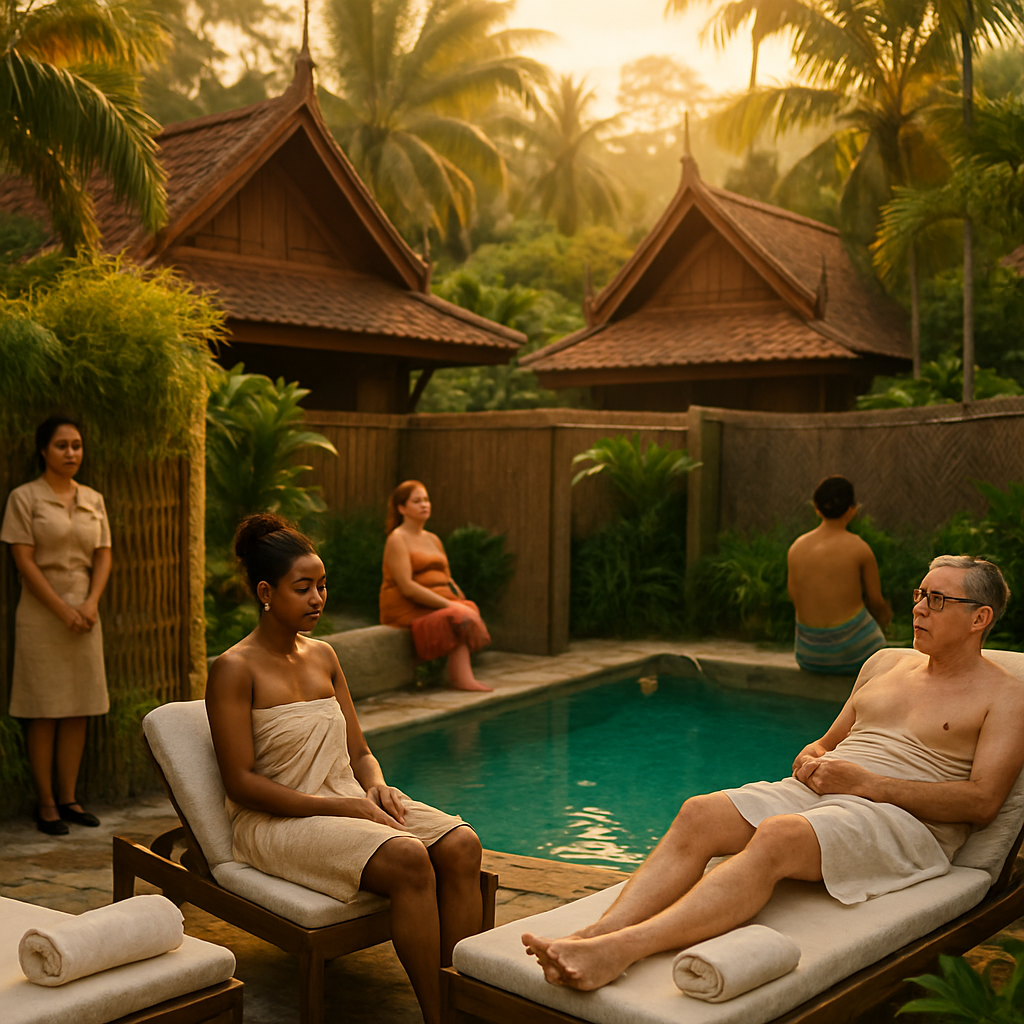
Someone on Facebook recently turned a few heads — and perhaps loosened a few tans — after posting a candid review of a naturist resort in Thailand. Their write-up, accompanied by photos and a short video, has introduced many people to a corner of Thai hospitality most had never imagined: a fully clothed-free retreat where the rules, oddly enough, are all about respect.
The resort in question operates on straightforward naturist principles: when you join in communal activities like swimming, sunbathing, walking about the grounds or using shared facilities, clothing is off the menu. Guests are expected to remain naked while in these spaces. If that sounds radical, the review stresses that the place functions on consent, courtesy and clear boundaries rather than chaos.
Two non-negotiables
According to the guest, the resort enforces two major rules that keep the environment safe and private. First, no photos or videos of other guests unless you have their explicit permission. Photography is only allowed inside private rooms or in areas confirmed to be empty. Second, sexual activity in public areas is strictly forbidden. Break either rule and the penalty is immediate removal from the property.
These policies aren’t meant to be killjoys — they’re the scaffolding that allows a diverse group of people to unwind without fear of exposure or exploitation.
Everyday etiquette that matters
Beyond the big rules, the resort encourages some commonsense etiquette that keeps things comfortable for everyone. Use a towel when sitting on shared furniture (for hygiene and courtesy), avoid intrusive staring, and respect personal space. If someone feels uneasy or suspects they’re being watched, staff are available to intervene. That level of responsiveness, the reviewer said, made the place feel safer, not riskier.
Body positivity as a practical philosophy
The reviewer framed the experience as less about exhibitionism and more about dismantling appearance-based hierarchies. Without the constant visual shorthand of designer labels or the latest fitness trends, guests reportedly treat each other more equally. Clothes-off communal life, in this telling, becomes an exercise in self-acceptance and in seeing people for who they are rather than what they wear.
That ethos seems to resonate with the resort’s clientele. The property is enclosed and not visible from the street, and most guests are foreign tourists, while Thai staff manage operations. This mix reportedly creates a calm, cosmopolitan atmosphere where people go to relax and unplug.
Is it legal in Thailand?
Understandably, many readers asked about legality. Thailand’s Criminal Code Section 388 prohibits indecent exposure in public and carries a fine of up to 5,000 baht. The key legal hinge here is “public.” Private spaces that are fully enclosed and accessible only to registered guests are generally treated as “private places.” In that context, nudity among consenting adults typically does not amount to a criminal offense.
There’s an important caveat: if outsiders — passersby, neighbors or anyone outside the resort — can see into the property, the space may lose its private-place protection and become effectively public under the law. That’s why physical enclosure matters so much for these resorts.
Digital risks: photos and the Computer Crime Act
Another legal flashpoint is distribution of images. Sharing nude photos or videos online could run afoul of Thailand’s Computer Crime Act or criminal statutes related to obscenity and pornography. Offenses in that realm can carry far heavier penalties including imprisonment and steep fines. That legal exposure is why the no-photography rule is not just about manners — it’s a practical way to protect guests and staff from serious legal consequences.
Why the post went viral
The Facebook post drew attention because many people had no idea nudist resorts like this existed in Thailand. Add a few candid photos and a short, well-written review, and the curiosity multiplier kicks in. For some readers, the post provoked fascination; for others, confusion or discomfort. But whether you’re intrigued or skeptical, the post sparked a wider conversation about privacy, consent and what liberal hospitality can look like.
Bottom line
This particular Thai naturist resort appears to run on a simple formula: clear, strictly enforced rules; a physical layout that ensures privacy; and a culture of mutual respect. The combination of on-site staff, explicit no-photo policies, and a ban on public sexual activity aims to create a space where people can practice body positivity without fear. As long as the site remains enclosed and consensual limits are respected, the experience sits in a legal gray-to-acceptable zone under Thai law — though distributing images or allowing outsiders to view activities could quickly change that calculation.
Curious travelers should do their homework: check the resort’s rules, confirm its enclosure and privacy practices, and be mindful of local laws. If you’re planning a stay, remember that the most important travel accessory there is a small towel — and a big dose of respect.













I wrote the piece to highlight rules and legal risks readers seemed to miss, not to promote anything. The resort emphasizes consent, enclosure, and strict no-photo policies to protect guests and staff. Happy to answer questions about the legal points or the review.
This sounds like a thoughtful approach and the no-photo rule is essential. Body positivity in a safe, regulated setting can be transformative for many people. I wish more places prioritized consent like this one does.
Nice in theory but once one photo leaks online the entire idea falls apart, legally and emotionally. Enforcement is only as strong as the staff and the guests’ willingness to comply. Social media incentives make this risk much higher than the article suggests.
Good point — the article mentions Computer Crime Act risks and why resorts forbid photography, but enforcement off-site is a gap. Guests should be briefed, agreements signed, and staff should have rapid-removal authority if rules are broken.
Nope. I would never go to a place where people walk around naked. Feels wrong and unsafe to me. Plus, why would tourists want this?
Not everything has to be for you, Joe. Some folks find it freeing and non-sexual, believe it or not. If it’s private and consensual I don’t see the harm.
I get the freedom argument but it still makes me uneasy. Maybe I’m just conservative in my thinking, nothing personal.
Legally, the distinction between public and private spaces is pivotal under Thai law, and the article explains that well. However, reliance on enclosure as a legal shield may be contested if visibility occurs even unintentionally. Operators should consult local counsel and have documented privacy measures to reduce liability.
As a frequent traveler I wish there were standardized certifications for privacy at resorts like these. It would help tourists trust them and protect staff from legal fallout.
Exactly — a combination of physical barriers, clear guest agreements, CCTV oriented only to non-sensitive areas, and staff training could create a defensible position legally. But no system is foolproof once digital sharing starts.
Local enforcement patterns matter too; laws exist on the books but are enforced selectively. That variability increases the practical risk for guests and operators.
I live in Thailand and some people here are surprised by this concept. Private resorts are legal when fully enclosed and not visible from the street. Still, many locals worry tourists do not understand our cultural values and can be disrespectful.
Thanks for the perspective, Nong. Are Thai staff comfortable working at these places, or is it mainly a tourist job with complicated feelings involved?
Many staff treat it as just a job and are professional, but not everyone is comfortable and recruitment should be consensual and well-paid. Cultural sensitivity training would help both visitors and employees.
Seems like an excuse for people to be creepy without consequences. I worry about voyeurism and the gray area of what ‘consent’ really means in holiday situations. No amount of rules matters if people drink too much and cross lines.
Totally agree about alcohol. Policies must limit intoxication in public areas and staff should intervene early. Otherwise the environment can become predatory without you noticing.
Right, and enforcement has to be zero-tolerance. The article’s ‘immediate removal’ sounds good but who’s policing that in real time?
Relax, it’s not a swingers’ club. Most people are there to relax, not to prey. Your paranoia ruins the fun for everyone else.
As someone who battled with body image, I find the idea beautiful. Removing clothes can strip away social status signals and encourage mutual respect. But the staff dynamics the article mentions deserve more scrutiny.
I respect the personal healing angle, but it’s naive to ignore power dynamics between foreign guests and local staff, especially in a tourism economy.
You’re right, Skeptic. Healing spaces have to be built ethically and with protections for staff and local community.
Why is this even news? People should be able to do what they want behind fences. The moral outrage is always selective and hypocritical. Let adults be adults.
Selective outrage is real, but laws and community standards exist for a reason. If someone’s actions impact non-consenting neighbors or children, it’s not just private.
If neighbors can see in, that’s a different story. Private property means private rules. Simple as that.
I love body-positive ideas but working conditions matter. Are Thai staff given privacy, respectful contracts, and the option to decline certain tasks? Tourism sometimes masks exploitation. Fans of naturism should ask these tough questions.
Some resorts do staff training and good pay, others treat it like any low-skill tourism job. Transparency from operators would help rebuild trust.
Exactly. Guests should check reviews not just for ambiance but for staff treatment and labor practices. That info is often missing.
Is there any NGO or watchdog that tracks ethical resorts in Thailand? Would be useful for travelers who care about labor rights.
The legal gray area worries me. Private can become public with a single oversight. And online distribution of images brings serious penalties under the Computer Crime Act. Tourists often assume their home laws apply, and they do not.
Beyond legality, this is morally wrong. I don’t care about laws — people should wear clothes in public places and respect decency.
You can hold moral beliefs, Kay, but the legal framework requires nuance. Operators have to navigate both cultural expectations and statutes.
This is offensive to many cultures and religions. Tourism shouldn’t mean imposing Western liberal ideas on other countries. The article glosses over local values.
I agree with Kay. Respecting local customs is non-negotiable. When in a different country, follow their moral framework.
Thank you. If resorts are truly private and staff consent, fine, but it still feels like cultural insensitivity at a minimum.
As a traveler, I try to research local attitudes before booking. This article is useful but I wish it listed how to verify community acceptance.