When Noodles Turned Nerve-Wracking: An 80-Year-Old’s Unplanned Detour into a Trat Water Factory
It was supposed to be a simple noodle break. Instead, an ordinary evening in Ban Nong Bua, Wang Krachae subdistrict, Trat province, turned into a scene straight out of a slapstick action clip — only thankfully without casualties.
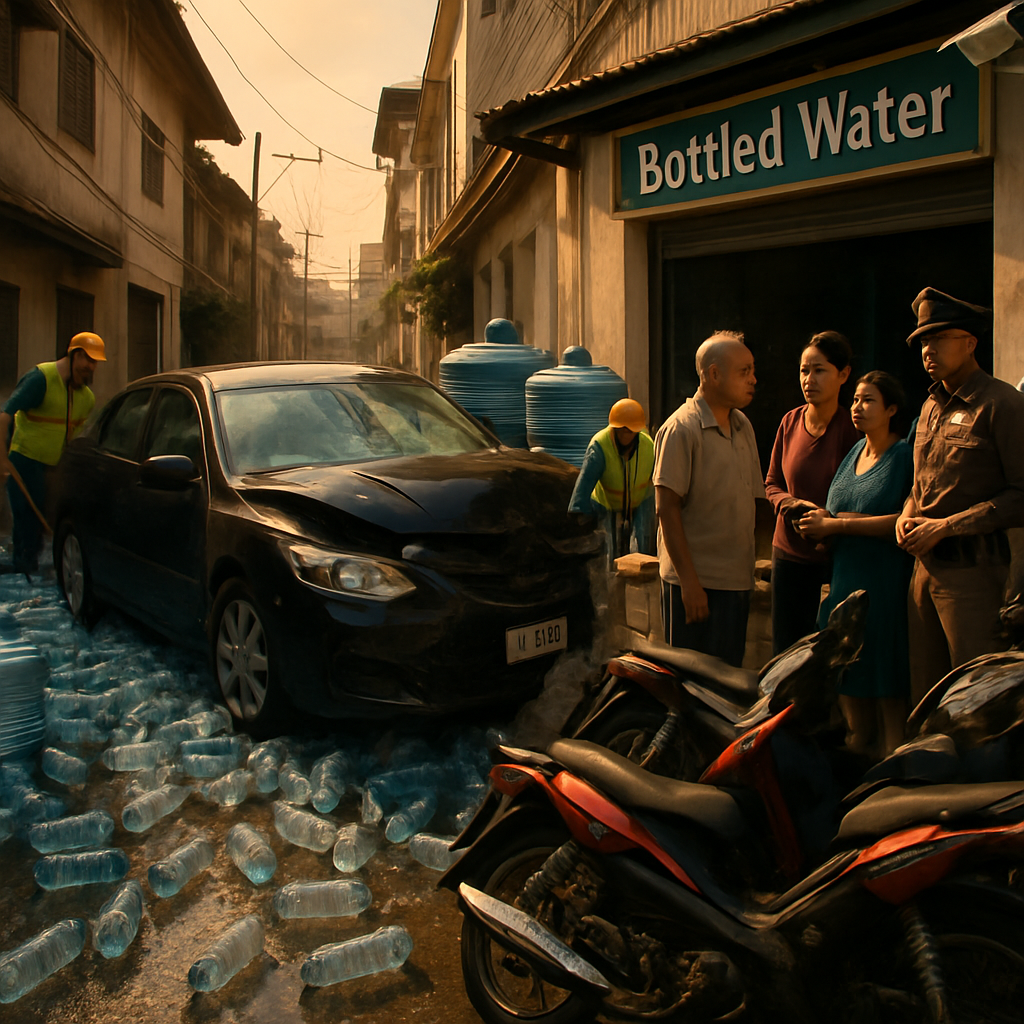
CCTV footage shows a black sedan gliding into a narrow alley beside a bottled water factory, then suddenly veering off course, clipping a row of parked motorcycles and smashing into massive water tanks and the factory wall. Glass shattered, plastic bottles exploded like confetti, and the front of the car was left looking as if it had been through a cyclone. Debris even ended up perched on the car’s roof and bonnet — a chaotic snapshot of an unusual accident.
The driver and his version
The driver, identified as 80-year-old Mitr, was still at the scene when police from Mueang Trat Police Station arrived. Calm and cooperative, he told officers he had been out to eat noodles and was leaving the restaurant when his automatic gear system malfunctioned. According to Mitr, the car refused to shift and the brakes failed. To avoid plunging into a busier street where people might be hurt, he steered the vehicle into the nearby alley and into the factory compound.
Police reviewed the CCTV footage as part of their investigation. At the time of reporting, no formal charges had been filed. Fortunately, the potentially worst outcome — injuries — was avoided: no one at the factory was hurt, though seven motorcycles owned by factory staff parked along the fence suffered varying degrees of damage.
Damage, promises and community relief
Photos shared by CH7 News captured the scattered wreckage — shattered water bottles, twisted metal, and the damaged black sedan — while factory workers began the delicate task of counting losses. Mitr’s relatives arrived shortly after and contacted his wife, who was out of province. They assured factory staff that compensation for the property and motorcycles would be arranged, a move that helped soothe tensions at the scene.
In small communities such as Wang Krachae, incidents like this create waves that extend beyond the immediate damage. It’s the relief that nobody was hurt and the prompting of human responses — calls to family, promises to pay, and polite exchanges with police — that tends to dominate the aftermath.
Not an isolated pattern
Oddly enough, the Trat crash echoed another recent local story involving an elderly driver. In Sai Noi district, Nonthaburi, two secondary school students were injured after a car driven by a 92-year-old man collided with their motorcycle while turning into a side street. That incident served as a grim reminder that as Thailand’s population ages, traffic incidents involving older drivers occasionally make headline news.
Neither episode is meant to stigmatize older drivers — many of whom are perfectly safe behind the wheel — but they do prompt important conversations about vehicle maintenance, driver fitness, and precautionary measures for everyone on the road.
Scenes captured, questions raised
CCTV was key to piecing together what happened in Trat. The footage not only recorded the dramatic moments leading up to the collision but also provided the police with an unbiased sequence of events that will help determine whether it was purely mechanical failure, human error, or a combination of both.
At the factory, workers set about clearing the wreckage and assessing damage to stock and machinery. Outside, Mitr and his family coordinated with police and factory management. Conversations turned quickly from shock to logistics: who will pay for the damaged bikes, how will the factory make up lost production time, and are the water tanks stable after the impact?
A lucky ending — and a nudge toward prevention
In the end, the incident in Ban Nong Bua could have been much worse. No lives were lost and injuries were avoided, thanks in part to Mitr’s split-second decision to steer the malfunctioning car into an alley rather than a busier road. Still, the crash leaves a trail of practical questions: routine inspections of older vehicles, clearer guidance for older motorists, and the ever-useful role of CCTV in keeping communities safe.
For now, the story closes on a practical note: police continue their investigation, relatives have promised to arrange compensation, and the community breathes a collective sigh of relief. It’s a dramatic episode that began with a noodle run and ended with a reminder — sometimes small, everyday outings can deliver the most unexpected detours.


















This story is wild and a little sad at the same time. An 80-year-old saying his gears and brakes failed sounds plausible but also raises questions about car maintenance. I think communities should check on elderly drivers more regularly.
Mechanical failure explanations are easy to accept until someone shows proof like a repair bill or expert testimony. CCTV helps but it does not replace a proper mechanical inspection of the vehicle. We need transparency so families and factories know exactly what happened.
If the brakes really failed he might deserve sympathy, but if it was negligence then compensation is rightfully expected. People keep saying ‘age’ like it’s the only factor, but broken parts can happen to anyone. The factory should also pay attention to where staff park.
I agree with Anna that parking policy matters and sympathy shouldn’t rule out responsibility. Also, CCTV footage should be released to support the investigation rather than only to the police. Families promising compensation is good but written agreements are better.
This feels like another example where the headline invites ageist panic more than measured discussion. We have to balance safety and dignity for older drivers and avoid blanket bans. Licensing reviews and mandatory checks for older drivers could be a reasonable middle ground.
Licensing reviews sound good until they become a bureaucratic hurdle that isolates seniors from daily life. Not everyone has easy access to public transport or family to drive them. So if reviews are implemented they must be fair, quick, and supportive.
Fairness is exactly the concern, but the safety of school kids and factory workers matters too. Two students were injured in the other incident mentioned, which shows a pattern that needs addressing. Maybe subsidized driving assessments for elders could help both safety and dignity.
Subsidized assessments are a sensible compromise that respects independence while protecting the community. They should include both medical checks and practical driving evaluations. We must avoid creating a system that punishes the vulnerable.
As someone who works around factories, I worry about the layout and safety protocols too. Why were motorbikes parked in such a vulnerable spot along the fence where a vehicle could crash into them? Mitr steering into the alley might have prevented worse, but the site should be safer.
From an engineering and policy perspective, single-vehicle incidents often reveal a cascade of small failures: aging components, delayed maintenance, and suboptimal infrastructure. The CCTV is forensic evidence but not diagnostic proof of mechanical causes. A full inspection by an independent mechanic should be part of the official record.
I agree that an independent inspection is necessary, but who pays for it when the elderly driver may be on a fixed income? The family promised compensation which helps, but institutional responsibility for public safety should not fall solely on individuals. Local authorities should offer support for evidence collection.
Exactly, Professor Lin, the mechanical report will change public opinion if it shows a failure beyond the driver’s control. We see too many assumptions made based on age alone, and that harms real analysis. A neutral inspection can also protect the elderly from unfair blame.
In small towns like Wang Krachae this becomes more than an accident, it’s social drama that affects neighbours for weeks. The relatives promising to pay is the usual way to smooth things over here, but it should not stop a proper inquiry. People need both justice and reassurance that safety will be improved.
I’m tired of the ‘noble steering’ narrative where the driver supposedly sacrificed to avoid worse harm without proof. It makes great TV but may not reflect real decision making in a panic. Let’s wait for the facts before turning him into a hero or a villain.
It was very scary and I am glad no one got hurt, period. We should all be more careful when leaving restaurants and near factories. Maybe there should be speed bumps and clearer exit signs in alleys.
Skeptic, the CCTV will clarify the sequence and whether steering was deliberate, so I think both perspectives can coexist until evidence emerges. Aunt May makes a good point about simple engineering fixes like speed bumps that reduce the chance of these kinds of accidents. We need both investigation and practical prevention.
Media likes the ‘no injuries’ ending, but they rarely follow up on compensation or safety fixes. I want to know if the factory will improve barriers and if the motorcycles will be reimbursed properly. Without follow-up, lessons are lost and the same scene repeats later.
Public policy must evolve with demographics, and that means clearer standards for vehicle maintenance and driver fitness across all ages. Mandatory periodic vehicle inspections could catch gear or brake issues before they lead to incidents. Combining that with accessible elder mobility programs reduces risk without stripping freedom.
There is also a cultural element where families assume elders will keep driving forever and defer to them. That respect is admirable but can be dangerous if it prevents checking licenses or eyesight. Education campaigns for families could help normalize supportive conversations about driving retirement.
Education campaigns are necessary but insufficient if infrastructure and regulation lag behind demographic shifts. Urban planning must include safe parking zones and protective barriers for vulnerable assets like motorbikes. A systems approach will reduce single-point failures and manage risk across communities.
I still think CCTV footage release would calm rumors and help decide if it was mechanical failure or human error. Police have the footage but public trust grows when evidence is transparent. Of course privacy concerns matter, but edited clips could serve clarity without exposing sensitive details.
As someone who once worked in a small bottling plant, I can say the sight of shattered bottles and workers counting losses is heartbreaking. Factories near alleys should have stronger perimeter protection to prevent any vehicle from crashing into storage tanks. The human cost is not just property — the stress for workers is real and long lasting.
We should be careful not to stigmatize older drivers while still protecting public safety. Programs that offer voluntary driving assessments and alternative transport options can preserve dignity and reduce risk. Social services can partner with local police to create compassionate check-ins for older drivers.
ElderCare’s point about compassion matters a lot to me, because ageism can be cruel and counterproductive. But practical steps like assessments and parking redesign are concrete actions that show respect by keeping everyone safe. I hope the community treats Mitr fairly while fixing the structural issues that made this damage possible.
I worry about CCTV normalization and the idea that every incident must be filmed to be believed. Surveillance is useful for evidence but it also shifts how communities behave and sometimes penalizes the poor. There must be limits and clear rules about who can access footage and for what purpose.
Sofia raises an important civil liberty concern that often gets overlooked in safety debates. We can have CCTV for accountability but with strict policies on release, retention, and usage. Transparency does not mean unrestricted public spectacle.
Surveillance policy should be community-driven with clear redaction rules for private individuals. The balance is tricky but possible if local governments engage residents. Public safety and privacy can coexist with thoughtful rules.
I appreciate the push for rules, but I still fear that CCTV clips make sensational headlines and stigmatize people before investigations conclude. Media literacy and restraint should be part of any policy conversation. Perhaps local outlets could pledge to avoid naming or shaming until investigations finish.
Small-town reputations are fragile and a single viral clip can harm someone permanently. Responsible journalism and official updates are essential so people don’t jump to conclusions. Local police should provide timelines and findings to curb gossip.
Police timelines help but need to be paired with proactive public safety measures. If braking systems are suspected, authorities should recommend immediate inspections for similar vehicles in the area. A short preventative campaign could avert future incidents quickly.
Preventative campaigns are great but must reach the people who need them most, who may not be online or in the usual info channels. Churches, markets, and noodle shops are effective places to share simple safety messages in small towns. Engaging community leaders makes messages stick.
Deploying targeted preventative measures in non-digital community hubs is smart and cost-effective. Data-driven allocation of inspections and infrastructure upgrades will maximize benefit for limited budgets. A pilot program in one community could provide valuable lessons for scaling up nationwide.
A pilot sounds promising, and it could include periodic vehicle checks, driver screenings, and infrastructure tweaks. Measuring outcomes like reduced incidents and community satisfaction would prove whether it’s worth broader adoption. Small experiments reduce political resistance because they limit risk while offering evidence.
If a pilot includes free or discounted inspections for older drivers then uptake will be higher in rural areas. Cost is often the barrier, not willingness. A well-publicized local program could also rebuild trust after an upsetting accident like this.
Funding models could include small contributions from local businesses that benefit from safer streets, like factories and markets. Shared responsibility keeps everyone invested in prevention and reduces the burden on individuals. Community partnerships are the most sustainable path forward.
I like the partnership idea since the factory also benefits from reduced risk and better community relations. If businesses chip in for inspections and barriers it’s a win for workers and residents alike. Let’s hope lessons from this noodle run-turned-crash lead to practical local reforms.