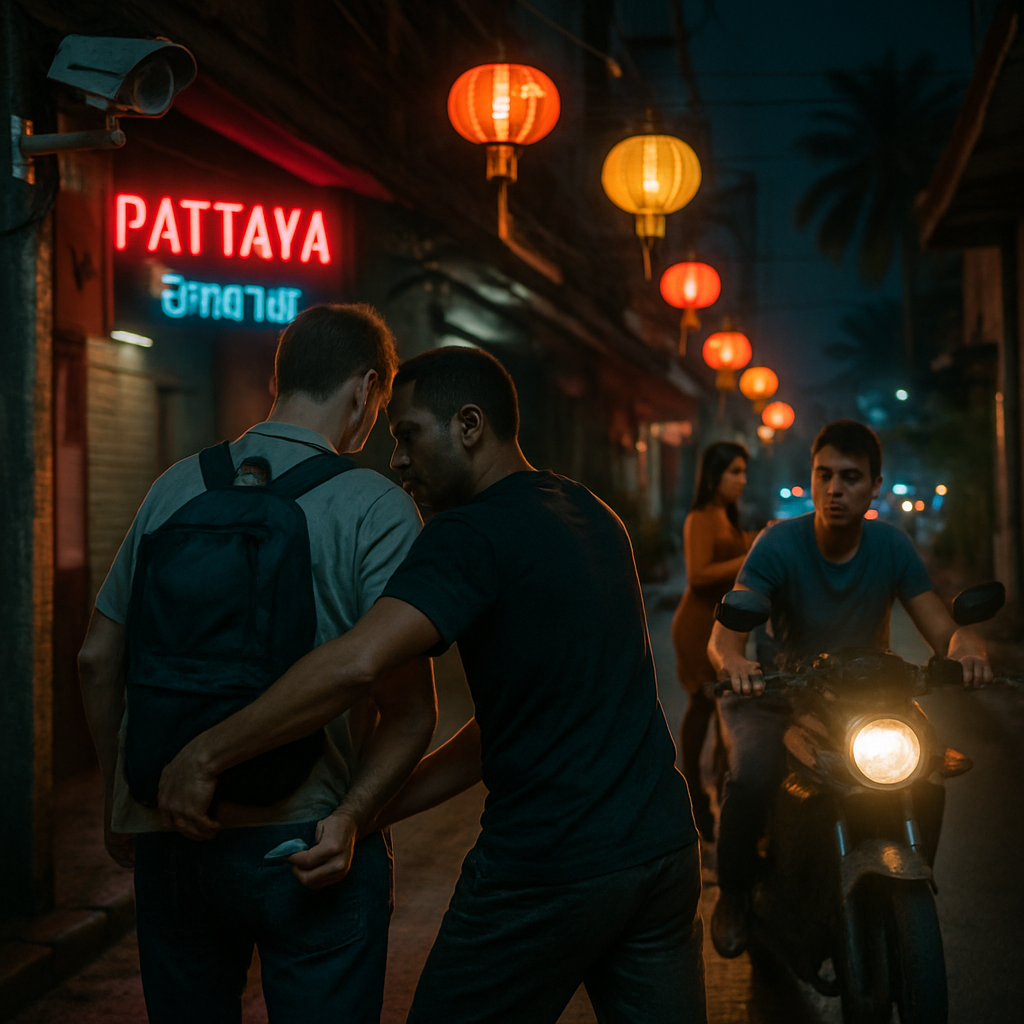
It was supposed to be another balmy evening in Pattaya — lanterns blinking, motos humming and the promise of seafood and sea breeze — but for 45-year-old Mohamed Abdelkaliq Abdalla Khadim Almaazmi, a tourist from the United Arab Emirates, the night turned sticky with the shock of loss. In mid-January, Almaazmi discovered he was lighter by 14,500 baht after an encounter in a quiet alley near the Marine Plaza Hotel that played out like a sleight-of-hand trick gone wrong.
The Casual Approach: Conversation as Cover
According to the complaint filed at Mueang Pattaya Police Station at about 7 a.m. on January 13, Almaazmi had been standing by the roadside in southern Pattaya talking with a woman when a stranger — one of two foreign men — strolled up, exchanged pleasantries and leaned in like an old friend. The encounter looked harmless: a warm greeting, a brief embrace, a little chat. But beneath the friendly facade, one of the men performed a textbook pickpocket manoeuvre.
CCTV footage reviewed by investigators reveals the scene in blunt detail. The suspects arrived together on a motorcycle. One wore a black T-shirt, the other a blue T-shirt. The man in black approached Almaazmi, greeted him and, during the embrace, slipped his hand into the tourist’s trouser pocket, removing the cash with practiced ease. He then tucked the money into his own shorts, kept the conversation going for a few casual seconds as if nothing had happened, and strolled away while his accomplice remained on the motorcycle as a lookout. Moments later, the pair sped off into Pattaya’s nightlife.
How It Happened — and Why It Worked
This was a classic distraction theft: two people working in tandem, one engaging the target at close range while the other maintained surveillance and a rapid escape route. In bustling nightlife areas and narrow alleys, such approaches exploit the sense of trust that comes from a warm greeting and the brief physical contact that follows. Even seasoned travellers can be caught off guard when a stranger suddenly feels familiar.
Police Response and a City-Wide Reminder
Mueang Pattaya officers have issued a public warning to foreign tourists and residents alike to stay vigilant, particularly in nightlife districts and quieter lanes where pickpockets may operate. The police urged anyone who recognizes the suspects shown in CCTV footage or anyone who experienced a similar incident to report details immediately — both to aid this investigation and to prevent further offences.
Not an Isolated Case
Police pointed out that this was not an isolated problem. A similar incident in Bangkok last month showed three women allegedly taking advantage of a moment outside a restaurant near Chinatown to relieve a foreign woman of items from her tote bag. Both cases underline a growing pattern: pickpockets who rely on distraction, speed and teamwork.
How to Keep Your Wallet (and Your Sanity)
Being a tourist shouldn’t mean being an easy target. Here are practical — and simple — steps to stay safer while enjoying Pattaya’s nightlife:
- Keep valuables out of back or loose pockets: Front pockets or inside zipped compartments are harder for thieves to reach unnoticed.
- Carry a slim money belt or an anti-theft bag: These make casual slips of the hand far more difficult.
- Be wary of overly friendly strangers: A hug or sudden close contact in a public place should set off a small mental alarm.
- Travel light at night: The fewer valuables you show, the less tempting you are.
- If approached, keep your distance: Politely decline close contact and move to a well-lit, busier area if you feel uneasy.
What to Do If You’re Targeted
Stay calm, make a note of distinguishing details (clothing, motorcycle color, direction of escape), and report the incident to local police as soon as possible — every detail helps. If possible, check nearby CCTV or ask venue staff to review footage; these small actions often make the difference between a cold case and a solved one.
Pattaya remains a vibrant destination — its neon nights and sandy days keep visitors coming back — but this episode is a sharp reminder that vigilance travels well. A warm smile from a stranger is nice, but when in doubt, keep your palms to yourself and your valuables close. Report any suspicious behaviour to authorities and help keep Pattaya safe for everyone.


















Thanks for reading — we posted this to warn visitors and locals alike about an ongoing pickpocket pattern in nightlife areas. Please share any CCTV images or tips with the Mueang Pattaya Police so they can follow leads quickly.
This makes me so nervous to go back to Pattaya, I was there last December and felt totally safe until now. Should hotels be doing more to warn guests on arrival?
Many hotels do provide safety briefings, but not all guests read pamphlets; we encourage hotels to put up visible notices in lobbies and to remind staff to watch for suspicious behaviour.
Classic tourist mistake — keep cash in back pockets and don’t act surprised when it disappears. Common sense would have prevented this.
Blaming the victim isn’t productive. While precaution is important, we should focus on systemic solutions like better lighting, more patrols, and community awareness campaigns.
Not all of us can afford fancy anti-theft gear, Joe. It’s easy to lecture when you’re not the one having your night ruined.
From a criminology standpoint this operation used classic diversion and team roles: engager, thief, lookout, and getaway. CCTV review and rapid reporting increase the odds of identification dramatically.
So why are authorities always a step behind? CCTV is great but actually following up seems slow in many tourist hotspots.
Often follow-up is hampered by resource constraints and cross-jurisdiction issues, especially when suspects are transient or foreigners. Public reporting helps bridge that gap.
I’ve seen this same trick at farmer’s markets, too. People need to stop assuming friendliness means safety. Keep elbows in.
That’s kind of sad advice though — walking around guarded all the time takes away from travel enjoyment.
This story makes me wonder if the suspects being described as ‘foreign’ will stoke xenophobia locally. We should avoid broad stereotypes while catching criminals.
I agree; labeling them ‘foreign’ is vague and can lead to unfair profiling of expats who live here peacefully.
But people need to know what to look for — motorbike getaway, black and blue shirts, two men. That’s practical, not racist.
Why wasn’t the woman who was with him more alert? It sounds like teamwork — maybe she was part of the ploy or distracted him even more.
We can’t jump to conclusions about the woman; she could have been a bystander. The police need concrete evidence before accusing people.
True, I just hate how easily strangers can manipulate trust in crowded places.
As someone from the UAE, this hits home — travel should be safer for everyone. I hope the police catch these guys and return the money.
Police will try, but tourists often don’t file detailed reports or stick around to follow up, which makes prosecution harder.
I had my phone snatched in Barcelona once, similar teamwork. The worst part is the feeling of violation, not just the loss of money.
Exactly, I felt the same when someone cut my bag strap and ran. You never get that sense of safety back easily.
You learn to travel differently after it happens, but it’s still annoying that we have to live in fear on vacation.
Local businesses could install more cameras in alleys and train staff to be vigilant. Prevention is a community effort, not just the police’s job.
We push for that, but costs and privacy concerns slow the rollout. Still, hotspot mapping and targeted patrols help reduce incidents.
Been visiting Pattaya for 30 years — the place changed but petty crime has always been part of nightlife circuits. Awareness helps, but so does local enforcement.
Enforcement works when locals cooperate and tourists report. Too many people shrug it off and move on.
Exactly, if victims don’t report the trend continues because criminals see low risk and high reward.
A reminder: if you see suspicious behaviour, note time, direction, vehicle details, and notify the nearest station immediately. Those small details often crack cases.
Good advice, but who among tourists knows the local station numbers? A helpline poster at bars would be useful.
I don’t like that this article might scare tourists away, but safety information is necessary. Maybe tour operators should include quick safety tips before night tours.