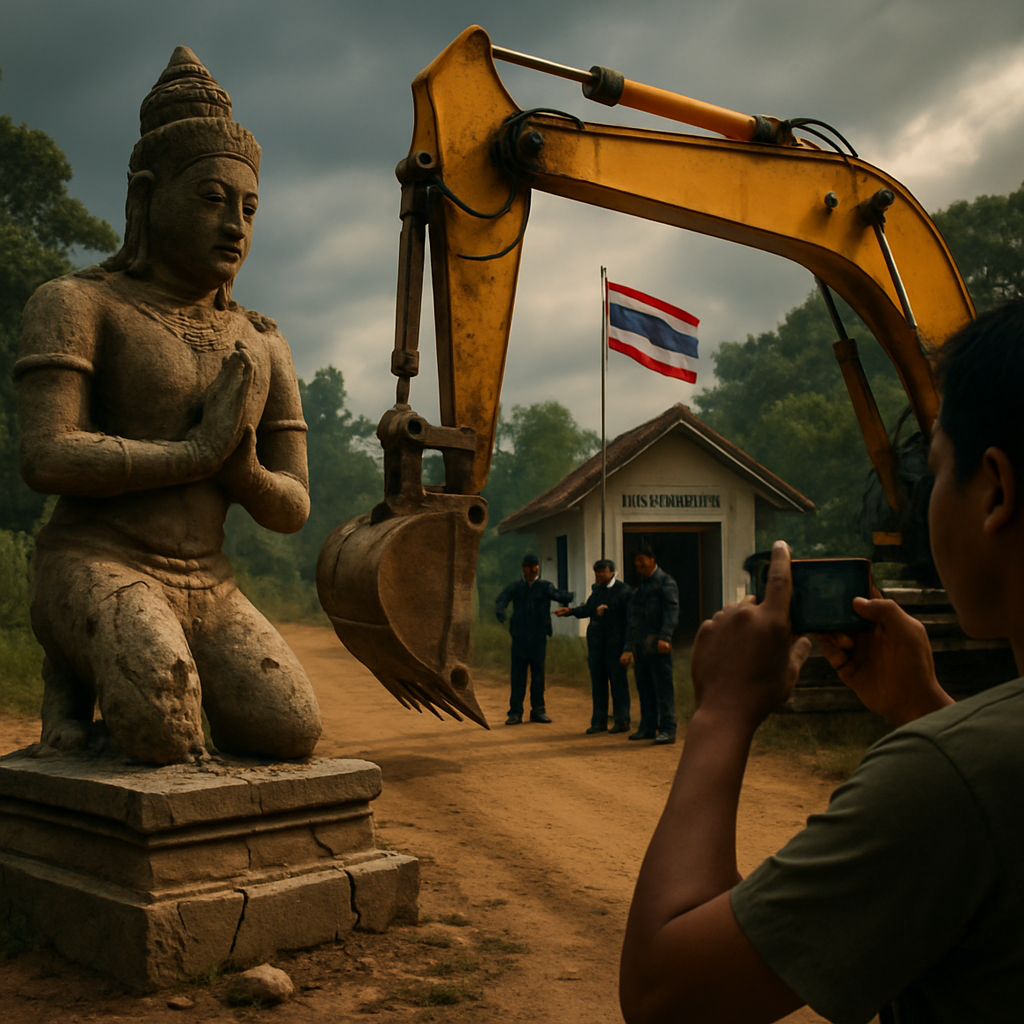
What started as a few seconds of shaky phone footage has snowballed into a full-blown online storm. A video that went viral across X and Instagram appears to show heavy machinery partially demolishing a statue of Lord Vishnu near the Thai–Cambodian border — and within hours hashtags like “Boycott Thailand” and “Boycott Pattaya” were trending among Indian social media users.
The statue, according to Indian media reports citing local sources, was erected in 2014 in Cambodia’s An Ses area, roughly 100 meters from the Thai border. The clip’s spread ignited furious reactions from many who interpreted the images as an affront to Hindu religious sentiment. Calls circulated urging Indian tourists to cancel bookings, boycott Thai businesses and apply economic pressure until answers were provided.
From viral clip to hashtag rebellion
Social media’s outrage moved fast. Within hours the simple act of sharing a two-minute clip escalated into national indignation for some — a classic example of how a single video can take on a symbolic life of its own. Posts framed the demolition as an attack on Hindu heritage, while a few narratives linked the footage to longstanding border tensions between Thailand and Cambodia. The emotional mix made for a combustible online environment: religious sensitivity blended with geopolitical history and a dash of travel-fueled patriotism.
Whether motivated by devotion, nationalism or just plain outrage, the immediate effect was plain to see — suggestions to cancel trips, pressure tourism operators and boycott Pattaya began to trend. Travel-related businesses in Thailand watched nervously as the wave gathered momentum, even as authorities scrambled to clarify the situation.
Thai clarification — “not meant to target religious symbols”
Thai officials were quick to respond through the Thai–Cambodian border press center, saying the scene shown in the video was part of an area management and security operation, and was not intended to disrespect any faith or sacred object. Their statement said the statue had been built on disputed land and that actions taken fell within Thailand’s claimed jurisdiction. Authorities expressed regret for any misunderstanding or discomfort the images caused and urged people not to interpret the incident as a religious matter.
The Thai response attempted to shift the lens from religion to jurisdiction: a land-management explanation rather than a cultural or religious affront. For some observers this was a calming hand; for others it read as anodyne damage control.
Cambodian authorities push back
Cambodia’s local officials did not accept that framing. A spokesperson for Preah Vihear authorities told local media that Cambodia condemns the destruction of statues and temples revered by both Buddhists and Hindus. They maintained the statue lay within Cambodian territory and emphasized its cultural importance across religious communities. That rebuke underscored how the incident sits at the intersection of cultural sensitivity and a fractured border narrative.
Tensions at the border — more than a single incident
This episode arrives against a backdrop of historically fraught ties along sections of the Thai–Cambodian frontier, where territorial disputes flare up intermittently and stir public passions on both sides. When an object as visible and symbolic as a religious statue is involved, events can quickly move beyond local officials and become matters of national sentiment.
So far there have been no travel advisories issued by either India or Thailand. Thai tourism authorities had not commented on potential impacts to Indian visitors at the time of reporting. But in the social media age, perceptions — particularly when fuelled by viral content — can be as consequential as formal diplomatic notes.
The era of instant escalation
What the incident illustrates is less about who was right or wrong in a complex borderland dispute, and more about how disputes are amplified today. A short clip, a handful of angry captions and a trending hashtag can move public opinion faster than embassies can arrange press briefings. For tourism-dependent locales like Pattaya, that speed can translate directly into economic anxiety.
At the same time, the reactions underline the deep cultural ties and sensitivities that transcend national borders in Southeast Asia. Symbols matter. So do the narratives people build around them — and those narratives are increasingly constructed in public, in real-time.
Takeaway
Until a clear, mutually accepted investigation is published or the governments involved reach a definitive common account, the video will remain a flashpoint — a reminder of how fragile border narratives can be and how quickly social media can turn local incidents into international controversies. For now, cooler heads and careful diplomacy will matter more than trending hashtags. The simplest, most constructive step may be to wait for verified facts while respecting the cultural importance this statue appears to hold for many.
Source: Times of India.


















This is exactly why travel decisions should consider more than just price — cultural respect matters and a video like that feels like a deliberate slight. Call me dramatic, but if nations can’t agree on a little statue then maybe tourists should think twice. Boycotting is strong, but public pressure gets attention fast.
Sounds like selective outrage to me, people see what they want to see from shaky footage. Maybe the machine was clearing an illegal structure, not attacking religion.
You can’t dismiss feelings of millions by calling them ‘selective’. Religion and heritage are sensitive, and viral clips spark real emotions. Context matters, but so does accountability.
I’m not dismissing feelings — I’m saying don’t let social media alone be the judge. Demand investigation, then decide on personal actions like boycotts. Quick anger rarely leads to justice.
Boycott Thailand? That’s irresponsible and will only hurt local workers and small businesses who had nothing to do with a border spat. Tourism is livelihoods, not just luxury spending for outsiders.
So you think economics always beat principles? If a country appears to disrespect a religion, money talks and maybe that’s the language people should use.
You both have a point, but throwing entire industries under the bus over a single video without facts is reckless. Targeted pressure on governments is smarter.
Precisely — targeted diplomatic pressure and verified facts, not mob boycotts that punish frontline workers. I’m pro-accountability, not collective punishment.
As a Hindu, seeing any statue damaged is painful; whether accidental or intentional, it looks terrible on camera. I want a proper apology and investigation from both sides. Heritage sites should be protected, period.
Emotionally charged responses are understandable, but we need to separate symbolism from territorial administration. If the statue was on disputed land, a legal process should determine jurisdiction and outcome.
International law is messy here; de facto control often dictates actions, but cultural property protection protocols could have been invoked. This is a governance failure as much as anything else.
Legalities are fine, but law should respect cultural value too. If there was a protocol, why wasn’t it used? That’s what people are angry about.
Look, I work in tourism; even whispered boycotts hit ordinary families. Outrage online can be a sledgehammer when diplomacy should be the scalpel. Calm down, get facts, then act.
Calm and facts are great, but how long do we wait while symbols are allegedly erased? Waiting can feel like complicity to many people.
I hear that, and I’m not saying do nothing. Ask governments for clarification and demand proof before wrecking 1000s of livelihoods. There are smarter ways than mass cancellations.
The average traveler won’t know which way to go; industry needs clearer statements fast or rumors will fill the void.
This is typical border politics — statues become trophies in long simmering disputes. Media inflames it, and politicians exploit the outrage for scoring points. Nothing new here.
So you’d prefer people ignore cultural insults because geopolitics is messy? Some things deserve a stand, even if the players are messy too.
I prefer careful responses. Emotional grandstanding helps nobody and escalates risks for locals on both sides.
I’m in 6th grade and I think breaking statues is mean. Adults should solve things with words, not machines.
From an academic viewpoint, this incident is a case study in rapid narrative formation — frames of religion, sovereignty and tourism collided in under 24 hours. Analysts should watch how hashtags translate to economic behavior.
Academic frames are important, but they can sound detached when real people’s incomes are threatened. Bridge that gap with practical recommendations, please.
As someone familiar with the region, I can say local authorities resent mischaracterizations; the statue sits near a tense border and actions were taken under security rationale. We condemn wanton desecration, but context matters.
Fair criticism, Michael. My point is to push for evidence-based engagement: measured consumer response tied to verified findings, not pure emotion.
I booked a trip to Pattaya months ago and now I’m scared to go. Social media makes it hard to tell truth from clickbait. My travel plans shouldn’t be political collateral.
I think India should use diplomatic channels, not hashtags. Boycotts are a blunt tool and often backfire. Let the foreign ministry handle this.
Diplomacy moves slowly while outrage is fast; people turn to boycotts because it’s what they can do immediately. Not ideal, but understandable.
Understandable, yes, but that doesn’t make it wise. Quick actions can become permanent economic scars on innocent people.
This whole saga shows how fragile communal trust is; a few seconds of clip and narratives are set. We need transparent cross-border investigations with neutral observers.
Who would be neutral though? International observers are often accused of bias too. It’s not an easy fix.
Neutrality is imperfect, but organizations like UNESCO or ASEAN mechanisms can offer a framework better than mobs on social apps.
UNESCO would help if the statue had recognized heritage status; otherwise ASEAN might be the best regional option for mediation.
Exactly — call in institutions with legitimacy and ask for a joint inquiry. Instant justice on social media is not justice.
Anger is valid, but I’m tired of every viral clip becoming a diplomatic crisis. We need media literacy and slower reflexes from influencers who amplify before verifying.
As a frequent visitor to SE Asia, this worries me. Places I love could suffer from viral outrage. Locals will pay the price for geopolitics.
Tourists also have a voice; if a government erases a culture, silence is complicity. Money is power and can pressure change.
True, but wielding money without facts risks punishing the wrong people. I’d rather see targeted sanctions against officials if wrongdoing is proven.