Viral omelette rice clip, location unconfirmed, puts street-food price rules back in view
A deleted TikTok clip showed a dispute over omelette rice priced at 100 baht for five eggs after a customer allegedly offered 25 baht. The filming site remains unconfirmed. Official price-display rules and Tourist Police channels already cover this ground.
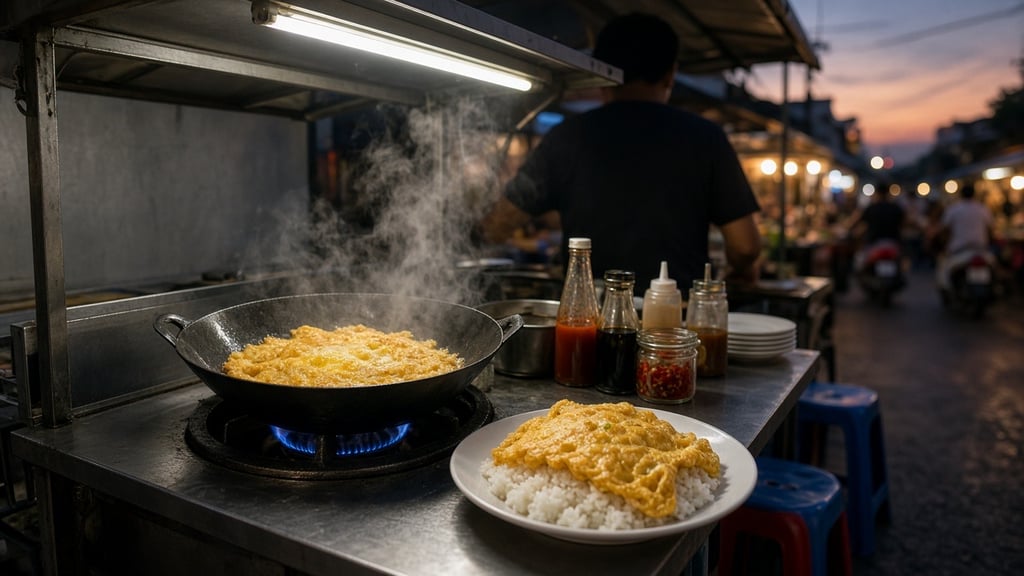
A short clip that circulated on 11 November 2026 showed a roadside food-cart argument over omelette rice. THAI.NEWS has not independently verified the filming location. Shares treated the city as unconfirmed, even where some viewers guessed a beach town. The original TikTok upload was later taken down, leaving only reposts.
A customer ordered omelette rice made with five eggs. The stall appeared to price eggs at 20 baht each, 100 baht for the plate. After the food was served, the customer was shown arguing for a lower figure of 25 baht. Relatives stood around the cart. Nearby transgender women stepped in and backed the vendor.
The customer can be heard insisting that the stall had quoted five baht per egg rather than 20. The vendor did not accept the reduced total. People around the cart accused the group of trying to leave without settling. A later caption said the customer telephoned a friend, then paid the 100-baht amount. THAI.NEWS could not reach either party, and police have not issued a public statement on the clip.
Street-food rows travel fast for two ordinary reasons. Thai carts often price omelettes by the egg, and 20 baht per egg is a common posted rate at tourist-facing stalls. Visitors who treat a posted figure as a starting bid can create a scene once the wok is hot. Haggling over a souvenir is one custom. Rewriting the bill after the plate has landed is another.
Price boards, not after-the-fact bargaining
Thailand's Department of Internal Trade reminds restaurants and food sellers to post prices before the order. Under Notification No. 68 (2025), issued under the Price of Goods and Services Act B.E. 2542 (1999), listed prices must be visible, shown per unit in Arabic numerals, written in Thai (other languages may be added), and charged as displayed. Extra fees such as service charge or VAT must be shown separately. Selling above the posted figure can draw a fine of up to 10,000 baht. Selling below it is allowed.
That rule cuts both ways. A stall that posts 20 baht per egg is on firm ground if it charges 100 baht for five eggs. A visitor who heard a different figure still has a remedy that does not involve leaving an unpaid plate. The Tourism Authority of Thailand tells travellers that dish prices should be displayed and that asking before ordering is part of eating well in the kingdom. Ministry of Tourism and Sports guidance is plainer: pick shops that show prices, and do not pay until the goods match what was agreed.
If the cart cannot settle it, official channels exist. The Tourist Police Bureau hotline 1155 lists unfair pricing of goods and services among matters it takes immediately. The Office of the Consumer Protection Board answers 1166. Internal Trade takes pricing complaints on 1569. TAT's call centre is 1672. None of those numbers require a shouting match on a footpath.
Why a 100-baht plate became a visa-era talking point
India is one of Thailand's largest inbound markets. TAT recorded 1,896,058 arrivals from India between 1 January and 26 October 2026. Indian visitors spent an average of 41,009 baht per trip and stayed 6.98 nights. Independent travellers made up 70.70 percent of that market, and 65.77 percent were first-time visitors. Thai cuisine sits among the leading stated interests. Since 15 September 2026, Indian passport holders have been included in the 30-day visa-exemption category.
Those figures describe a large, mostly first-time, self-guided visitor stream, not a national character. One disputed omelette does not speak for nearly two million arrivals. First-time independent travellers often meet Thai street food before they meet a concierge, and many stalls still post prices only in Thai. TAT's 2018 eating note still says to look for a clear price display. That advice is cheap. A viral clip is not.
Social media rewards the most combustible reading. Nationality labels travel farther than the unconfirmed location, the deleted file, or the settled bill. Vendors in tourist belts work thin margins on rice, oil, and eggs. Visitors on a 30-day exemption are guests under Thai immigration rules, not bargain hunters with a right to rewrite a posted per-egg rate after the eggs are in the pan. Conduct on the pavement is not a visa category. It is still the thing hosts remember.
What This Means for Expats and Travelers in Thailand
Confirm the per-egg or per-plate price before the vendor lights the burner. Photograph the board if the quote is only spoken. If the posted rate is 20 baht an egg, five eggs plus rice at 100 baht is arithmetic, not a scam. If you think you were quoted a different figure, stay at the cart and call 1155 or 1569 rather than walking off. Do not treat a single clip, or a single nationality, as a briefing on millions of other travellers. For this incident, the filming site remains unconfirmed.



Comment verification
Step 1 of 3
Verify your email once to publish your comment. Your email is never shown publicly.
Enter the 6-digit code sent to .
Choose the display name shown next to your comments.