Koh Samui Under Critical Flood Watch After 144.5mm Rain in 12 Hours
The Department of Water Resources raised a red-level alert for Ban Bang Makham on 11 November after 144.5 millimetres fell in 12 hours. DDPM Cell Broadcasts, a closed Chaweng canal sluice and extra pumps followed. Here is the practical picture for anyone on the island this week.
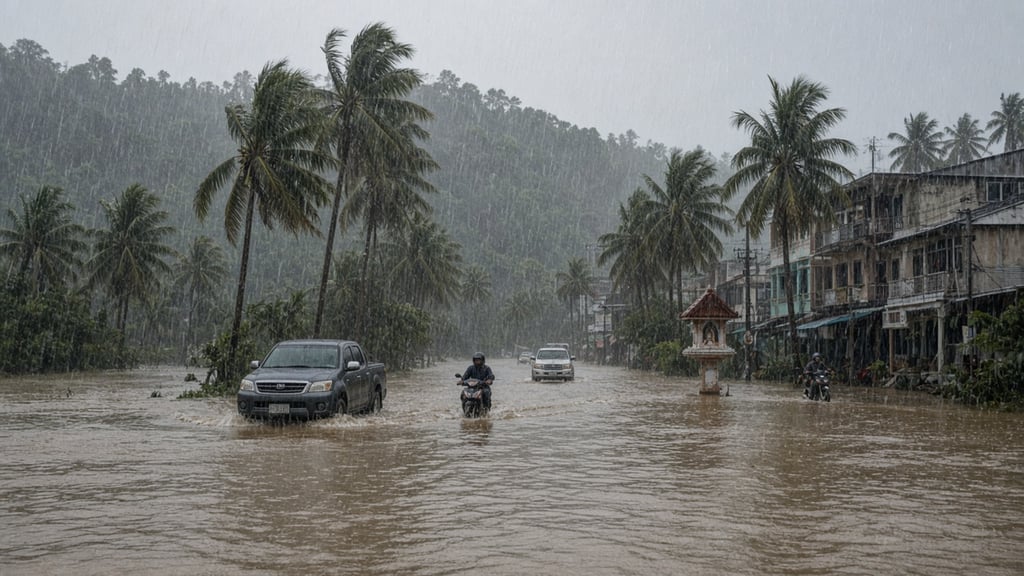
Koh Samui went from a wet afternoon to a critical flood watch in a few hours. On 11 November 2026 the Flood Warning and Flash Flood Monitoring Laboratory, under the Department of Water Resources Research, Development and Hydrology Division, raised a red-level (critical) alert for Ban Bang Makham in Ang Thong subdistrict. The station recorded 144.5 millimetres of rain in 12 hours, a pulse that on a hilly Gulf island runs off the interior faster than roadside drains can clear it.
The Thai Meteorological Department had already framed the window. Advisory No. 6 (304/2026), issued at 05:00 on 11 November, warned of isolated heavy to very heavy rain across the South through 13 November, with flash floods, overflows and landslides along waterways near foothills and lowlands. Waves in the lower Gulf were put at 2-3 metres, and above 3 metres in thundershowers. Small boats were told to stay ashore. A moderate northeast monsoon over the Gulf was the driver.
Ko Samui sits in the western Gulf of Thailand, in Surat Thani province. The island covers about 229 square kilometres, with a steep forested interior and a ring of low tourist beaches. Chaweng, Lamai, Bophut and Maenam sit on that ring. When the hills dump, those beaches take the water, and high tide can push seawater back into the same canals trying to empty inland runoff.
The Department of Disaster Prevention and Mitigation followed with Cell Broadcast alerts on 11 November for Koh Samui and Koh Phangan districts in Surat Thani, and for Thung Tako district in Chumphon. The messages, carried on AIS, True and NT networks, flagged flash floods, rapid run-off, landslides and standing water. Help lines listed were local officers, the DDPM 24-hour hotline 1784, and LINE @1784DDPM.
From early afternoon on 11 November, low stretches and canal-side lanes filled. Local traffic reports by evening still listed trouble on the Dao market approach and Ratchaphat Road for small vehicles, a blocked City junction, and a full closure in front of Wat Plai Laem, with a diversion via Plai Laem police station and the Thong Sai junction. Lamai's Sansee junction was circulating again once the burst eased.
On 12 November DDPM sent another Cell Broadcast for Koh Samui, pairing continued rain with high sea levels and landslide risk on foothill slopes. Koh Samui Municipality closed the Khlong Chaweng sluice at the First intersection to stop seawater pushing back into the canal, and ran large pumps at full power. Koh Samui Police, at 08:28, reported standing water in front of the municipal office. Small cars could still pass, but officers asked people without urgent business to delay trips.
Extra pumps went in at three known choke points: Ratchaphat Road, Bang Po, and near Hin Ta Hin Yai. TMD kept nine southern provinces on a heavy-to-very-heavy rain list for 12-13 November. By the afternoon of 12 November rain on Samui had largely stopped and land and sea links were running normally. DDPM still pushed a reminder Cell Broadcast at 13:04 that flash-flood risk does not vanish the hour the sky clears, because saturated slopes and full canals keep moving water for hours.
What This Means for Expats and Travelers in Thailand
Samui International Airport usually keeps flying through this kind of monsoon pulse. The delay is on the island roads and on the water. If you hold a Seatran, Raja or Lomprayah ticket to Phangan, Tao or Donsak, treat TMD's small-boats-ashore line as a live instruction until the operator confirms. High-speed cats cancel or slow when the lower Gulf is running 2-3 metres. Recheck at dawn. Do not assume a Grab exists from a cancelled pier.
Chaweng and Lamai are the two beaches most visitors book, and both sit on the low ring. Khlong Chaweng is the drain for the island's busiest strip. When the municipality shuts the sluice against a high tide, water that cannot leave sits on the road. Ground-floor rooms and beach-road shopfronts take it first. Hillside villas above Chaweng and Lamai feel dry in the lobby. That is not a landslide test. If you can see a steep cut behind the pool, have a Plan B hotel on flatter ground.
Keep passports, arrival cards and insurance papers in a dry bag. Do not ride a motorbike through brown water. Do not walk close to canals or under overhead wires in floodwater. Tourist SIMs often miss Thai Cell Broadcasts, so ask reception or call 1784. Koh Samui Police can be reached on 077-421097. Photograph any water line before you move out. Thai catastrophe payouts are for Thai households. Foreign guests and leaseholders are on private cover, if they bought it.



Comment verification
Step 1 of 3
Verify your email once to publish your comment. Your email is never shown publicly.
Enter the 6-digit code sent to .
Choose the display name shown next to your comments.