Thailand needs 26,000 more EV chargers as holiday queues build, says operator
SHARGE estimates Thailand is short about 26,000 public connectors, with rest stops on the M7, M9 and M6 and holiday routes to Pattaya, the northeast and the south filling first. Official tallies show more than 450,000 battery cars against a public network of about 5,000 stations.
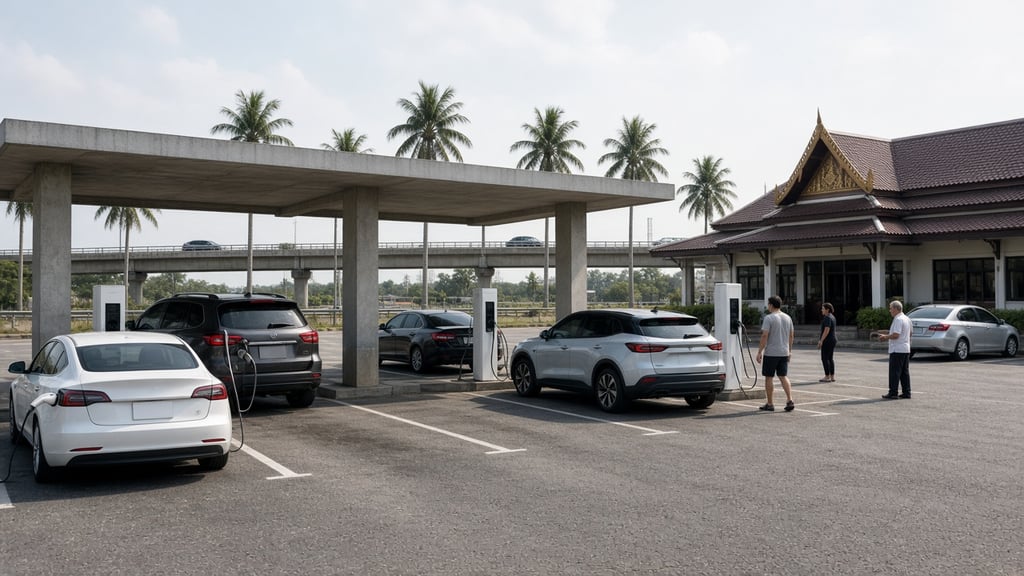
Holiday traffic is exposing a gap that a national charger count conceals. SHARGE Management estimates Thailand needs about 26,000 extra public connectors, from roughly 15,000 today toward about 41,000. The pinch is not even. Motorway rest stops and festival routes fill first, while many city chargers sit quiet on ordinary Tuesdays.
The Electric Vehicle Association of Thailand recorded about 5,021 public charging stations as of 30 September 2026. Its poster, using Department of Land Transport figures, put the battery-electric fleet at 562,029 the same day. Of those, 450,465 were cars. Another 105,867 were electric motorcycles, which mostly use different plugs. SHARGE's ratio of about 30 cars per public charger tracks the car fleet against a connector count near 15,000.
The International Energy Agency's Global EV Outlook 2026 found about 11 electric light-duty vehicles per public charging point worldwide at the end of 2025. Thailand's car-to-charger ratio is nearly three times that global average. Direct-current fast chargers are tighter still. SHARGE puts that slice near 47 cars per DC outlet.
Where the queues form on long weekends
Usage data from SHARGE's driver app flags rest stops on motorways M7 (Bangkok toward Chon Buri and Pattaya), M9 (the outer Bangkok ring) and M6 as filling in peak hours. The Chon Buri to Pattaya corridor is described as nearly fully occupied on holidays. The Saraburi to Nakhon Ratchasima stretch, the gateway toward Khon Kaen and Udon Thani, still lacks enough large DC hubs. On the southern route, the Prachuap Khiri Khan to Chumphon section is short of big stations. Transit districts such as Kamphaeng Phet and Chumphon need stopover chargers before the long legs.
The Department of Highways, under the Ministry of Transport, is trying to catch up at the rest-stop layer. It currently operates 164 highway rest areas and is expanding toward 223. A separate public-private track is meant to put EV charging at more than 150 truck rest sites nationwide. The Rest Village project on M7 at Sriracha, developed with highway approval, is planned with more than 60 EV bays when fully open in 2027. Those additions will help one corridor. They will not, on their own, close a 26,000-connector gap.
Policy targets were set for a smaller fleet
The Energy Policy and Planning Office at the Ministry of Energy still cites the National Electric Vehicle Policy Committee target of about 12,000 public DC fast-charging outlets by 2030, under the 30@30 industrial plan. An EPPO charging-plan study also sketched roughly 5,024 highway fast chargers and 8,227 in major cities by that year. Those figures were framed when the battery fleet was a fraction of today's. EPPO's 2025 annual report counted 372,703 registered BEVs at year end and 147,571 new BEVs during 2025.
The 2030 DC target is a different yardstick from SHARGE's all-connector shortfall. Hitting 12,000 DC points would not clear New Year queues at a handful of motorway toilets. Location, power rating and whether chargers actually work matter more than a national total. New BEV registrations from January to September 2026 reached 191,283, including 168,733 cars, according to the same EVAT poster.
The Pollution Control Department has separately urged a faster shift away from diesel because urban PM2.5 is still driven in large part by combustion traffic. Its State of Pollution reporting recommended supporting electric vehicles in place of petrol and diesel cars. They do little for a family driving to Ubon or Hat Yai when every CCS2 bay at the rest stop is occupied.
What This Means for Expats and Travelers in Thailand
Long-stay residents who bought a BYD, MG or Tesla on a DTV, retirement or work permit should not treat Bangkok mall chargers as a proxy for holiday range. Many condo buildings in Sukhumvit, Chiang Mai and Phuket still lack overnight AC points, which pushes more drivers onto public DC on Friday evenings. CCS2 is the plug that matters at Thai public sites. CHAdeMO bays are fading. Apps remain fragmented: SHARGE, EV Station PluZ, EA Anywhere, PEA VOLTA and others still want separate logins or RFID cards.
Practical steps before a long weekend: ask the juristic person about a wallbox if you have a parking bay; budget an extra 30 to 90 minutes at motorway stops during Songkran, New Year and Chinese New Year; check occupancy in more than one app; carry a Type 2 cable for hotel AC posts; and treat the Chon Buri to Pattaya run, the Isaan gateway at Saraburi to Nakhon Ratchasima, and the southern Prachuap to Chumphon leg as the stretches most likely to queue. Tourists in rental EVs should confirm the car is CCS2 and that the hire firm provides a working charging account. Cafes, souvenir shops and small hotels along those corridors are the sites operators are pitching as the next wave of chargers, with claimed paybacks of three to seven years depending on how often the plugs are used.



Comment verification
Step 1 of 3
Verify your email once to publish your comment. Your email is never shown publicly.
Enter the 6-digit code sent to .
Choose the display name shown next to your comments.