Tourist Police Open Nationwide High-Season Scam Patrol From Hua Hin
Tourist Police sent 115 personnel out from the Hua Hin clock tower on 14 November to start a nationwide high-season watch on scams, theft, and Loy Krathong hazards, with 1155 as the 24-hour number visitors should actually save.
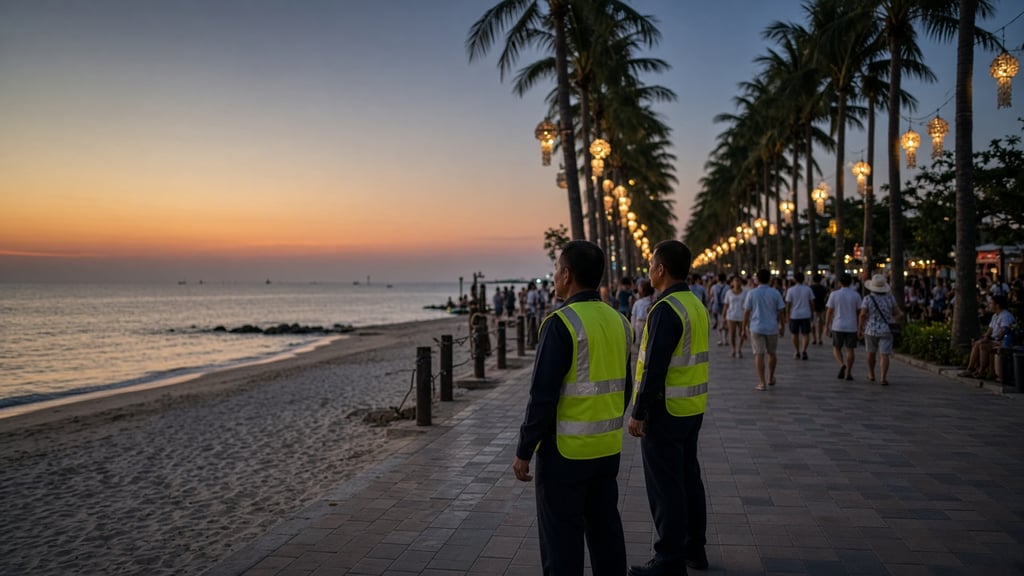
At 6pm on Friday, 14 November 2026, Tourist Police Bureau Commissioner Pol. Lt. Gen. Phongsiam Meekhanthong stood at the Hua Hin clock tower in Prachuap Khiri Khan and sent 115 officers, volunteers, and partner-agency staff into the high-season streets. The ceremony was not a local photo call. It was piped live to all 33 tourist police stations so that, on paper at least, 1,500 personnel began the same watch at the same hour.
The bureau's own notice sets the first enforcement window as 14-20 November, timed for the run-up to Loy Krathong. The festival itself falls on Tuesday, 24 November 2026, the full-moon night of the twelfth lunar month, according to the Thai government event calendar. The operational brief is broader than a crime sweep. Officers were told to watch for scams and overcharging aimed at visitors, for theft in crowds, and for water accidents and injuries from fireworks, aerial fireworks, and firecrackers.
Why the send-off started on a beach promenade
Hua Hin is a mixed Thai-and-foreign beach town, not a nightlife island. The bureau said that is why it was chosen: a destination both domestic families and long-stay foreigners already treat as a winter default. The local line-up behind the commissioner included Hua Hin police, Prachuap Khiri Khan immigration, the provincial Tourist Assistance Centre, the Tourism Authority of Thailand Prachuap Khiri Khan office, provincial administrators, Hua Hin municipality, tourist police volunteers, and the Sawang Hua Hin Thammasathan Foundation.
Four days earlier, on 10 November, the same commissioner had sent 100 officers, volunteers, and lifeguards out from Soi Bangla in Patong. The Hua Hin launch is the national version of that Patong deployment, under the bureau slogan "One Team, One Strongest for Safety Tourism." After the clock-tower ceremony, Phongsiam walked the Hua Hin night market and spoke with vendors and visitors. That walkabout is the part beach-town residents will actually see: extra high-visibility vests on the promenade, not a new statute.
What the patrol is actually watching
The Tourist Police Bureau, a Royal Thai Police unit elevated from a division to a national bureau in 2017, exists to assist visitors and to cut fraud that hits them. A public summary of the bureau still lists roughly 1,700 officers and translation cover in English, Chinese, German, Japanese, Russian, French, Hindi, and Korean. The November order is more specific: proactive patrols at attractions, festival grounds, and places where visitors bunch up.
A later bureau advisory for Loy Krathong named five festival-week risks: fake links and QR codes, pickpocketing in crowds, slips and falls at rivers and piers, sexual harassment, and fights. That list sits alongside the older, year-round playbook that foreign missions already publish. The U.S. Mission in Thailand's scam note still flags gem-shop detours sold as government sales, tuk-tuk and taxi diversions, and jet-ski or scooter shops that keep a passport against claimed damage. The UK FCDO safety page adds ATM skimming, bag snatches from motorbikes, and a blunt instruction not to leave a passport as rental collateral.
None of those schemes are new. High season and a water festival simply pack more strangers onto piers, night markets, and taxi ranks at the same time. Hua Hin's clock tower, night market, and beach road are exactly the kind of mixed crowd the bureau described. The same pattern holds in Pattaya, Patong, Chiang Mai river banks, and Bangkok festival piers.
How to reach help before the argument gets expensive
The number that matters is 1155. The bureau repeats that the Tourist Police hotline is staffed 24 hours and, as of a 22 October 2026 English-language notice, handles eight languages. Incidents can also go through the Thailand Tourist Police mobile app, which the bureau says can pass location data to the 1155 centre. TAT has long told visitors to treat 1155 as the first call, with TAT's own 1672 centre as the tourism-information line.
Calling 1155 does not guarantee a refund. It does put a multilingual officer between a visitor and a shop, a taxi rank, or a jet-ski desk before a passport is locked in a drawer. For gem-shop and credit-card cases, the U.S. Mission still advises a formal Thai police report, in Thai with an English translation, and an immediate call to the card issuer. For ATM use, the FCDO advice is simple: use a machine inside a bank and cover the PIN.
What This Means for Expats and Travelers in Thailand
If you are in Hua Hin, Cha-am, or another Gulf beach town through late November, expect more high-visibility vests at the night market, the promenade, and festival water's edge. That is the useful change. It does not retire the old rules. Agree a taxi fare before the wheels move, or insist on the meter. Walk away from any gem, tailor, or closed-temple detour. Photograph a jet ski or scooter before you take it, and never leave your passport as a deposit. Use bank ATMs. Keep bags zipped in festival crowds. Stay off slick pier edges after dark, and treat fireworks as a hazard, not a souvenir.
Long-stay residents should save 1155 in their phones even if they have never needed it. Neighbours on tourist visas often freeze when a dispute turns into shouted English. A 24-hour desk that can talk to both sides is faster than arguing in a shop. The bureau's own app is worth installing before Loy Krathong night, when river banks and beach roads are at their densest.
The 14-20 November window is the named sweep. Loy Krathong on the 24th is the night the crowds, the water, and the fireworks overlap. Patrols after that date will look like ordinary high-season policing unless a later order extends them. Treat the clock-tower ceremony as a reminder of the numbers you already needed: 1155 for the Tourist Police, 191 for general police, 1669 for medical emergencies, and 1672 for TAT.



Comment verification
Step 1 of 3
Verify your email once to publish your comment. Your email is never shown publicly.
Enter the 6-digit code sent to .
Choose the display name shown next to your comments.