Tourist Wallet Converts Crypto to Baht for Thai QR PromptPay and Visa Prepaid Spend
A Tourist DigiPay wallet converts USDT and USDC into baht so visitors can pay Thai QR PromptPay merchants without a Thai bank account.
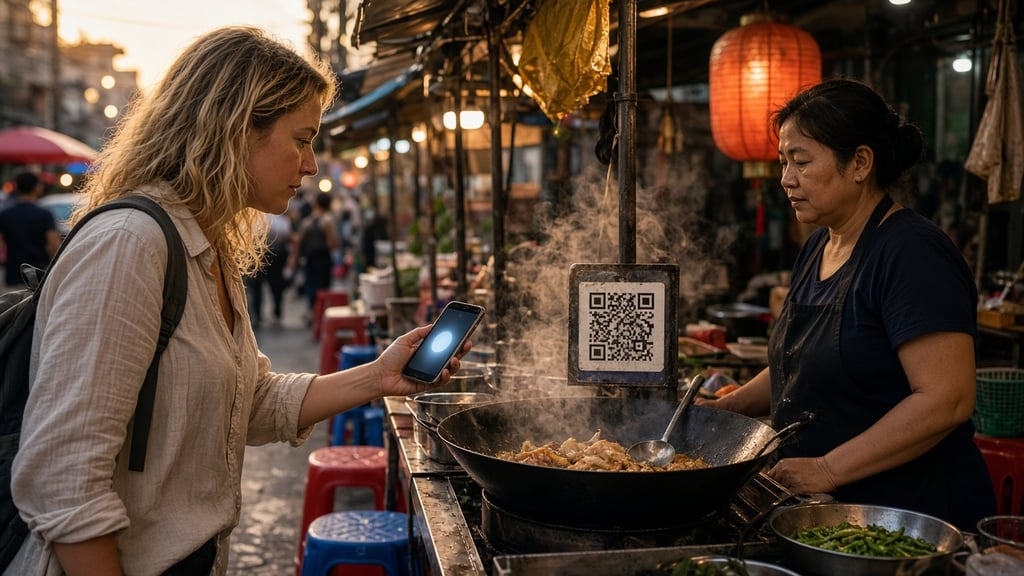
International tourists in Thailand can now convert dollar-pegged stablecoins into baht inside a licensed tourist wallet, then pay stalls, hotels, and shops by scanning the same Thai QR codes locals use. WORPT sits inside the Securities and Exchange Commission's TouristDigiPay sandbox, for visitors who hold crypto but do not have a Thai bank account. Merchants still receive baht. Crypto never lands in the till.
The SEC opened TouristDigiPay on 25 September 2025, after Notification Kor Thor. 20/2568 took effect in the Government Gazette. The 18-month test lets licensed digital-asset exchanges, brokers, or dealers convert crypto into baht for foreign visitors who are temporarily in the Kingdom. Those baht sit in an e-money wallet run by a Bank of Thailand-supervised provider. The sandbox is explicit: digital assets are not a means of payment at retail.
WORPT splits that job between two licensed firms. Waan Exchange Co., Ltd. (Waanx) holds the SEC digital-asset exchange and broker licences and handles conversion. Wipay Co., Ltd. holds the BOT e-money licence and runs the tourist wallet. The companies said the app went live in late October 2026. Supported coins are USDT and USDC on Ethereum (ERC-20). Users connect a non-custodial wallet they control. WORPT does not hold private keys.
Who can open it, and what it costs
Applicants must be foreign tourists, not Thai citizens, with an NFC-enabled passport that still has at least six months of validity on the date of entry. Face verification is part of know-your-customer checks. One account is allowed per passport. Visitors with fewer than three days of permitted stay remaining cannot open an account. US nationals are excluded. The terms also refuse users with nationality, domicile, or income ties to listed high-risk places, including Myanmar, North Korea, and Iran.
Each conversion costs 1.5 percent, including VAT. The baht balance cannot exceed 100,000 baht. Top-ups are capped at 100,000 baht per transaction and 500,000 baht per account per month. Monthly spending is capped at 300,000 baht, with a possible short lift to 500,000 baht for up to five days after extra due diligence. Personal QR (Tag 29) stalls sit much lower: 1,700 baht per scan and 50,000 baht a month. Merchant QR (Tag 30) allows up to 100,000 baht per transaction. Cash cannot be withdrawn from converted baht. Leftover baht on exit must be converted back into digital assets and sent to the original wallet.
The Visa prepaid card is not a bank product
Physical Visa prepaid cards were scheduled for airport pickup and hotel delivery from 28 November 2026, with virtual cards later. The card shares the same baht balance as the QR wallet. It is prepaid, not credit, and it is not a Thai bank account. Card terms list a 1,200 baht issuance fee and a 3.5 percent foreign-currency conversion fee when a transaction needs FX. The card cannot be used for cash withdrawals or person-to-person transfers.
PromptPay, launched in 2016, is already the everyday rail for Thai QR. The Bank of Thailand has linked Thai QR to inbound tourist corridors including Malaysia, Vietnam, Indonesia, Cambodia, Laos, Hong Kong, Korea, Singapore, and China. TouristDigiPay is a different door, for visitors whose home apps are not on those corridors or who hold stablecoins rather than a foreign bank app. BOT Tourist Wallet standards use the same idea: NFC passport, biometrics, then scan Thai QR. Shops receive baht.
Sandbox rules that will trip people up
Operators must screen the source of coins with blockchain forensics unless monthly conversion stays at or below 50,000 baht. Users cannot speculate inside this tourist flow, swap one coin for another, or send baht to another person. High-risk merchant categories, including gold, gems, foreign exchange, crypto dealers, and easily cashed investment products, are off limits under Anti-Money Laundering Office rules. Unused accounts can be closed after three months. The sandbox ends unless the SEC extends or graduates it. WORPT is a test product, not a deposit-taking bank.
What This Means for Expats and Travelers in Thailand
Short-stay tourists who already hold USDT or USDC, have an NFC passport, and are not US nationals can treat this as a PromptPay workaround that does not require a Thai bank. Budget the 1.5 percent convert fee, the 100,000 baht wallet cap, and the 1,700 baht per-scan ceiling at many mom-and-pop stalls. Keep cash or a regular travel card for taxis and shops that still want notes.
Long-stay expats on retirement, work, or marriage visas sit outside the tourist definition in the published terms. Thai residents already have licensed exchanges and PromptPay bank apps. This wallet will not replace a local account, will not pay rent by transfer, and will not automatically survive the sandbox end date. Convert leftover baht before the permitted stay ends.



Comment verification
Step 1 of 3
Verify your email once to publish your comment. Your email is never shown publicly.
Enter the 6-digit code sent to .
Choose the display name shown next to your comments.