ThaiBev FY2026 profit 31.63bn as demand stalls
ThaiBev booked 31.63 billion baht net profit for the year to 30 Sept 2026 as spirits and beer margins widened, even as Thai sales and household demand stayed flat.
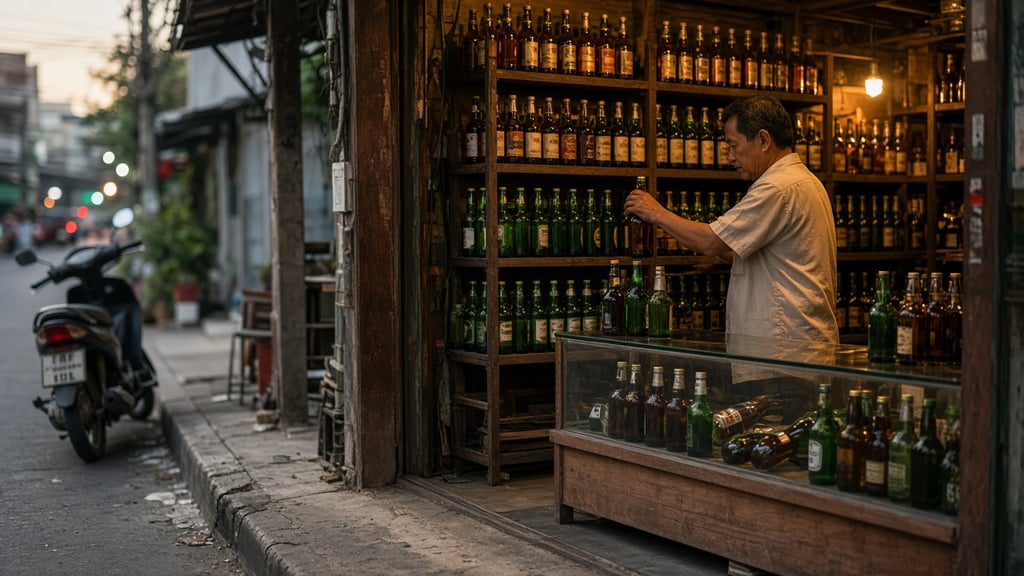
Bangkok's largest drinks company closed the year to 30 September 2026 with more profit on a smaller till. Thai Beverage Public Company Limited, listed in Singapore as Y92 because the Stock Exchange of Thailand still bars alcohol stocks, reported net profit of 31.63 billion baht, up 1.5 percent from the prior year. Group sales slipped 0.7 percent to 331.04 billion baht.
That gap between earnings and demand is the household story in another form. Thai wages have lagged prices, household debt remains high, and a night out has become a cheaper bottle at home. Thailand still supplied 214.25 billion baht of ThaiBev's sales, more than 64 percent of the group, yet that figure was down from 217.39 billion baht a year earlier. The extra profit came from cheaper malt and molasses, lighter finance costs, and spirits that kept growing outside the country.
Margins did the work that drinkers did not
Spirits remain the cash engine. The division booked 120.34 billion baht of sales, up 1.5 percent, on 622.5 million litres, a 0.8 percent rise. Net profit reached 21.01 billion baht. Domestic Thai consumption, the filing said, stayed stable, which in this market means flat. The extra litres and the extra margin came from international brands. Myanmar spirits revenue jumped to 18.09 billion baht from 15.60 billion, the strongest geographic lift in the brown-spirits book.
Beer told a harsher volume story and a better earnings story. Sales fell 3.0 percent to 119.49 billion baht. Litres fell 1.1 percent to 2.35 billion. Strip out Sabeco, the Vietnamese unit that still accounts for most of the group's beer volume, and the remaining 967.3 million litres were down 3.0 percent. Yet beer net profit rose 9.0 percent to 7.09 billion baht because barley and other inputs got cheaper and plants ran leaner. Vietnam beer sales translated into baht fell to 47.58 billion from 50.15 billion, under pressure from currency translation, intense local competition, and drink-driving rules under Decree 100 and Decree 168 that have chilled on-trade pouring.
Non-alcoholic drinks slipped 1.5 percent in sales to 63.80 billion baht even as litres rose 1.2 percent on bottled water. A less helpful mix, higher packaging costs, border-trade disruption, and start-up costs at a Malaysian dairy farm left net profit 3.6 percent lower at 4.95 billion baht. Ready-to-drink tea was the weakest NAB category in Thai press tallies, down 18.1 percent to 269 million litres, while carbonates and dairy also contracted. Food, led by the KFC quick-service portfolio, grew sales 3.8 percent to 22.73 billion baht and still lost 168 million baht. Publishing and printing lost another 263 million baht.
A 986 million baht impairment on a discontinued joint venture sat between the 32.62 billion baht of profit from normal operations and the 31.63 billion baht reported line. Profit attributable to ThaiBev's owners was almost unchanged at 25.46 billion baht. Earnings per share stayed at 1.01 baht.
Singapore payout, Thai demand, ASEAN risk
ThaiBev listed in Singapore after civic and monastic protests blocked a SET debut in 2005. The board now wants to keep the full-year dividend at 0.62 baht a share, matching FY2025: 0.15 baht already paid as an interim, and 0.47 baht proposed as a final, due 26 February 2027 if shareholders approve it on 29 January. The payout ratio is 61.2 percent of attributable profit. Singapore shares closed 1.19 percent higher at S$0.425 on 27 November, before the after-hours filing.
The group's own 12-month commentary is cautious rather than triumphal. It flags US trade protectionism, geopolitics, and Thai household debt as the drag on recovery. Beverage makers in Thailand, it says, still face weaker purchasing power and fewer international tourist arrivals. Vietnam's alcohol market remains competitive and legally constrained. Management did not publish a numeric 2027 profit target. Myanmar's 24.51 billion baht of group sales, up from 22.59 billion, is the quiet offset: spirits there are growing, beer there is not.
What This Means for Expats and Travelers in Thailand
A fatter ThaiBev profit does not mean cheaper Chang at 7-Eleven. The year was won on input costs and a still-tight Thai drinker, not on a price war. Visitors who drink in Ho Chi Minh City will notice Sabeco's Bia Saigon more than Chang. Grand Royal whisky in Myanmar is the quieter growth line. SGX holders collecting the 0.62 baht dividend should budget for Thai withholding tax of 10 percent. Anyone hoping the SET will one day list the stock is still waiting on a rule the exchange has not reversed. For residents watching the cost of a night out, the filing is a reminder that alcohol remains a discretionary spend in a high-debt economy, even when the company that bottles it reports a record-adjacent year.
Comment verification
Step 1 of 3
Verify your email once to publish your comment. Your email is never shown publicly.
Enter the 6-digit code sent to .
Choose the display name shown next to your comments.