Thailand Rethinks 20bn Baht Civil Service Buyout
Thailand's Cabinet deferred a 20-billion-baht early retirement plan for 30,000 civil servants, ordering agencies to prove buyouts will cut lifetime pension costs without draining mid-career talent.
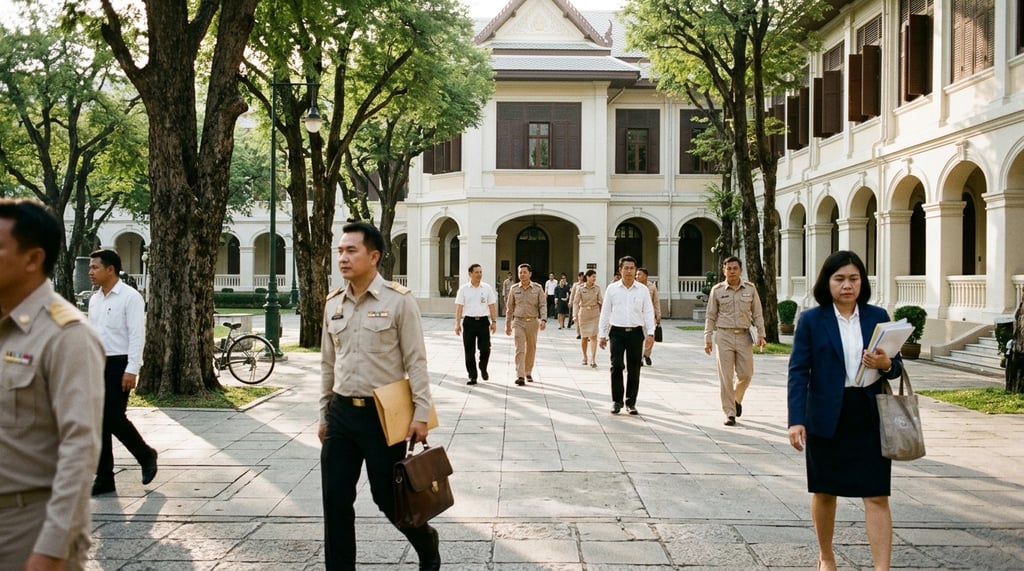
Thailand's Cabinet has put the brakes on a sweeping voluntary early retirement plan for 30,000 civil servants, sending the 20-billion-baht proposal back to state personnel and budget planners for a comprehensive fiscal rethink. The November 24, 2026 deferral underscores a mounting dilemma in Bangkok: how to curb public-sector payroll expenses that now anchor 73 percent of the annual national budget without triggering a fresh wave of lifetime pension liabilities or losing experienced mid-career specialists.
Under the draft submitted by the Office of the Civil Service Commission (OCSC) and the Public Sector Workforce Commission, ordinary civil servants would have been offered voluntary buyouts over five fiscal years starting October 1, 2027. Prime Minister Anutin Charnvirakul and senior ministers declined to grant approval in principle, instructing the OCSC and the Budget Bureau to produce airtight proof that spending more than 20 billion baht upfront, with some multi-year projections approaching 29.62 billion baht, would deliver genuine net savings to taxpayers.
Why the Cabinet Halted the 30,000-Post Buyout
At the center of the Cabinet's skepticism is a structural accounting problem unique to the Thai public sector. When a private corporation funds an early retirement package, a single severance check ends the employer's financial obligation. Under the deferred civil-service draft, departing officials aged 50 and older, along with eligible mid-career staff aged 40 to 49 if quotas remained open, would have collected lump-sum incentives of 8 to 18 times their monthly salary while still retaining statutory lifetime pensions worth roughly 70 percent or more of their final pay, plus lifelong civil-service medical coverage.
Ministers questioned whether paying billions upfront while keeping decades of monthly pension and healthcare disbursements on the Comptroller General's Department ledger would actually relieve fiscal pressure. In response to that concern, officials are now weighing a more radical payout structure modeled closer to private-sector buyouts, in which participants would receive a single lump-sum settlement in exchange for waiving future monthly pension entitlements.
Deputy Prime Minister Pakorn Nilprapunt clarified after the November 24 meeting that the Cabinet had deferred rather than killed the initiative. He noted that the workforce committee had already debated many of the Cabinet's objections, but the briefing papers submitted to ministers lacked clear numerical modeling on net fiscal savings, service continuity, and long-term headcount controls.
Preventing Position Creep and Mid-Career Brain Drain
Beyond raw pension math, Cabinet members flagged two operational risks that have undermined past Thai bureaucratic downsizing drives. The first is quiet refilling of vacated seats. Without binding legal locks, ministries have historically abolished posts under early retirement programs only to lobby for fresh headcount allocations one or two budget cycles later. Ministers demanded strict guarantees that every position vacated under the scheme is permanently eliminated, building on an existing Cabinet cap that freezes overall civil-service headcount at current ceilings.
The second worry is adverse selection. Opening voluntary buyouts to officials in their 40s and early 50s risks encouraging Thailand's most capable, digitally literate, and market-ready civil servants to pocket lump-sum packages and jump into private corporations, leaving agencies understaffed in core technical divisions. Pakorn indicated that the reworked proposal slated for January 2027 will pair buyout eligibility with tighter performance evaluations and targeted retention safeguards so critical agencies are not hollowed out.
The Aging-Society Paradox: Buyouts vs. Retirement at 65
The early retirement rethink also exposes a sharp tension at the heart of Thailand's demographic policy. Thailand has already crossed the threshold of an aged society, with more than one-fifth of its population aged 60 or older, and demographic projections show it accelerating toward super-aged status before the end of the decade as birth rates stay near historic lows.
Because fewer young workers are entering the labor force, the government has simultaneously been studying a gradual extension of the mandatory civil-service retirement age from 60 to 65. Proponents of the 65-year track, including senior legal and administrative planners, argue that keeping experienced personnel on the job longer eases staffing shortages in specialized fields such as healthcare, engineering, and the judiciary while delaying pension payouts. Under OECD-inspired models reviewed by Thai planners, salaries and pension calculation baselines would be capped at age 60 so extra working years do not inflate lifetime retirement benefits.
Yet pursuing early buyouts for 30,000 general administrative staff while debating a 65-year retirement age for scarce specialists highlights how uneven Thailand's bureaucracy has become. Routine clerical departments remain overstaffed despite years of digital e-government rollouts, while provincial hospitals, technical regulators, and specialized agencies struggle to recruit and retain skilled professionals.
Fiscal Outlook for Thailand's Budget and Taxpayers
Economists at the Puey Ungphakorn Institute for Economic Research (PIER) and Ministry of Finance analysts have long warned that rising civil-service pensions and medical welfare bills are crowding out capital investment in infrastructure, education, and green energy. With recurrent expenditure absorbing 73 percent of the annual budget, Thailand has narrow fiscal room to respond to trade shocks, industrial restructuring, or broader social-welfare demands.
The disparity between public and private retirement security also fuels taxpayer sensitivity. While retired civil servants draw structured monthly pensions and comprehensive hospital benefits, millions of informal Thai workers rely on modest personal savings and a baseline state Old Age Allowance starting at 600 baht per month. Any perceived windfall buyout for government employees that fails to visibly shrink long-term state spending risks swift backlash from private-sector taxpayers and business groups.
What This Means for Expats and Travelers in Thailand
For foreign residents, retirees, and business owners in Thailand, the civil-service reform debate carries practical implications beyond macroeconomics. First, tight fiscal headroom explains why the Revenue Department and Ministry of Finance have intensified efforts to broaden the tax base, modernize digital compliance, and enforce rules on remitted foreign income rather than relying solely on borrowing.
Second, the outcome of the OCSC's January 2027 revision will directly affect front-line public service speed. If ministries successfully pair permanent headcount reductions with genuine digital automation, routine procedures at immigration offices, land departments, and district halls could become faster and less paper-heavy. Conversely, poorly managed buyouts that drain experienced mid-career officers without modernizing workflows could create processing bottlenecks in provincial offices during the transition.
Finally, Thailand's demographic squeeze reinforces long-term policy interest in attracting affluent retirees, remote professionals, and skilled foreign specialists through programs such as the Long-Term Resident (LTR) visa and Destination Thailand Visa (DTV), as policymakers look for external consumption and tax-contributing residents to offset a shrinking domestic workforce.
Related Coverage
All Economy →


Revision History (2 versions)JSON API
- Rev 2THAI.NEWS Editorial Desk
Replaced source link that returned HTTP 406 to automated link checkers with verified Prachachat primary coverage
- Rev 1 · OriginalSiriporn Rattanakul
Original publication
Comment verification
Step 1 of 3
Verify your email once to publish your comment. Your email is never shown publicly.
Enter the 6-digit code sent to .
Choose the display name shown next to your comments.