Bangkok Cabinet delays 20bn civil-service buyout
Thailand's Cabinet postponed a civil-service early-retirement scheme costing more than 20 billion baht. Deputy PM Pakorn Nilprapunt says the pause is not a political snub and wants the file back in January 2027.
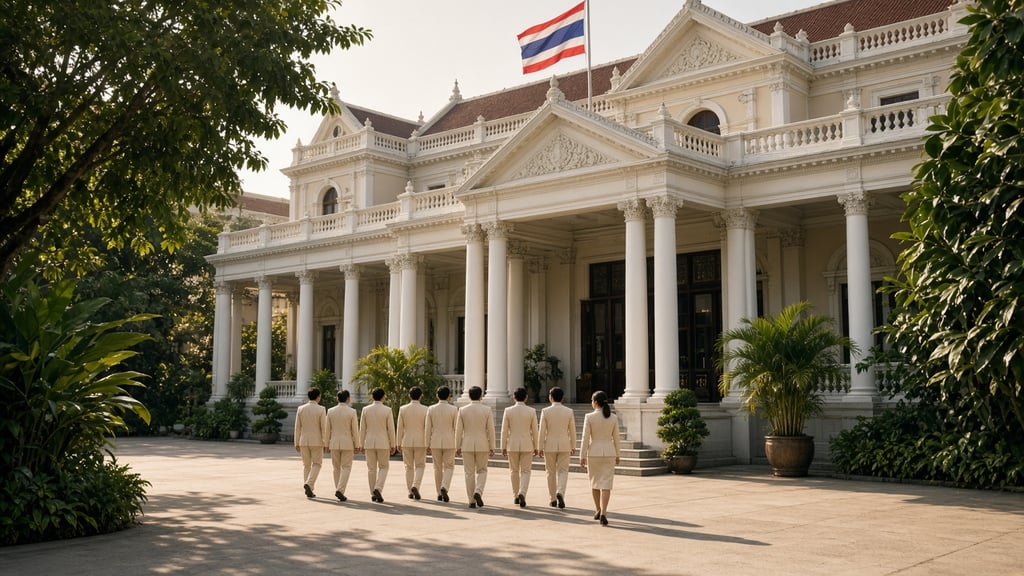
Thailand's Cabinet left a civil-service early-retirement scheme on the table at Government House in Bangkok on 24 November 2026. Prime Minister Anutin Charnvirakul, who also holds the Interior portfolio, sent the Office of the Civil Service Commission and the Bureau of the Budget back to recast the arithmetic. The dispute was not whether the public payroll is heavy. It was whether a buyout would actually lighten it.
Starting at once would have required more than 20 billion baht in the first wave. Ministers declined to write that cheque on the paper in front of them. Four days later, Deputy Prime Minister Pakorn Nilprapunt rejected a political reading of the pause. He had been overseas, then unwell, and said he does not treat the delay as a public snub. Cabinet postponed consideration so officials could close three holes in the file: whether the strongest staff would leave, why a lump-sum exit would still leave a lifetime pension bill, and how abolished posts would stay abolished.
The fiscal file Cabinet would not rubber-stamp
The proposal covers ordinary civil servants, not the parallel early-exit tracks already used by the military and police. The working design is a five-year window. Eligible staff would generally be 50 or older, with a possible opening for people from 40 if a unit's quota is unfilled or an agency head cites health or relocation. Participation is voluntary, and an agency chief would have to approve each name. A 5% annual ceiling per unit is meant to stop a rush for the door.
The money is the hard part. The lump-sum incentive in the draft formula runs as high as 15 to 18 times monthly pay, scaled to remaining years of service, on top of ordinary gratuity and pension rights. After the meeting, Government House spokesman Ekkapop Pianset said ministers wanted a clearer handover plan for the work those people leave behind. Deputy Prime Minister and Finance Minister Ekniti Nitithanprapas, and Paradon Prisananantakul, the minister attached to the Prime Minister's Office who oversees the Budget Bureau, pressed the same cost test. A private firm that pays someone to go is usually finished with that person. The Thai state is not. Pension and gratuity law can still leave the treasury paying around 70% of current salary for the rest of a retiree's life.
The five-year sheet shown to Cabinet put the combined incentive, gratuity, and pension cost at 29,620 million baht, including about 5,899 million baht in gratuities and 12,962 million baht in pensions that would climb year by year. The political fear sitting on top of those figures is older than this government. Thai agencies have a habit of cutting a post, then asking for it back once the work piles up. Anutin told the table that pattern cannot be the business model of a buyout.
Pakorn's reply, and the January clock
On 28 November Pakorn set out a six-point defence of the wider reform, not only the buyout. Early retirement, he said, is not a miracle cure. A Cabinet ceiling on headcount is already in force. The Office of the Public Sector Development Commission has for years allowed agencies to rearrange structures without adding posts. Digital document standards and a government data-sharing decree are supposed to cut clerical load. Roughly 200,000 government employees already sit in general, service, and technical grades that overlap clerical civil-service work, against only about 12,000 in specialist grades. The buyout would then lower the ceiling by one post for each person who leaves.
He has told OCSC to tighten performance ratings. A system that stamps 80 to 90% of staff as outstanding each year cannot be a serious screen for who should stay. Agency heads would keep the people they cannot afford to lose by refusing their applications, inside that 5% cap. One design option still on the table would raise the cash payment sharply if the leaver signs away ordinary pension, medical, and related rights and manages the money as a private nest egg. Participants would be barred from returning to government service.
OCSC is aiming to bring a revised paper back in January 2027 so the scheme can still meet its fiscal-year 2027 timetable, with the first departures pointed at 1 October 2027. Pakorn's warning sits in the budget arithmetic Thailand already knows: a shrinking population and a thinner tax base will make a 73% recurring-spend share even harder to carry. He marks eight months in the post on 6 December. Speed is not vanity. Delay, if the numbers stay muddy, is also not a snub. It is Cabinet doing what cabinets are for.
What This Means for Expats and Travelers in Thailand
Foreign residents meet the Thai state at immigration counters, land offices, one-stop service centres, and provincial halls staffed by the same ordinary civil service this scheme would thin. If posts disappear and the work process stays the same, queues lengthen. If the digital redesign Pakorn describes actually lands, some windows can close without the wait getting worse. Neither outcome is in force. The scheme is still a draft, and Cabinet has not approved a single baht of buyout money.
Do not plan around an October 2027 exit wave. Teachers, police, soldiers, and many local-government officers sit outside this ordinary-civil-service paper, or on separate tracks. What is already true is the budget squeeze behind it. Recurring pay, medical bills, and pensions crowd the annual budget. That squeeze is what shapes how quickly the state can staff visa counters, digitize address reporting for foreign residents, and keep provincial land offices moving. The January 2027 resubmission is the date to watch, not a rumour that the civil service is about to empty out.

No comments yet. Be the first to join the conversation.