Cabinet Sets 35 Percent Excise on Fully Imported EVs From 1 January 2027
Cabinet raised excise on fully imported battery and range-extended electric vehicles to 35 percent from 1 January 2027, leaving locally built models on the EV 3.5 track.
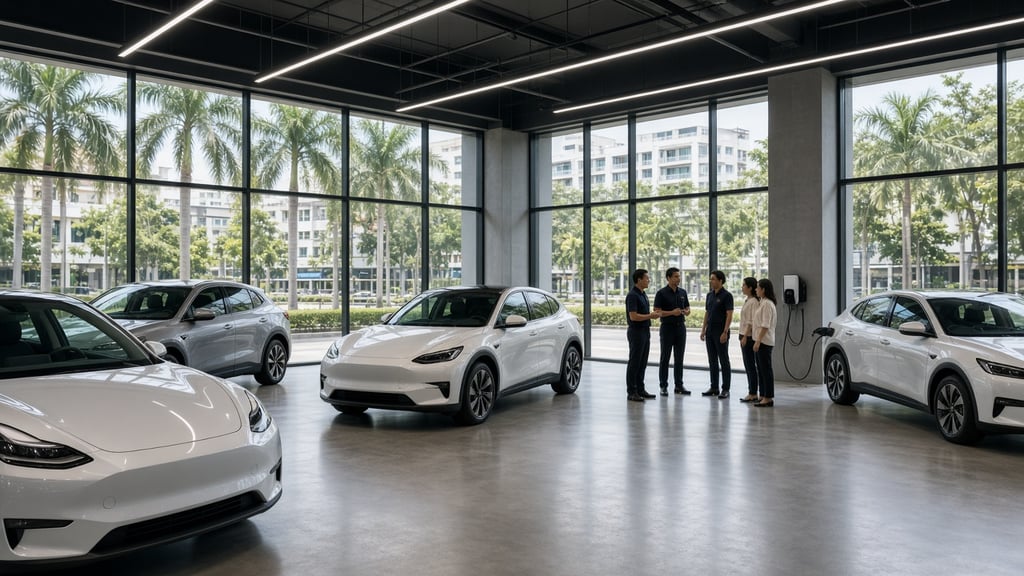
Thailand's Cabinet, meeting off-site in Udon Thani on 3 November 2026, approved a single 35 percent excise rate on fully imported battery electric vehicles and range-extended electric vehicles from 1 January 2027. The Finance Ministry said the new rate replaces 10 percent on imported battery models and 15 percent on imported range-extended models, and that it applies to vehicles brought in with no Thai factory and no locally made parts.
Deputy Prime Minister and Finance Minister Ekniti Nitithanprapas presented the paper as a fairness measure for firms that already put plants, workers, and supplier contracts in Thailand. Locally built electric vehicles that meet the government's production conditions stay on the reduced-excise track. Buyers and dealers have a two-month window to clear imported stock or open orders.
What the 35 percent rate covers, and what it does not
Battery electric vehicles run only on stored electricity. Range-extended electric vehicles can take fuel as well as a charge, but an electric motor still drives the wheels and the engine is used to generate power. Cabinet set both imported groups at 35 percent from New Year's Day. Plug-in hybrids and combustion cars sit on separate schedules and were not rewritten in this vote.
The higher rate targets completely built-up imports outside government support schemes. That is a different track from EV 3.5, the 2024-2027 package that still cuts qualifying battery-electric passenger-car excise from 8 percent to 2 percent, with a production offset of two units for every imported unit by 2026, or three by 2027. A car assembled in Rayong or Chonburi under those rules is not the same object as a fully imported CBU with no Thai content.
The vote follows the National Electric Vehicle Policy Committee. Meeting 1/2568 on 25 November 2025 and meeting 1/2569 on 10 September 2026 asked the Excise Department to reward investment, local parts, and export capacity instead of treating every electric car as a climate good regardless of where it was built.
Why the EV board moved first
On 10 September 2026 the same committee, chaired by Ekniti with Board of Investment Secretary-General Narit Therdsteerasukdi as secretary, endorsed a four-step tax idea. Fully imported electric vehicles from firms with no Thai plant would pay more. Firms that already manufacture here could still import limited volumes to test the market. Locally built models would pay less as Thai parts content rose. The 3 November vote is the first public rate on that ladder: 35 percent at the no-plant, no-local-parts rung.
The September briefing also showed how fast the mix has changed. In the first seven months of 2026, 126,950 battery-electric vehicles were registered, up 88 percent from a year earlier. Battery, hybrid, and plug-in hybrid models together made up 55 percent of new registrations. BOI promotion stood at 189 schemes and 151.37 billion baht as of 31 August 2026.
Investment first, then imports
Finance officials set three tests: imports should pull investment, Thailand should remain a regional export hub for cleaner vehicles, and local content should move into high-value parts, not only paint and tyres. Japanese makers with Thai plants, including Mitsubishi, Honda, Mazda, and Isuzu, had already tabled more than 50 billion baht of extra investment plans when the EV board met in September.
The Excise Department was told to open talks with investors who want a plant, and to consider special rates for genuine new investment. That is the carrot next to the 35 percent stick, and a warning to brands that used Thailand as a duty-light showroom without a factory.
What This Means for Expats and Travelers in Thailand
If you are shopping for a fully imported Tesla, a European battery coupe, or a Chinese range-extended model with no Thai plant, treat 1 January 2027 as a hard date. Dealers can still clear 2026 stock at the old 10 or 15 percent excise. Ask in writing whether the vehicle is a completely built-up import or a locally assembled unit, and whether the brand has an EV 3.5 production-offset file with the Excise Department. A showroom badge that says electric is not a Thai factory stamp.
Buyers of locally built models already assembled here should not assume a 35 percent jump. Those cars stay on the 2 percent EV 3.5 excise if they still meet the package rules. Tourists and short-stay visitors do not pay this tax at the airport. It is a vehicle excise on cars entering the Thai tax net, not a tourist surcharge and not a change to visa, TM30, or rental-scooter rules.
Used-car prices for 2024-2026 imported battery models may firm if new completely built-up stock becomes dearer. Charging, insurance, and the annual road tax are separate bills. The 35 percent figure is the excise rate, not a promise that the sticker will rise by exactly 35 percent after value-added tax and dealer margin. Get an on-the-road quote dated before and after 1 January on the same specification.

Comment verification
Step 1 of 3
Verify your email once to publish your comment. Your email is never shown publicly.
Enter the 6-digit code sent to .
Choose the display name shown next to your comments.