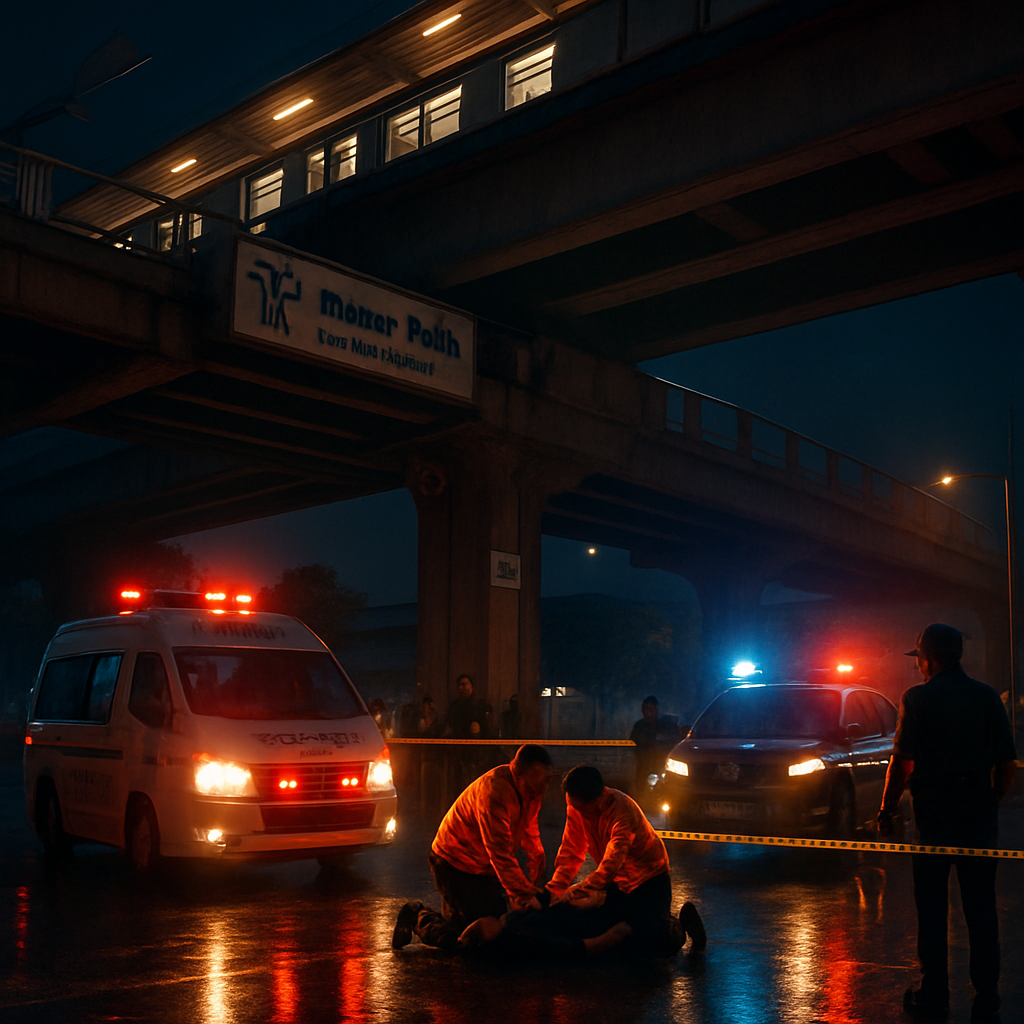
Shortly after midnight on Thursday, January 22, Bangkok police and rescue teams were called to a grim scene beneath the BTS Phahon Yothin 24 station after a man believed to be in his twenties fell from a great height and died at the site. The incident, which occurred around 12:30 a.m. on the outbound side of Phahon Yothin Road heading toward the Ratchayothin intersection in Chatuchak district, has left investigators piecing together the final hours of a young life.
The scene and emergency response
Police Lieutenant Nipon Sakulphet-aram, the duty officer at Phahonyothin Police Station, was among the first to respond after an emergency call. Officers arriving at the scene found the man unconscious and critically injured on the road beneath the BTS station. He was dressed in a grey long-sleeved shirt and white shorts. Erawan rescue workers immediately performed cardiopulmonary resuscitation (CPR) for roughly 40 minutes, but despite their efforts the man was pronounced dead at the scene. No identification documents were found on his person.
What the CCTV and station staff revealed
Investigators reviewed closed-circuit television (CCTV) footage and spoke with BTS staff as they worked to reconstruct what happened. According to station personnel, the man boarded a train at Samrong Station earlier in the evening and arrived at Phahon Yothin 24 station at about 10:00 p.m. Notably, staff say he did not exit the station that night. At approximately 12:25 a.m., CCTV captured him falling from an estimated height of 15 to 20 metres onto the road below.
Authorities transported the deceased to the Institute of Forensic Medicine at Police General Hospital for further examination. Police are continuing efforts to identify the man and notify his family, while the official cause of the fall remains under investigation. Local coverage cited CH7 News as reporting the developing story.
A second fall in Din Daeng
In an unrelated incident on the same night, police and emergency teams also responded to a dangerous situation on Vibhavadi Rangsit Road in the Din Daeng area. Near Rajamangala University of Technology East in the Chakraphong Phuwana area, officers found a man standing atop an expressway pylon. Negotiators attempted to persuade him to come down, but those efforts were unsuccessful. After some time, the man jumped from the pylon onto the roadway below.
First responders administered immediate first aid and rushed the injured man to a hospital for urgent treatment. Authorities in Din Daeng are handling the case separately, and details about his condition have not been fully disclosed to the public.
What we know — and what remains unclear
- Time of Phahon Yothin incident: around 12:30 a.m., January 22.
- Location: outbound side of Phahon Yothin Road toward Ratchayothin intersection, beneath BTS Phahon Yothin 24 station.
- Estimated fall height: 15–20 metres.
- Rescue response: Erawan teams performed CPR for approximately 40 minutes; victim pronounced dead at the scene.
- No identification cards were found on the deceased; body taken to the Institute of Forensic Medicine at Police General Hospital.
Although CCTV footage has captured key moments, investigators are still seeking to understand the circumstances that led to the fall. Was it an accident, a deliberate act, or the result of some medical emergency? At this stage, police have not released a cause and are pursuing witness statements and further forensic evidence.
Community impact and safety reminders
Incidents like these are a sharp reminder of how quickly a night out can turn tragic. The areas around major transport hubs—busy roads, elevated platforms, and expressway pylons—pose real dangers when barriers are bypassed or people find themselves in a vulnerable state. Authorities usually urge the public to report anyone acting erratically or appearing to be in distress, so trained responders can intervene before a situation escalates.
Police continue to appeal for anyone with additional information, images, or footage that could help identify the deceased or shed light on the events leading up to the fall to contact Phahonyothin Police Station. Meanwhile, the Din Daeng case remains under review by emergency services and local law enforcement.
As the investigation continues, Bangkok residents and commuters are reminded to stay vigilant and to reach out to authorities or mental health hotlines if they encounter someone in crisis. For now, the city waits for clarity while relatives and friends of the victims hope for answers.


















This is heartbreaking. Stations need better barriers and staff training if people can get up to a 15–20m drop without being stopped.
Structural improvements help, but we shouldn’t jump to infrastructure as the only fix; mental health crises and intoxication often precede falls from height.
What does ‘intoxication’ mean? Like drinking? Kids should be taught to stay away from edges.
Yes, drinking or drugs can make someone stumble or make poor choices. But education + safety design together would reduce these tragedies.
Barriers? CCTV footage probably edited. Why so many unexplained BTS deaths lately, hmm?
If staff said he didn’t exit the station, how did he get onto the platform edge? Either negligence or cover-up from BTS.
I work nights and it’s not that simple. Stations are crowded and one person can slip into maintenance areas; we do our best but resources are limited.
Quick accusation of cover-up isn’t helpful. Police will check CCTV, staff logs, and forensics. Jumping to conclusions fuels conspiracy but rarely uncovers facts.
I get that, but repeated incidents make commuters lose trust. Transparency about safety audits would calm people down.
I feel so sad for the family we don’t even know. This shows how important mental health support near transport hubs is.
Statistically, urban transport nodes are hotspots for both accidental and intentional falls. We need integrated crisis teams on night shifts, not just police.
Are there hotlines in Bangkok you can call if you see someone unstable? People should be reminded frequently.
Yes, reminders and signs would help. Also training for staff to spot warning signs could save lives.
I don’t buy the ‘mystery’ angle. CCTV exists—someone is hiding something or the system failed. Either way, public trust erodes.
Conspiracy talk doesn’t help the dead. Let investigators do their work and please stop weaponizing tragedies for clicks.
Call it what you want. When multiple unexplained falls happen near stations, reasonable people will ask questions.
Questions are fine, but accusing without evidence harms families and workers. Demand transparency, not sensationalism.
No ID found on him — that complicates things. Identification needs to be quicker to inform relatives and avoid misreporting.
Forensic ID can be fast with dental records or fingerprints, but only if databases are accessible. We need better inter-agency coordination.
Exactly. Bureaucracy shouldn’t slow down contacting families when time is critical.
The media often sensationalizes these events, focusing on gore rather than prevention and context. That’s irresponsible journalism.
True, but local outlets also play an important role in informing the public about safety alerts and missing-person appeals; tone matters though.
Informing is fine, but headlines that hint at conspiracy or dwell on images do more harm than good for public mental health.
That’s so sad. Why would someone jump? I don’t understand.
Sometimes people are in pain no one sees. Others could be accidents at night. We can’t know yet, but it’s tragic either way.
I hope his family finds out and gets answers. This makes me scared to go to stations late at night.
Practical fixes: higher platform screen doors, better night-time staff presence, and emergency intercoms on platforms should be standard.
As a transport planner, I agree but budget and retrofitting old stations are real hurdles. Still, targeted upgrades at hotspots are possible.
Start small then — pilot screens at several vulnerable stations and measure the impact before wider rollout.
We have to be careful with details while the investigation is ongoing; releasing unverified speculation can hamper identification efforts.
Fair point — police transparency balanced with investigative integrity is tough but necessary to keep public trust.
Thanks. We’re appealing for CCTV and witnesses; any footage people have could be invaluable to reach the family.
Every life matters. Beyond policy debates, we should send thoughts and support to whoever knew him and to first responders who tried to save him.
CCTV caught the fall but that footage isn’t the whole story. Investigators should also look at station access, staff shift logs, and health checks.
As someone who lives nearby, late nights can feel unsafe. More patrols and visible staff would help people feel protected.
Exactly — community safety isn’t just cameras. Active human presence and clear reporting channels are crucial.
I feel anger and sadness at the same time. It’s easy to point fingers, harder to fix root causes like social isolation and lack of services.