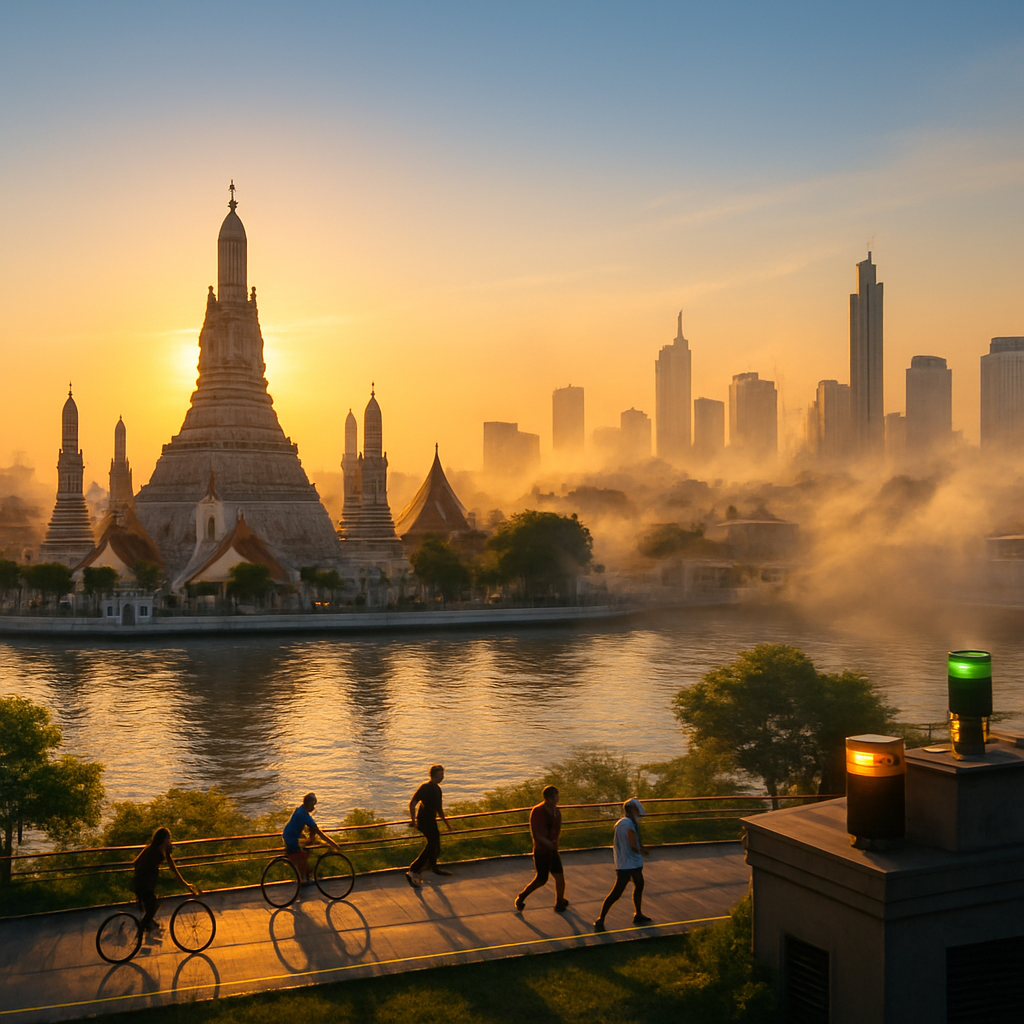
Bright skies and breathably clean air — at least for now. The Bangkok Air Quality Information Centre reported its early-morning readings on Wednesday, January 7, 2026, at 7:00 a.m., and the city’s PM2.5 story is looking pleasantly less dramatic than recent seasons. The average fine particulate (PM2.5) level across Bangkok was 24.3 micrograms per cubic metre (µg/m³), comfortably below the national standard of 37.5 µg/m³.
That average hides a little local personality: some neighborhoods flirt with the upper end of the scale while others are practically taking an oxygen selfie. Here are the dozen spots topping the PM2.5 leaderboard this morning — ordered from highest to lowest — so you can see how your part of town fared.
- Chatuchak: 36.6 µg/m³
- Pathum Wan: 35.8 µg/m³
- Sathorn: 31.9 µg/m³
- Khlong Sam Wa: 31.2 µg/m³
- Ratchathewi: 31.0 µg/m³
- Bang Phlat: 30.1 µg/m³
- Phra Khanong: 29.6 µg/m³
- Nong Kham: 29.4 µg/m³
- Bang Rak: 29.1 µg/m³
- Samphanthawong: 29.0 µg/m³
- Bang Sue: 29.0 µg/m³
- Lat Krabang: 28.8 µg/m³
Those Chatuchak and Pathum Wan readings are close enough to the standard to keep sensitive groups paying attention, while a number of districts — including Lat Krabang and Bang Sue — are enjoying more comfortable levels.
Air quality by region
Breaking the city down a little further, the Bangkok Air Quality Information Centre provided ranges for each region that paint a calm, mostly “good” picture, with pockets of “moderate” air where a little caution may be wise.
- North Bangkok: 21.1 – 36.6 µg/m³ (moderate)
- East Bangkok: 19.4 – 31.2 µg/m³ (good)
- Central Bangkok: 16.5 – 31.0 µg/m³ (good)
- South Bangkok: 19.1 – 35.8 µg/m³ (moderate)
- North Thonburi: 17.3 – 30.1 µg/m³ (good)
- South Thonburi: 18.2 – 29.4 µg/m³ (good)
In plain language: most areas are in the “good” bracket, with northern and southern parts of the city showing moderate pockets. The good news? Overall PM2.5 levels are on a downward trend and today’s classification lands in the “good” range citywide.
What those numbers mean for you
PM2.5 refers to fine particulate matter smaller than 2.5 micrometres — tiny enough to sneak past your nose hairs and lodge deeper in the lungs. The Thai standard referenced here is 37.5 µg/m³; staying below that limit is the goal. When numbers hover in the mid-20s to low-30s, everyday activities like jogging or walking the dog are generally safe for the general population.
Still, if you have asthma, chronic respiratory or cardiovascular conditions, or you’re caring for young children or older adults, it’s sensible to pay attention. On days where local readings climb into the mid-30s, consider limiting prolonged outdoor exertion, keep fast-paced exercise indoors, and check real-time updates before planning outdoor group activities.
Practical tips (that don’t sound like doom and gloom)
- Check morning readings before your commute — a quick glance at the Bangkok Air Quality Information Centre’s live feed can help you choose routes with greener corridors.
- Ventilate wisely: when outside levels dip, air out your home; when they rise, close windows and use air purifiers if available.
- For runners and cyclists: pick parks and side streets rather than busy highways during peak traffic hours.
- Keep masks handy if you’re in a sensitive group — a certified particulate mask can be a useful tool on days when levels spike.
For now, Bangkok residents can enjoy a bit of breathing room — literally. The downward trend in PM2.5 is encouraging, and with a little attention to local readings and sensible precautions, most people can go about their day without a second thought. If you’re curious about how your neighborhood stacks up tomorrow, check the latest morning update — after all, the city’s air has a way of telling its story one sunrise at a time.















Nice to see a calm morning reading for Bangkok, but let’s not get too relaxed. Averages hide hotspots and vulnerable people still need protection. I posted this so locals can plan their day sensibly.
Numbers look fine today but sensors can be gamed and nearby field burning still smells bad to me. I doubt the city captures pollution from outskirts properly.
Calibration and siting of monitors matter a great deal, and the Bangkok centre has improved coverage in recent years. That said, satellite and ground measurements together give the most accurate picture. Public access to raw data would reduce suspicion.
Totally agree — more transparency would calm people and help researchers. I’ll ask the centre if they share raw feeds publicly and post an update.
This is just propaganda from the government to keep tourists happy. Last week my kid had a coughing fit and the readings said ‘good’ — something’s off. Who do we trust if not community sensors?
Calling it propaganda without evidence is unfair; the centre is an independent agency and universities also publish data. If you have local sensor logs, post them and we can compare.
I installed a low-cost sensor at my condo and it showed spikes during rush hour that official stations missed. The network is improving but uneven. Community science can complement official sources.
See, that’s my point — official network misses everyday spikes. We shouldn’t treat press releases like gospel.
Both community sensors and official stations have roles. Low-cost sensors need frequent calibration to be useful for health guidance, but they are invaluable for local awareness.
I run every morning and these mid-30s numbers still make me nervous. Masks are uncomfortable for a run but maybe I should switch to indoor treadmill on certain days. Routes through parks definitely feel cleaner.
Try the canal-side paths early before traffic picks up; pollution is lower and the breeze helps. Also consider lower-intensity runs on moderate days to reduce lung dose.
As a PE teacher, I’ve had to shorten outdoor lessons when readings tick up. Schools should get alerts tied to official thresholds so we can act fast.
Good tips, I’ll map new routes and ask my gym about filtered indoor air on bad days.
Burning fields north of the city still wrecks mornings sometimes, and nobody enforces agricultural bans. These industrial and rural sources are as guilty as traffic. Until they fix that, improvements feel fragile.
Agricultural burning is an issue some months, but here in urban Bangkok traffic and diesel engines are the constant source. Both need addressing, but priorities differ by season.
Identifying source contributions requires chemical analysis and wind modeling. Policies that target the largest local sources yield the fastest health benefits, but public pressure is necessary to sustain them.
This ‘good’ classification only applies to downtown monitoring points; poor neighborhoods near factories still breathe worse air. Environmental injustice is real here and rarely discussed.
Are there studies showing the poorest areas have higher PM2.5? I’d like to see hard data before we blame industries.
Yes, spatial analyses often show higher exposures near industrial zones and busy roads, and those areas correlate with lower-income populations. Policy needs to consider equity, not just city averages.
Air seems okay today but my asthma flared yesterday so I still carry my inhaler. Is a PM2.5 of 29 safe for kids playing outside? I’m worried about my little brother.
Under 30 is usually okay for most kids, but if your brother has asthma keep meds ready and avoid intense play until it’s lower. Schools should allow flexible outdoor breaks for sensitive kids.
Thanks, I’ll tell my mom to watch him and check the live feed before afternoon play.
They’re manipulating numbers and hyping ‘downward trends’ to push big events and keep the city open. When readings dip near tourist zones, it’s too coincidental. Wake up people.
Conspiracy claims need evidence. Air quality fluctuates with meteorology and human activity, and multiple independent datasets (satellites, portable monitors) can confirm trends. Let’s demand transparency rather than assume deception.
Transparency is fine, but I still think we need open APIs and citizen access to raw sensor output. Only then can we trust trending statements.
Policy suggestion: expand low-emission zones, incentivize electric tuk-tuks, and create continuous green corridors to lower street-level PM2.5. Infrastructure changes beat daily hand-wringing. Bikes and trees both help.
I support low-emission zones but they must be fair; small vendors rely on older vehicles and need subsidies to upgrade. Otherwise you push pollution to poorer neighborhoods.
Green corridors sound nice but take years and money; meanwhile, focusing on traffic flow and vehicle inspection gives quicker wins. Start with enforcement first.
Agreed there’s no single fix; combine short-term enforcement with long-term planting and modal shifts. Community consultation will keep measures equitable.
From a health perspective, the downward trend is encouraging, but occasional mid-30s readings matter for people with heart or lung disease. The public should be given simple, actionable thresholds and real-time alerts.
Small statistical nuances are being flattened in headlines: daily averages can hide hour-long peaks that matter for exposure. Researchers should push for reporting both hourly peaks and 24-hour means.
Totally — an hour-long spike during rush hour can double someone’s daily dose. We need both metrics for informed decisions.
This is reassuring for parents who worry every morning, and I appreciate the practical tips at the end. Hope the trend continues through the season.
Keep windows closed early if you live near busy roads and open them later in the day when traffic eases. Small household habits add up.
School administrators, please note: have a simple plan for days in the mid-30s that protects kids without shutting down activities entirely. Mask options and indoor backup plans are inexpensive and practical.
If teachers put plans in place and share them publicly, parents will feel less anxious and schools can stay flexible. I can compile a checklist from community suggestions and share it here.
Why do we always focus on PM2.5? What about NO2, ozone, and other pollutants from cars and factories that affect health differently? A single number is misleading.
Good point: PM2.5 is a useful summary but does not capture gaseous pollutants or chemical composition. Comprehensive monitoring would inform better targeted interventions.
Masks for sensitive groups make sense, but mask distribution programs should target low-income communities. Otherwise only the well-off will have protection when needed.
Distribution sounds good, yet masks are not a long-term substitute for cleaner air policies. We need investment in systemic fixes, not just PPE.
Real talk: people will keep riding motorbikes and idling because it’s cheap and convenient. Behavioral change is the hardest part. Policy can nudge but culture shifts slowly.
Subsidies for e-bikes and better public transit options make the choice easier. When alternatives are cheap and convenient, habits change faster.
I used to get headaches on bad days, but since my neighbour installed a small purifier, my household feels better. Simple home measures can help while waiting for big fixes.
True, but those purifiers cost money and electricity. We need community centres with clean-air spaces for those who can’t afford devices.
Community action—like shared filtered rooms in temples or schools—could be a stopgap for vulnerable residents. It’s low-tech and high-impact if coordinated locally.
I’d volunteer to help organize that in my district. Let’s not wait for top-down solutions when community solidarity works.
I still don’t trust any ‘good’ labels until I see longer-term seasonal trends. One calm week doesn’t make a clean city. We need sustained data transparency over months.
Exactly — short-term snapshots are informative but not definitive. Longitudinal datasets and peer-reviewed analyses are what inform policy.
Traffic enforcement on idling NGOs and delivery trucks would cut a lot of needless emissions. Why are we so tolerant of avoidable pollution? It’s a governance problem.
I like the line about ‘oxygen selfies’ — makes the data feel human and less scary. Media framing matters and right now this piece balanced caution with optimism well.
Practical tip: when levels are moderate, reduce indoor cooking with open flames and use exhaust fans if possible. Household sources add to personal exposure and are controllable.
Urban planning must integrate air quality: more trees, fewer surface parking lots, and better zoning can reduce exposure near homes. It’s cheaper to build clean cities than to retrofit them later.
Can the air quality centre provide mobile alerts by neighborhood? Push notifications would actually change behavior and reduce exposure if timed to peaks. Real-time local warnings work.
I’ll add: include translations and outreach for migrant communities so everyone understands health guidance. Equity must be part of any alert scheme.
Final thought: celebrate improvements but demand plans for when numbers rise again. Complacency after a few good mornings is exactly how we get blindsided.