Immigration detains Chinese bid-rigging suspect at Huai Khwang hotel
A 51-year-old Chinese national was taken into custody at a Huai Khwang hotel on 11 November after immigration officers revoked his permission to stay over an alleged 2.5-billion-baht housing tender case in Dongguan.
Thai Immigration Bureau investigators detained a 51-year-old Chinese national at a hotel in Huai Khwang on the afternoon of 11 November after matching him to a Dongguan arrest warrant tied to an alleged housing-contract bid-rigging scheme valued at more than 500 million yuan, or about 2.5 billion baht. The man, identified in immigration briefings as Guan Shi, had entered Thailand with permission to stay. Officers revoked that permission at the hotel and moved him into immigration detention pending removal to China.
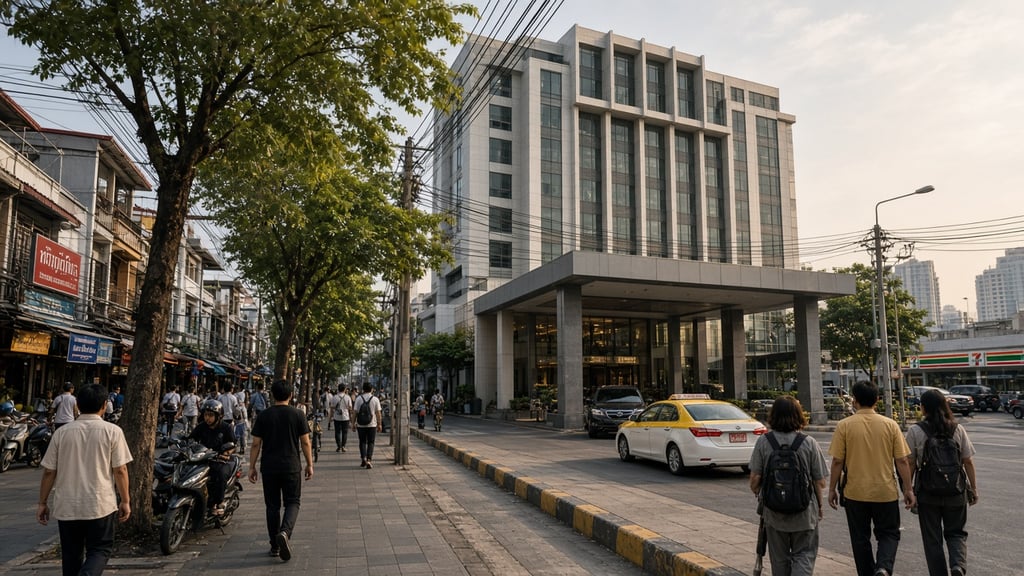
The operation was a records-led pickup, not a public raid. Officers from Investigation Division 1 of the Immigration Bureau located him at about 1.30pm at Siam Privi Hotel on Pracha Uthit Road in Samsen Nok, inside Bangkok's so-called New Chinatown. Pol. Lt. Gen. Noppasin Poolsawat directed the case. The detainee was later transferred to Investigation Division 3 for holding.
THAI.NEWS checked immigration.go.th for a standalone English bulletin on this arrest and did not find one at the time of filing. The account below is synthesized from Thai-language police briefings issued the same evening, then checked against the Immigration Act B.E. 2522 (1979). The Chinese charges remain allegations. No Thai court has tested them.
The Dongguan housing tender, as alleged
Dongguan's Public Security Bureau in Guangdong province issued a warrant dated 29 July 2026 for alleged fraud and conspiracy in a bidding process. Dongguan municipal police had opened a criminal investigation on 16 April 2026. The alleged conduct is dated to March 2023.
Chinese investigators allege that Guan Shi worked with an associate identified as Wei Lifeng, already in custody in China, and other people linked to Guangdong Mingye Construction Engineering Co., Ltd. The group is accused of bribing bid-evaluation experts so Mingye would win a Songshan Lake housing contract. Thai briefings present the 500 million yuan figure as the reported value of that housing project, not a proven financial loss. Those claims have not been proven in a Thai courtroom.
The trigger in Thailand was a written request from the Embassy of the People's Republic of China in Bangkok to the Royal Thai Police, asking that the man be found and returned. Immigration investigators then pulled travel and hotel records and placed him at the Huai Khwang hotel.
How Thailand removes a wanted foreigner who entered legally
Guan Shi is not accused in the briefings of overstaying a Thai visa. He had permission to remain in the Kingdom. The legal path used here is stay revocation, detention and repatriation, not a Thai criminal prosecution for the Dongguan tender.
Under the Immigration Act B.E. 2522 (1979), a foreigner subject to a foreign arrest warrant can fall into the prohibited-person category. Section 12(7) covers a person under warrant of arrest issued by a foreign government. Section 36 gives the Director-General or the Immigration Commission power to revoke temporary permission to stay. Section 54 then lets a competent official detain the person and repatriate them, with detention costs borne by the foreigner.
Briefings say investigation commanders signed the revocation order, officers served it, and the man was moved to Division 3 while removal is arranged. A flight date has not been announced. His arrival date and visa class have not been disclosed.
Huai Khwang is a logical place to search. The district covers about 15 square kilometres east of central Bangkok, with 81,515 registered residents in the 2017 official count, and a dense cluster of Mandarin-language shops and long-stay hotels around the Huai Khwang MRT. Samsen Nok, where the hotel sits, is one of three subdistricts. A wanted person with legal stay can live there without tripping an overstay alert.
What This Means for Expats and Travelers in Thailand
A valid Thai stay stamp is not a shield against a foreign warrant. Immigration can revoke permission under Section 36 and hold a person under Section 54 while a removal flight is booked. That process does not require a Thai criminal charge or an extradition hearing in open court.
Hotel stays in Huai Khwang, Sukhumvit, and other long-stay districts leave a name on a guest ledger that immigration can query. That does not make every foreign neighbor a fugitive. It does mean a mid-range hotel on Pracha Uthit Road is not a hiding place from a bureau that already has your passport scan from the airport.
Check your arrival stamp and any extension at an immigration office. Keep copies of visa pages. If you are the subject of a foreign case, get independent legal advice in Thailand before assuming a tourist visa or retirement extension will outlast a diplomatic request. The 1178 Immigration Bureau hotline is the public tip line for suspected immigration offences.
Two cautions close this case file. First, the 2.5 billion baht figure is the alleged project value in Chinese investigators' account, not a Thai finding of stolen money. Second, deportation here is an immigration outcome. It does not decide guilt in Dongguan. Until a Chinese court rules, the Bangkok detention is a transfer of a wanted person, not a verdict.


Comment verification
Step 1 of 3
Verify your email once to publish your comment. Your email is never shown publicly.
Enter the 6-digit code sent to .
Choose the display name shown next to your comments.