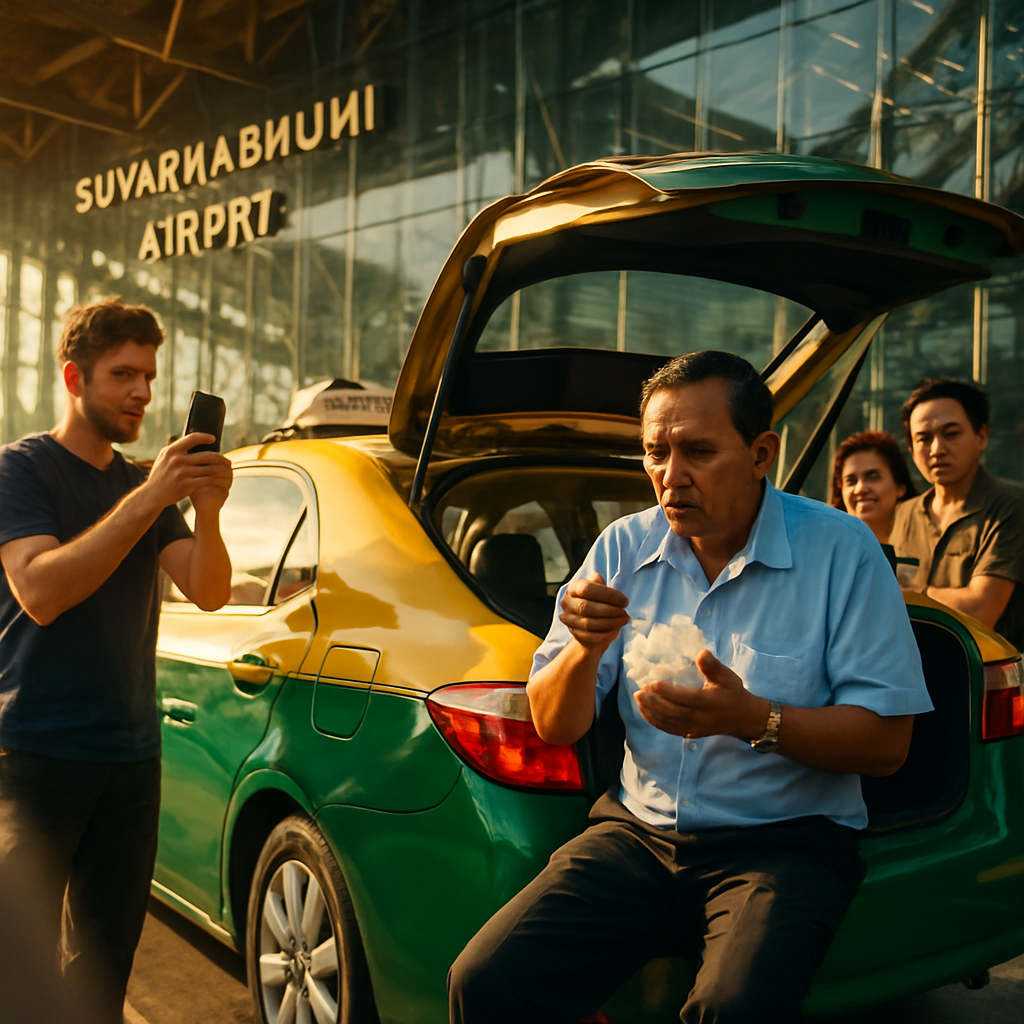
In a story that mixed bad manners with viral outrage, an Italian tourist has found himself at the center of a social media storm after posting a video that insulted a Thai taxi driver eating from a plastic bag at Suvarnabhumi Airport in Bangkok. The clip, shared on Facebook, shows the driver calmly eating with a plastic spoon while seated on the boot of his green-and-yellow taxi — a scene ordinary to many Thais but turned into fodder for ridicule by the foreign filmer.
The man behind the camera, identified on Facebook as Giuseppe Taddeo, provided a running commentary in Italian. Translated captions accompanying the post read: “Enjoy travelling in Thailand. His lunch goes viral. Let’s see why.” In the footage, Taddeo allegedly compares the driver to a dog, saying, “Look at our taxi driver. He is having lunch. He eats from a plastic bag like a dog. He is exactly the same as a dog. I love dogs, but this kind of people is disgusting.”
It didn’t take long for the video to catch fire. Within hours it had racked up hundreds of thousands of views, drawing sharp rebukes from Thai and international netizens who called out the tourist for disrespect, xenophobia, and poor manners. The post’s shock value was amplified not just by the insult itself but by the calm dignity of the taxi driver — who appears unaware that he’s being filmed and demeaned.
Many Thai commenters were quick to defend local customs. Eating food from plastic bags is a commonplace and practical habit across Thailand — a grab-and-go solution embraced by street vendors and drivers alike. To locals, it’s not a sign of filth but of convenience and resourcefulness. Several responses reminded Taddeo that cultural differences do not justify derision, and urged visitors to learn before they mock.
Beyond cultural sensitivity, others pointed to a legal angle: Thailand’s Personal Data Protection Act (PDPA). Recording and broadcasting videos of people without their consent can run afoul of privacy rules, and some viewers suggested reporting the clip to authorities or even to immigration officials. Whether legal action will follow remains unclear, but the warning underscoresthat public shaming via social media isn’t risk-free.
Rather than apologizing, Taddeo dug in. According to reports, he insisted the right to comment came from being a paying tourist who “uses his own money” to travel. He later escalated tensions by posting the location of his Bangkok hotel in the video’s comments, daring critics to confront him in person. Predictably, that move only fueled more backlash and outrage online — a classic example of how provocation can rapidly backfire in the age of virality.
The post also wasn’t an isolated jab. Observers noted that Taddeo had uploaded other videos criticizing Thailand — including one deriding a street food cart as “dirty.” Those clips helped shape the narrative: this wasn’t a lone lapse of judgment but a pattern of dismissive content that fed into national pride and frustration.
By the latest updates circulating online, the original video had drawn more than 670,000 views, nearly 900 reactions, and over 1,100 comments, and it had been republished by multiple Thai news outlets. But the metrics tell only part of the story. What followed was a broader conversation about respect, tourism, and digital responsibility.
There are a few tidy takeaways from the episode:
- Context matters: Practices that look strange through the lens of another culture are not automatically “wrong.” Understanding local customs is basic travel etiquette.
- Consent matters: Filming people without their knowledge and then posting the footage — especially with mocking commentary — can cause real harm and may have legal repercussions under laws like Thailand’s PDPA.
- Words travel fast: Social media amplifies everything. A single ill-considered post can become an international incident and follow you long after you leave a country.
For travelers, the episode is a reminder to put curiosity ahead of condescension. Bangkok is famously full of surprises: street food traders balancing steaming plates, drivers grabbing a quick meal between fares, and neighborhoods where practicality trumps polish. Those scenes are part of the city’s character, not something to be weaponized for clicks.
As for the taxi driver in the viral clip — he remains the unwilling subject of a public spectacle, emblematic of how ordinary people can be drawn into viral controversies through no fault of their own. The wider reaction suggests that, while tourists are welcome, the era of undiscerning criticism is rapidly losing social license. If nothing else, this episode may teach a reluctant visitor that empathy travels as well as a plane ticket — and costs a lot less than a public shaming.

















I honestly think people are overreacting; he was just pointing out odd behavior and has the right to post what he sees.
Right to post? You can’t humiliate someone in public just because their lunch looks different from yours, that’s basic respect.
Respect is one thing, but tourists should be able to report what they observe without being mobbed online.
Observation isn’t value-neutral when it’s framed with insults about nationality and dignity; context and power matter in public shaming.
As a Thai, this hurts — eating from plastic is normal for drivers and street vendors, it’s not an insult, it’s survival and practicality.
Totally agree, and the PDPA point is real too; people should think before broadcasting strangers’ images internationally.
Exactly, Linda. This is about dignity and privacy, not semantics about lunch containers.
But if digital folk won’t self-regulate, legal consequences are sometimes the only way to teach lessons.
This feels like typical tourist arrogance — mocking local customs for clicks is shameful, and I hope authorities look into the PDPA angle.
Legal or not, morality aside, posting someone’s hotel location was reckless and escalated things dangerously.
Yes, that was a provocation not protected by any ‘right to film’ argument; it invites harassment.
I worry this chills tourism too; but cultural education should be in travel guides, not enforced by mobs.
This case is a neat illustration of online moral panics, digital vigilantism, and the geopolitics of everyday humiliation.
Well said. There’s a scholarly angle here: social media flattens nuance and amplifies shame, often harming the least powerful.
Indeed — and we should interrogate how travel culture and postcolonial attitudes still shape what tourists feel entitled to mock.
That’s too academic for most people — to me it’s simple: don’t be a jerk in public, you’re representing your country.
I used to travel a lot and never felt the need to ridicule people; this guy made a bad impression on every tourist, not just Thais.
So you think one idiot ruins it for all travelers? That’s a slippery slope argument.
Not ruins, but his behavior reflects poorly and provokes real consequences for both him and the community he insulted.
As someone who loves Thailand, this made me angry. People should learn basic etiquette before they travel.
Anger is understandable, but turning it into harassment might be disproportionate; we need measured responses.
Measured doesn’t mean indifferent — calling out xenophobia publicly is part of social accountability.
And sometimes accountability becomes online lynching. People forget there’s a human on the other side of the phone.
This highlights a blind spot in travel etiquette: many tourists assume Western standards are universal, which is arrogant and dangerous.
You sound like an activist, but what’s the practical fix? Cultural classes at airports?
Public information campaigns and platform policies that discourage targeted shaming would help, plus respectful travel education.
I can’t believe people want to press legal charges over a video like this; isn’t the internet full of worse stuff?
Quantity of bad content doesn’t negate the harm of a specific act; law sometimes steps in where social norms fail.
I watched the clip and felt both embarrassed for him and protective of the driver; social media rewards nastiness with clicks.
Protective? The driver might have thought the cameraman was curious — it’s modern paranoia to think every camera is hostile.
You can be curious without calling someone ‘disgusting’ and posting their hotel address; that’s the difference between curiosity and cruelty.
This is why some countries detain offensive tourists — words have consequences and sometimes legal ones.
Detention feels extreme for a rude video, but a fine or warning under privacy laws seems reasonable.
Fines are more about deterrence than vengeance; it’s about teaching respect for local norms.
There’s also the tourism economy angle: natives rely on respectful visitors, and viral shaming can damage livelihoods and perceptions abroad.
True, but businesses can also use incidents like this to promote cultural sensitivity and better host-guest relations.
As a 6th grader reading this, I think everyone should be kinder and learn before they judge. Simple as that.
Imagine being filmed eating your lunch and becoming a national conversation without your consent — terrifying and unfair.
Tourists sometimes weaponize differences to feel superior; it’s a colonial leftover that hasn’t died yet.
If platforms punished deliberate harassment more consistently, we’d see fewer incidents like this.
This should be taught in travel prep courses: curiosity first, condescension never.
Agreed. We need institutional solutions: travel agencies, influencers, and platforms all share responsibility.
I still think the internet will overcorrect and cancel anyone who makes a dumb joke; it’s messy and ugly either way.
There’s a comforting symmetry: people who think mocking strangers is entertainment are now themselves globally shamed.
Could this incident lead to a boycott of Italian tourists? That seems extreme but not impossible if nationalism flares up.
We should separate individual misbehavior from national identity. Punishing all tourists for one person’s cruelty is unjust.
Social media gives everyone power to amplify harm — with power comes the need for restraint, which many lack.
The driver becoming an unwilling viral subject is the saddest part; his dignity was stripped for a few thousand views.
I hope he faces platform consequences; posting private individuals to humiliate them should violate terms of service.
We also need to teach empathy in schools — if more people understood other cultures, this wouldn’t be news.
Empathy starts at home, and it’s absent when strangers are mocked for convenience.
Some defend free speech as a shield for nastiness. Free expression doesn’t mean freedom from social consequences.
At minimum, the tourist should apologize and take the video down, but I won’t hold my breath given his follow-up behavior.