Hospitals Put on Dust Watch as PM2.5 Season Opens Over Bangkok and Central Thailand
The health ministry ordered hospitals to screen dust cases from 13 November as PM2.5 began climbing in Bangkok, the surrounding provinces, and the central plains. Five capital districts were already orange by the next morning.
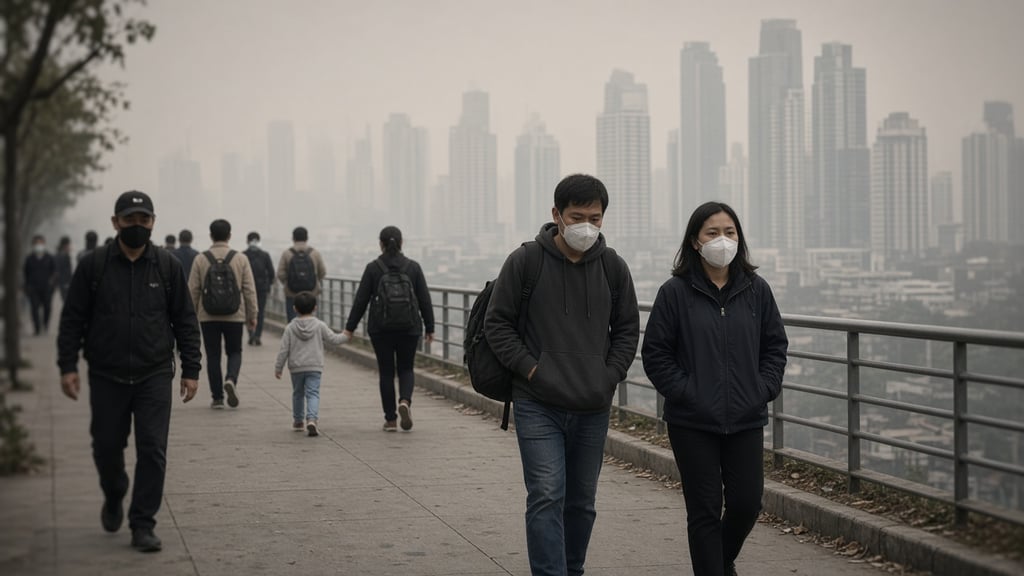
Thailand's cool-season dust window opened on schedule. The Ministry of Public Health told hospitals and provincial health offices on 13 November 2026 that PM2.5 is likely to rise from this month in Bangkok, the surrounding provinces, and central Thailand, because stagnant winter air holds emissions close to the ground. Officials said the dust season can run from November through May, and they ordered clinics to stand up screening, treatment, and referral before readings climb further.
Public Health Minister Pattana Promphat said low air pressure, weak circulation, traffic, industry, and open burning can let fine dust pile up over the capital region. Permanent Secretary Dr Somreuk Jeungsaman told health regions and provinces to score their own risk, watch the monitors, and point people to advice and listed clean-air rooms. Hospitals were told to screen, treat, and move patients, not wait for a red-day announcement from City Hall.
Bangkok, the five surrounding provinces, and a 40-province watch
The 13 November alert covers Bangkok, the surrounding ring of Nonthaburi, Pathum Thani, Samut Prakan, Samut Sakhon, and Nakhon Pathom, and the central plains. A 6 November briefing had already put 40 high-risk provinces on a longer watch, mainly the North and Northeast plus Bangkok, after three years above the national 24-hour PM2.5 limit of 37.5 microgrammes per cubic metre. Officials flagged about 16 million vulnerable people: young children, older adults, pregnant people, and anyone with heart, lung, or allergy disease.
On the morning of 14 November the monitors caught up. The Bangkok Air Quality Information Centre, reporting 09:00 to 11:00 readings, put the capital's PM2.5 between 21.9 and 40.1 microgrammes per cubic metre, with a city average of 29.5 against the 37.5 standard. Five districts were already orange, the band Thai agencies describe as beginning to affect health: Lat Krabang at 40.1, Bang Khen at 39.4, Pathum Wan at 39, Pom Prap Sattru Phai at 39, and Yan Nawa at 37.8.
The Pollution Control Department's noon bulletin widened the map to nine orange areas: those five districts plus Phra Pradaeng and Mueang Samut Prakan, Mueang Samut Sakhon, and Mueang Nakhon Pathom. Bangkok and the surrounding provinces ranged from 21.9 to 44.2 microgrammes per cubic metre. The North was still relatively clear at 4.6 to 15.2, the South at 5.0 to 6.9. Winter had been declared on 9 November. Satellites counted 30 hotspots on 13 November, mostly in rice fields of the lower North and central plains. PCD said another build-up is likely on 19 and 20 November.
Hospital instructions and the three official apps
Department of Health director-general Dr Thiti Sawaengtham told the public to check Air4Thai, AirBKK, or Life Dee before leaving home. When levels are high, cut outdoor time, skip outdoor exercise, close windows, and use a clean-air room. Anyone who must go out should wear a fitted N95 or KN95 mask. Keep usual medicine to hand if you have a chronic illness. Seek care for a frequent cough, chest tightness, difficulty breathing, dizziness, or a red rash. Find listed rooms on the Department of Health podfoon map or call 1478. Stop burning rubbish and crop waste.
The apps are easy to mix up. Air4Thai , run by PCD, shows Thai 24-hour PM2.5 in microgrammes per cubic metre. Orange on that scale starts at 37.5. AirBKK is Bangkok's 50-district map. Life Dee carries the health advice layer. Global apps often show US AQI, a different index, so a "100" there is not 100 microgrammes on Air4Thai. Read the unit before you decide on a morning run.
What This Means for Expats and Travelers in Thailand
Pack N95 or KN95 masks that seal on your face, not a loose surgical mask from the hotel lobby. If you are here with children, treat orange days as indoor-play days: skip the playground at rush hour, keep school pickup short, and ask whether the classroom has a listed clean-air room or a working purifier. Older travelers and anyone with asthma, COPD, or heart disease should keep rescue inhalers and regular medicine in the day bag.
Outdoor exercise is the first thing to drop. Lumpini, Benjakitti, and riverside runs push extra air into the lungs. Move the workout indoors, or wait until Air4Thai at the station nearest your route is back below orange. Motorbike taxis and open-air khlong boats put you in the plume. The BTS, MRT, and malls are the cleaner path across town on high days.
Before you step out, open Air4Thai, find the station closest to where you will walk, and read the microgrammes number, not a foreign AQI screenshot. Cross-check AirBKK if you are in Bangkok proper. If the district is orange, wear the mask outdoors, keep children inside, and use the podfoon map if your condo filter is weak. If symptoms start, public hospitals were told this week to screen dust-related cases.
Comment verification
Step 1 of 3
Verify your email once to publish your comment. Your email is never shown publicly.
Enter the 6-digit code sent to .
Choose the display name shown next to your comments.