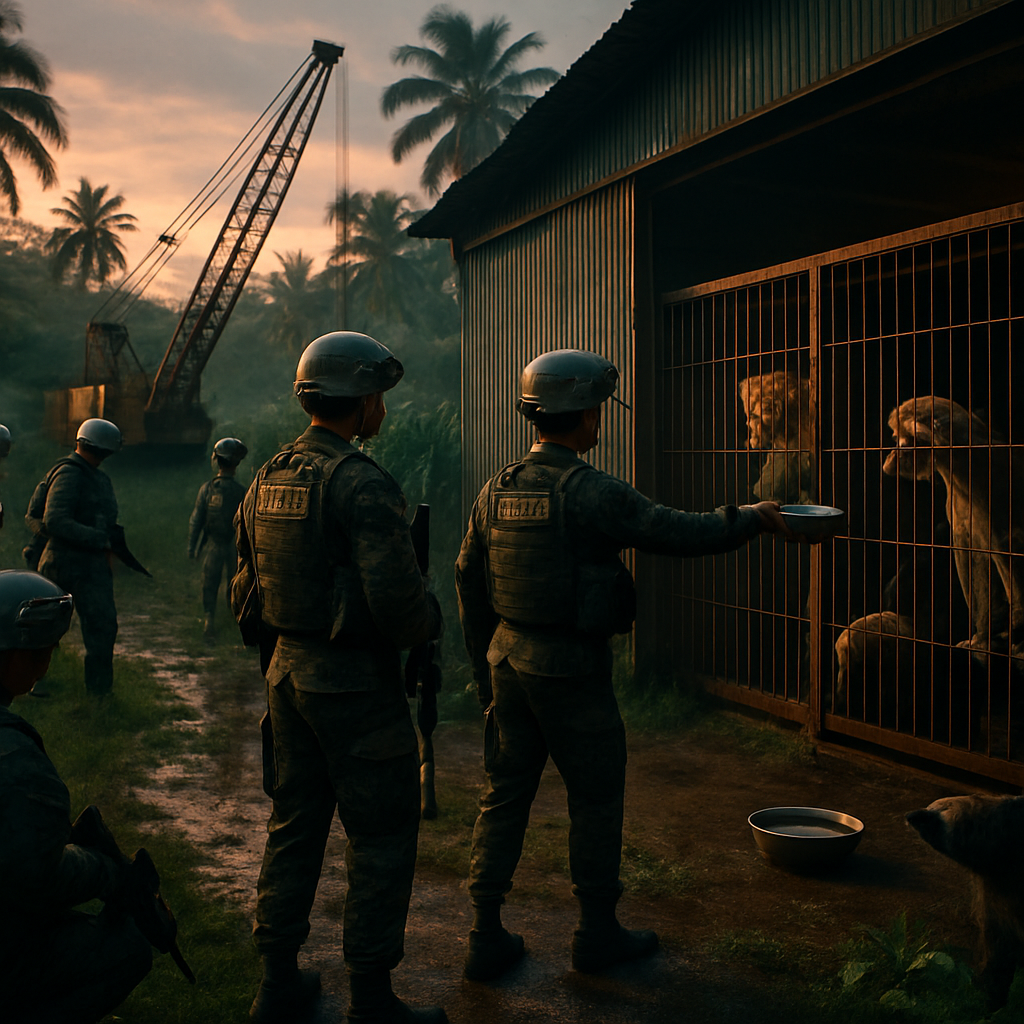
In a raid that read more like a grim wildlife thriller than a routine military sweep, Royal Thai Marine forces uncovered a heartbreaking scene on December 22 in Ban Tha Sen, Trat province. Inside a compound linked to the Thamoda casino near the Thai–Cambodian border, troops found two lions and three bears locked in metal cages — gaunt, aggressive and reportedly without food or water for several days.
The raid: what troops found
The operation began after reports of foreign operations and unusual activity in the area. As marines cleared the Thamoda casino grounds and surrounding properties, they entered a building where the animals were being kept. According to military sources, the compound had reportedly been used by Cambodian military personnel as a command post and was also tied to a casino network operating near the border.
Because the big cats and bears were agitated and potentially dangerous, troops could not safely open the cages. Instead, they improvised — tossing food and water into the enclosures to ease the animals’ immediate hunger while awaiting specialist help. Initial assessments suggested the animals had gone without proper care for three to four days and appeared severely malnourished.
Ownership, cross-border complications and safety risks
Investigators say the owner is believed to be a Chinese national connected to a casino network in the region, although authorities are treating ownership claims as part of an ongoing inquiry. The area’s recent violent clashes may have contributed to the apparent abandonment and lack of care for the animals; instability and sudden departures are often the reasons exotic animals end up neglected in conflict zones.
Complicating the rescue, military officers warned that landmines and other unexploded ordnance might be present around the compound. Officials contacted the Department of National Parks, Wildlife and Plant Conservation to coordinate an urgent rescue and relocation, but clearance and safe access were necessary before any heavy machinery could be brought in to free the animals from their robust cages.
What comes next
Authorities said the extraction operation was expected to proceed on December 23 once explosives experts certified the site safe. Because the cages are large and rigid, cranes or other heavy equipment will likely be required to remove panels and lift animals out without further distress or injury. The Department of National Parks will oversee medical assessments and temporary housing, and animal welfare groups are expected to be involved in the longer-term relocation and rehabilitation plans.
A sombre reminder: a separate bear mauling and a medical triumph
The discovery in Ban Tha Sen comes against the backdrop of another recent bear-related story in Thailand that captured both horror and hope. A 60-year-old Thai fisherman, reportedly mauled by an Asiatic black bear, survived a brutal attack that tore much of his face away. He underwent multiple, innovative surgeries using donor cartilage and skin grafts to reconstruct facial features and restore basic functions.
Remarkably, within two months the fisherman could breathe and eat on his own and had regained essential facial movements — a recovery hailed as a medical triumph and recently documented in a surgical journal. That case underscores both the danger wild animals can pose when human-wildlife boundaries are blurred and the extraordinary lengths modern medicine can go to repair catastrophic injury.
Why this matters
Beyond the immediate drama, the Ban Tha Sen discovery raises broader questions about exotic animal ownership, cross-border criminal networks, and wildlife protection in conflict-prone zones. When casinos, private compounds, and armed operations intersect near international borders, animals often become collateral victims — kept illegally, moved abruptly, and neglected when their human keepers flee or are detained.
For wildlife officials and conservationists, the priority is clear: secure the animals, provide urgent veterinary care, and trace the supply chain that brought them there. For local authorities, the challenge is equally stark — balancing a criminal probe, a mine-clearing operation and a delicate animal rescue without endangering personnel or the animals themselves.
A cautious ending — and a call for better safeguards
As rescue teams prepare to extract the lions and bears and investigations continue into the casino links and ownership, the situation serves as a call to strengthen cross-border cooperation on wildlife crimes and to ensure that exotic species are not treated as trophies or bargaining chips in illicit enterprises. The coming days will show whether the animals recover and whether authorities can unravel the network that left them to suffer.
Whatever the outcome, both stories — the starving big cats and bears in Ban Tha Sen and the fisherman’s remarkable surgical recovery — remind us of the fragile line that divides human drama, animal welfare and medical possibility. In the aftermath, the hope is that compassion, expertise and justice will move faster than the neglect that put these creatures at risk.


















This is sickening — animals used as props for illegal casinos and left to starve when trouble brews. The marines did the right thing to intervene, but how did this go on for so long without anyone noticing? I want a full investigation into the casino network and those who profited from keeping wild animals captive.
If the cages were on a compound tied to cross-border gambling, local oversight probably never happened, which is the whole problem. These animals should never be private possessions, period.
Saying ‘never’ is sentimental but doesn’t solve border corruption or demand for exotic pets. We need practical enforcement, not only moralizing.
I appreciate the military caution about mines, but waiting for explosives teams can cost animals’ lives. Why isn’t there a rapid-response wildlife & EOD joint unit in these border hotspots?
Agreed — specialized rapid teams would save both people and animals. If authorities coordinate fast enough, the animals might recover and the criminal links can be traced.
This story is a mess: casinos, suspected foreign military use, landmines and abused animals all in one. It’s hard to know where to start fixing it without sounding paranoid about cross-border politics. Still, the animals are the victims here and deserve urgent care.
The intersection of criminal networks and wildlife trafficking is well-documented, and casinos often act as fronts. Medical teams should prioritize humane triage, but the political fallout will dominate headlines.
Thanks, Dr. Lin — that’s what I feared. Media will love the drama, but without follow-through on prosecution the same networks will carry on.
I worry that calling out ‘foreign’ actors will fuel xenophobia. Focus on the crimes and the individuals, not nationality.
Honestly, anything near a casino feels shady. People who gamble big also gamble with lives — humans and animals. If the owner is linked to a network, lock them up and seize assets to fund rescues.
Seizing assets is great in theory, but legal proof takes ages and meanwhile the animals suffer. Immediate humanitarian care should be the first move.
As someone who visited border casinos years ago, security was lax and weird stuff went on. I wouldn’t be surprised if exotic animals were trophies for wealthy patrons.
Thanks for the on-the-ground perspective, Tom. That kind of tourist testimony could help investigators connect the dots.
We need to remember local farmers who live near these compounds; landmines and traffickers endanger everyone. It’s not just exotic animals, it’s rural safety.
This is a case study in how illicit economies externalize costs to vulnerable beings. Ecosystems and animals become collateral in geopolitical and criminal strategies. Scholars should document the supply chain and pressures that made captivity profitable in this region.
From a clinical standpoint, malnourished lions and bears present complex metabolic and infectious risks. Veterinary triage must be methodical to avoid refeeding syndrome and to quarantine zoonotic threats.
Please don’t forget the mental trauma; these animals are likely traumatized and aggressive. Rehabilitation needs space and expert behaviorists, not just medical care.
I want to hear more about whether international wildlife treaties are being enforced here. Border areas are loopholes for smugglers, and weak governance amplifies the problem.
Absolutely — treaties like CITES matter, but enforcement falters at porous borders. Academic partnerships can support forensic tracing of animal origins.
As a local, I am angry and heartbroken. Those animals made noise for days and no one checked; corruption runs deep when casinos spend money locally. We need transparency and community involvement in rescues.
Back in my day people would have reported this and pressured officials. Now fear of gangs keeps people quiet, which is why such abuse can happen.
Fear is real here, OldMan. People know which houses to avoid and which names not to speak. That’s why outside oversight is needed.
I support local whistleblowers but they need protection. Witness protection for those who report wildlife crimes should be part of the rescue budget.
I keep thinking about the fisherman who survived that bear mauling and got reconstructed — what a contrast. One story shows medical triumph, the other shows neglect and cruelty. Which narrative will shape public policy?
Stories that mix trauma with recovery inspire reforms, but only sustained advocacy does that. The surgical case might push interest in human medical capacity, while this raid should push wildlife reformers to act.
Let’s hope both stories lead to concrete action: better human safety, better animal protections, and tougher anti-trafficking measures.
I find it unsettling how quickly people call for punishment instead of rescue. Yes, prosecute if guilty, but rescue and rehabilitation should be non-negotiable. Animals didn’t ask to be part of illegal schemes.
Rescue is my priority, but accountability is essential to prevent recidivism. If owners face no consequences, traffickers will keep using animals as assets.
I agree accountability matters, but let’s ensure animals aren’t rushed into exploitative sanctuaries that are just another stop on a trafficking route.
Seeing the mix of landmines and exotic animals in one story feels like satire, but it’s real. Border areas attract weird investments and people who think rules don’t apply to them. I’m glad the marines found the animals before worse happened.
Anyone else suspicious that media jumped on the casino angle so fast? It sells papers, but what if the ownership trail is more complicated than a single foreign owner? We should wait for facts.
Skepticism is healthy, Leo, but there’s enough corroboration here — casino-linked compounds have been investigated before. Waiting forever risks more neglect.