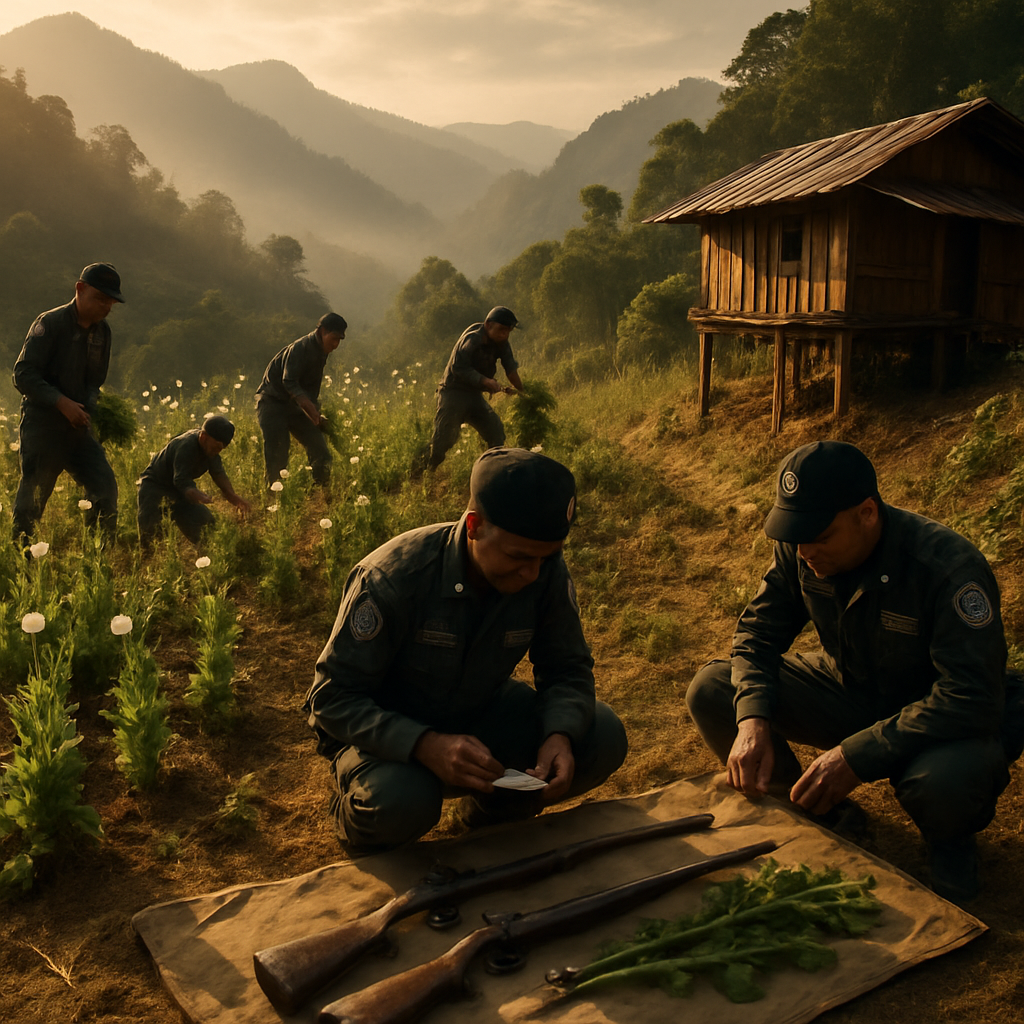
Coordinated Raid in Nan: Authorities Destroy Opium Plot and Seize Illegal Firearms
In a decisive swoop on 24 January 2026, multiple Thai government agencies teamed up to locate and destroy an illicit opium plantation deep in Wiang Sa district, Nan province. The raid, carried out in the remote hamlet of Ban Phu Fah Mai (Village No. 8, Yab Hua Na subdistrict), saw officers uproot one plot of opium—classified under Thai law as a Category 5 narcotic—and recover two unregistered muzzle-loading rifles nearby.
The operation read like a carefully choreographed play: intelligence led the way, a regional support team executed the plan, and evidence was cataloged for investigators. No suspects were present at the scene when authorities moved in, and the seized firearms were promptly handed over to Wiang Sa Police Station for forensic examination and legal follow-up.
Photo via Channel 7 News
Who Led the Operation
The mission was spearheaded by the Support Office for Prevention and Suppression Region 3 (Northern Region), working alongside officers from several related agencies. Top brass who ordered and endorsed the crackdown included:
- Naruephon Thipmontha, Director of the Forest Fire Prevention, Suppression and Control Office
- Wisut Muangcharoen, Director of the Prevention and Suppression Operations Division
- Somboon Phutthawong, Head of the Regional Support Office
On the ground, Supol Boonyawong—Head of Special Operations Unit 2 under the regional support office—led the tactical team responsible for locating and destroying the opium plot. The unit’s swift, on-site clearance of the plantation prevented further propagation and removed a potential supply source from circulation.
Part of a Broader Strategy
Officials said the raid forms a strategic link in a larger campaign to curb illegal drug cultivation and unlicensed firearms possession across Thailand’s northern forested and high-risk areas. The operation aligns with national directives issued by Atthapol Charoenchansa, Director-General of the Department of National Parks, Wildlife and Plant Conservation, emphasizing stricter enforcement against narcotics, illegal weapons, and forest-related offences.
Under the directive, officials are increasing patrols, sharpening intelligence gathering, and expanding surveillance in zones deemed vulnerable to illicit activity. Authorities indicated that further operations are planned in Nan province and neighboring regions as part of a continued suppression strategy.
What Was Found and What Happens Next
Investigators demolished the opium plot in situ, a standard practice intended to deny traffickers the chance to transplant or harvest the crop. The two seized muzzle-loading rifles—unregistered and potentially modified—were collected as evidence and transferred to Wiang Sa Police Station for detailed forensic work and to determine any links to wider criminal networks.
With no suspects detained at the scene, follow-up inquiries will rely on forensic leads, local intelligence, and continued surveillance. Authorities plan to trace possible supply chains and identify anyone connected to the plantation’s cultivation and weapon possession.
Local Impact and National Message
For residents of Yab Hua Na and surrounding communities, the raid sends a clear message: the authorities are prioritizing the protection of forests, public safety, and the rule of law. The presence of illegal cultivation within forested areas not only fuels narcotics markets but also damages fragile ecosystems—raising concerns for conservationists and public officials alike.
By targeting both narcotics cultivation and illegal firearms together, officials hope to strike at the twin problems that often feed one another in remote regions: illicit crop production and the unregulated circulation of weapons.
Reporting and Coverage
7HD Online News and other outlets reported the raid’s details on the same day, highlighting the collaborative nature of the operation and the high-level backing it received. As the investigation proceeds at Wiang Sa Police Station, authorities are expected to release updates if the probe uncovers broader networks or yields arrests.
What to Watch For
- Further raids or increased patrols across Nan province and neighboring northern regions
- Forensic results on the seized firearms and any forensic links to other crimes
- Follow-up arrests or intelligence that ties the cultivated plot to larger trafficking operations
For now, the plantation in Ban Phu Fah Mai lies cleared, the rifles are in custody, and investigators are piecing together the next chapter of what officials call a sustained campaign to protect Thailand’s forests and communities from narcotics and illegal weapons. The operation is a snapshot of coordinated enforcement—where conservation, public safety, and law enforcement converge in the highlands of the north.


















We covered the raid in Wiang Sa today; authorities destroyed an opium plot and seized two unregistered muzzle-loading rifles. We will follow up on forensic results and any arrests as the investigation continues.
Good job by the cops, but how do we know this wasn’t a planted operation to boost someone’s promotion?
That conspiracy angle pops up every time law enforcement acts, but without evidence it’s just speculation and it distracts from the bigger issues.
Maybe, but I’ve seen too many stories where local power plays use ‘drug raids’ as cover. Transparency would calm people down.
Those hills are full of poor families; crushing a crop without giving them alternatives just pushes them into deeper poverty. The government should offer replacement crops and income first.
Officials told us they plan increased patrols and intelligence work, but your point about alternative livelihoods is echoed by several sources and conservationists we spoke to.
Two muzzle-loading rifles? Sounds like small-time self-defense, not a trafficking network. Why the dramatic press then?
This is exactly the kind of enforcement needed to protect our forests and communities from narcotics and illegal guns. I fully support the regional teams.
Support is fine but enforcement without addressing root causes—land rights, poverty, and market demand—won’t stop cultivation long term. We need integrated policy, not just raids.
Integrated is good on paper, but immediate action is necessary when illegal crops threaten protected areas. Both can be done together.
Drugs bad. Burn them all!
That’s an emotional response, but eradication alone often fails because it ignores demand, economic drivers, and the social fabric of remote communities. Evidence suggests combining law enforcement with development and healthcare yields better outcomes.
As a conservationist, I worry the environmental damage from opium cultivation is significant. Clearing plantations is essential to protect biodiversity.
Plantations aren’t just about drugs, they’re often about survival. If authorities clear farms and don’t offer help, families suffer and may resent conservation efforts.
I agree support must accompany enforcement; conservation cannot succeed if local livelihoods are ignored.
Seizing crops and firearms without suspects present raises procedural questions: chain of custody, proper warrants, and due process must be respected or prosecutions will fail.
Officers followed directives from the regional support office and transferred the rifles to Wiang Sa Police Station for forensic handling; standard protocols were reported.
Standard in reports, but the proof will be in the documentation at the station—photos, warrants, and signed inventories. We’ll see if prosecutions are robust.
Those muzzle loaders are antiques for mountain people, not weapons of crime. Labelling everything ‘illegal’ misses culture and nuance.
Cultural nuance matters, but unregistered or modified firearms can increase violence in remote areas; context should guide a balanced response.
Balance, yes. But first talk to the people before destroying what they use.
I’m skeptical: are these operations more about optics ahead of national directives than actual long-term suppression? Seems politically convenient.
The directors named are career officials, not politicians; praising their work for protecting forests is fair—don’t demonize enforcement for doing its job.
Career official or not, enforcement is embedded in politics. Accountability and follow-up matter more than press releases.
Both sides make sensible points; prove it with data, not rhetoric.
I’m glad illegal guns were seized; even old muzzle-loaders can be dangerous in criminal hands. Forensics should trace if they’re linked to other crimes.
Muzzle-loading rifles have unique ballistics but can be linked via modifications, serial remnants, or residue; forensic timelines will be telling and could reveal wider distribution.
I remember when these hills were quiet and forested. Seeing narcotic plots in protected areas is heartbreaking and shows how desperation changes landscapes.
Then make policies that take land back and punish those who profit, including traffickers and complicit officials. Soft talk hasn’t worked.
Punishment alone won’t rebuild lost forest or community trust; restoration and support are needed.
This incident illustrates an intersection of conservation biology, criminology, and rural development. Empirical studies show that eradication without substitution programs often leads to crop displacement rather than elimination, so policymakers should monitor for leakage effects and prioritize sustainable alternatives.
My nephew lives near Nan; he said the police came like storm and scared the kids. Who protects the villagers from fear?
Several residents expressed concern about disruption; our team noted officials promised increased community outreach alongside patrols, but implementation details were scarce.
Outreach must be real, not just words.
Transparency is crucial: will Wiang Sa Police Station publish forensic findings and chain-of-custody reports? Journalistic scrutiny should follow to prevent cover-ups.
Can you show the photos of the destroyed plot and the seized guns? Visuals help verify claims.
We used Channel7 images in the piece and requested official photos and records; if they release more we will publish them alongside analysis.