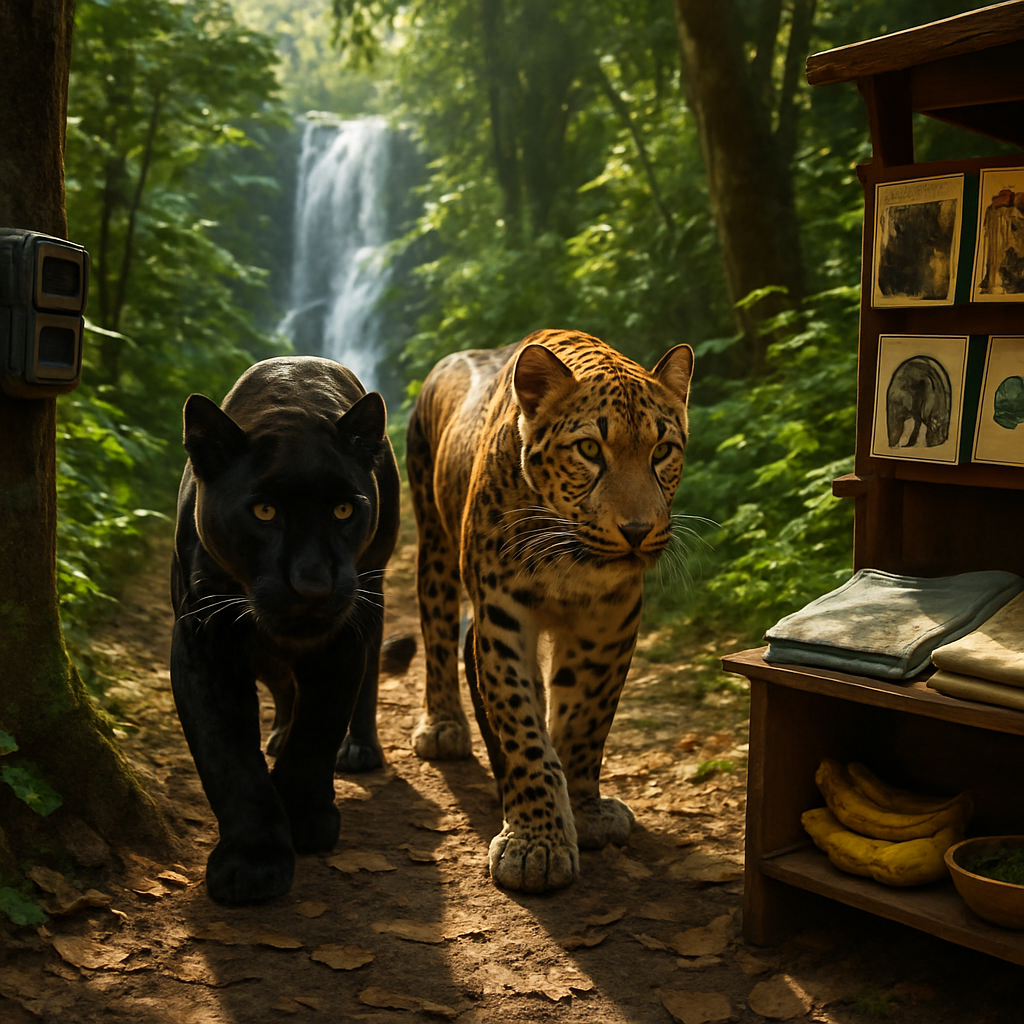
Deep in the emerald folds of Khlong Lan National Park, Kamphaeng Phet, a remarkable pair of feline celebrities has quietly been stealing the spotlight. Office of Conservation Area Management 12 recently re-released footage that feels almost too cinematic to be true: a leopard and a black panther padding through the same patch of forest, captured by camera traps set up by WWF Thailand. The original clips date back to June 2020, but watching them now is like discovering a nature documentary you didn’t know you needed.
Not two species, but two moods of the same cat
Before the excitement spins off into myth, it’s worth pausing to appreciate the biology. Both animals belong to Panthera pardus delacourii — the Indochinese leopard. The “black panther” isn’t a separate species at all but the same leopard exhibiting melanism: an overproduction of dark pigment that cloaks the usual rosettes in shadow. Up close, careful observers can still make out the faint leopard pattern beneath the black coat, like a secret script written in twilight.
What makes these images especially rare is the pairing itself. Melanistic individuals are uncommon, and the odds of seeing melanistic and non-melanistic leopards sharing the same territory — let alone crossing paths on camera — are tiny. For park officials and wildlife lovers, the footage is a moment of pure conservation serendipity.
A pair with provincial personality
Park staff and WWF Thailand embraced their new stars with local flair. The black panther was christened “Chao Kuay” (herbal jelly) while the spotted companion became “Kluay Khai” (lady finger banana) — both beloved symbols of Kamphaeng Phet’s culture and cuisine. The names are playful, memorable, and perfect for the role the duo has taken on: mascot and ambassador for Khlong Lan National Park.
Visitors can now find Chao Kuay and Kluay Khai on park souvenirs, from T-shirts to postcards, turning a conservation success story into something people can take home and share. It’s a clever way to channel public enthusiasm into funds and awareness for ongoing protection efforts.
More than cute mascots: what these cats tell us
Beyond the charm of their nicknames, these leopards are a barometer of ecosystem health. Their presence speaks to functioning prey populations, intact forest corridors, and effective protection measures. Since the footage was recorded, Khlong Lan National Park and WWF Thailand have launched a long-term collaboration to monitor and study the pair’s behavior — part of a broader push to understand big-cat ecology in Thailand’s remaining forests.
Camera traps, tracking, and community engagement are pieces of that strategy. The goal is simple and urgent: keep these apex predators and their habitats thriving. When top predators do well, the whole forest sings — from deer to birds to the insects that help recycle nutrients.
Why this spotlight matters
- Raising awareness: Viral wildlife moments build public support for conservation.
- Science and data: Repeated sightings and camera-trap data help researchers map territories and behaviors.
- Local benefits: Ecotourism and souvenir sales can provide income for nearby communities.
In short, Chao Kuay and Kluay Khai are more than photo ops. They are indicators, teachers, and ambassadors for a landscape that still holds wild things.
Not an isolated surprise
The resurgence of interest in Thailand’s big cats doesn’t stop at Khlong Lan. In a recent separate sighting, a young male tiger made a surprise appearance near a popular viewpoint in Nakhon Ratchasima — another reminder that Thailand’s forests still harbor truly wild encounters. Each sighting is a pulse-check: encouraging, humbling, and a call to keep protecting the places where these animals roam.
For anyone planning a trip to Kamphaeng Phet or simply scrolling through social feeds, the story of the leopard and the black panther feels like a modern fable — part nature documentary, part hometown legend. But underneath the charm lies a practical truth: conservation works when people care, when parks are managed, and when organizations like WWF Thailand and the Office of Conservation Area Management 12 team up to keep forests whole.
So next time you see Chao Kuay’s midnight silhouette or Kluay Khai’s sun-speckled coat on a postcard, remember this is not just wildlife wallpaper. It’s evidence that with attention, resources, and a little local flair, the wild heart of Thailand can keep beating — one pawstep at a time.















Be First to Comment