Pattaya police detain 20-year-old Russian over alleged 40,000 baht scam cash collection
Officers from Pattaya City Police and Chonburi's transnational-crime unit detained a 20-year-old Russian man outside Big C in South Pattaya on 12 November 2026, seizing 40,000 baht and a phone they say tied him to a call-centre cash-out network.
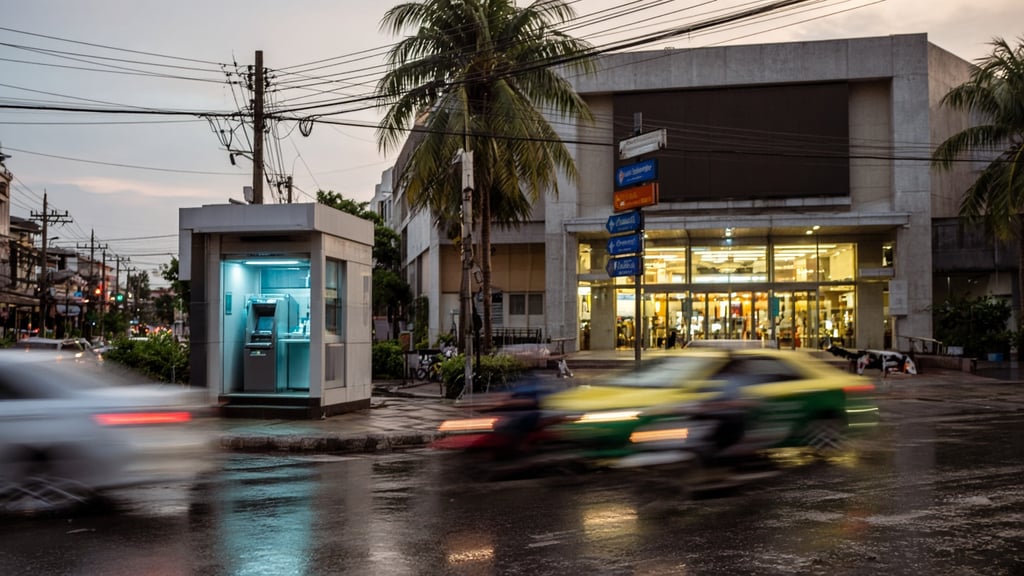
A 20-year-old Russian man, identified only as Dmitrii, was detained outside Big C in South Pattaya on 12 November 2026 after officers said he was collecting cash for an alleged call-centre scam network. Police reported seizing 40,000 baht and a silver-bronze iPhone. The detention is a police action, not a conviction. He has been charged, according to officers.
Officers from Pattaya City Police Station, also known as Mueang Pattaya Police, made the arrest with the Center for the Suppression of Transnational Criminals attached to Chonburi Provincial Police. Investigators said they had been watching foreign cash collectors after a tip that a scam group was coordinating withdrawals around Pattaya. They moved in as the man collected money in front of the shopping centre in Moo 10, South Pattaya.
What investigators say they found
Police said the phone held contact lists and written instructions that, in their view, connected him to a network that cashes out proceeds from online fraud. Officers described him as a suspected cash collector, sent to an ATM or mall pickup to empty mule accounts before banks can freeze the funds. No victim names or the full contents of the phone have been released.
That last-mile cash-out is how many call-centre operations still move money inside Thailand. Once a victim pays into a mule account, the window to withdraw is short. Banks now freeze suspicious accounts faster, so networks send people to ATMs and counters inside the country. A 40,000 baht pickup at a busy mall is a small slice of that pipeline. It is also the moment police can put a hand on someone.
Three charges, three different laws
Officers said they filed three counts. The first is jointly defrauding the public, used when a fraud is aimed at people at large rather than one named victim. Public fraud under section 343 can carry up to five years in prison, a fine of up to 100,000 baht, or both.
The second count is under the Computer-Related Crime Act B.E. 2550 (2007). Section 14(1) covers dishonestly entering false computer data likely to damage the public, with a maximum of five years and a 100,000 baht fine. Prosecutors have used that provision against people who handle mule accounts and digital instructions, not only against the original callers.
The third count is membership of a group that conceals its methods for an unlawful purpose, the secret-society offence under Criminal Code section 209, often called Ang-Yee. Membership can bring up to seven years and a fine of up to 140,000 baht. In January 2026 the Anti Cyber Scam Centre and the Office of the Attorney General said they would add Ang-Yee, and the related section 210 count, against mule handlers and cash-withdrawal mules. A court still has to prove the group and concealment elements.
A courier slice of a much larger market
Forty thousand baht is weekend money for a visitor, not the scale of the fraud Thailand has been fighting. The Technology Crime Suppression Centre has put online-fraud losses above 100 billion baht, with more than 1.09 million complaints filed since 2022. A mule-account sweep in November 2025 mapped 55 recruiting cells across 27 provinces. Cash collectors sit at the retail end, easier to arrest than the people who run the call floors.
Pattaya has seen a run of similar operations this year. On 9 and 10 November, city police raided a luxury house used as an alleged Chinese romance and investment-scam base, detaining ten people. Earlier in November, Region 2 officers arrested eight people, including three Chinese nationals, in a raid tied to more than 100 million baht in nationwide losses. Those files are separate. They do not prove this Russian man's guilt.
What This Means for Expats and Travelers in Thailand
If a stranger asks you to withdraw cash, collect a bag of banknotes at a mall, or let them use your account because their card does not work, that is the job this arrest describes. Do not do it for a dating-app contact or easy money for walking to an ATM. Mule-account holders can face up to three years in prison and a 300,000 baht fine under the 2023 technology-crime emergency decree. Claims of not knowing where the money came from have not been a reliable defence in recent official briefings.
A Russian name in a Pattaya blotter is not a verdict on the city's large Russian resident and tourist community. The man is 20. He has been charged, not convicted. Treat him as a defendant, not as a stand-in for a nationality.
Hang up on callers who want remote access to your phone or bank app. Do not share an OTP. If money has already moved, call the bank first, then report through the 1212 anti-scam hotline so the receiving account can be frozen while it still holds funds. A 40,000 baht seizure at Big C will not empty a network. It is a reminder that cash-out now happens in ordinary tourist places, at the same ATMs everyone uses.


Comment verification
Step 1 of 3
Verify your email once to publish your comment. Your email is never shown publicly.
Enter the 6-digit code sent to .
Choose the display name shown next to your comments.