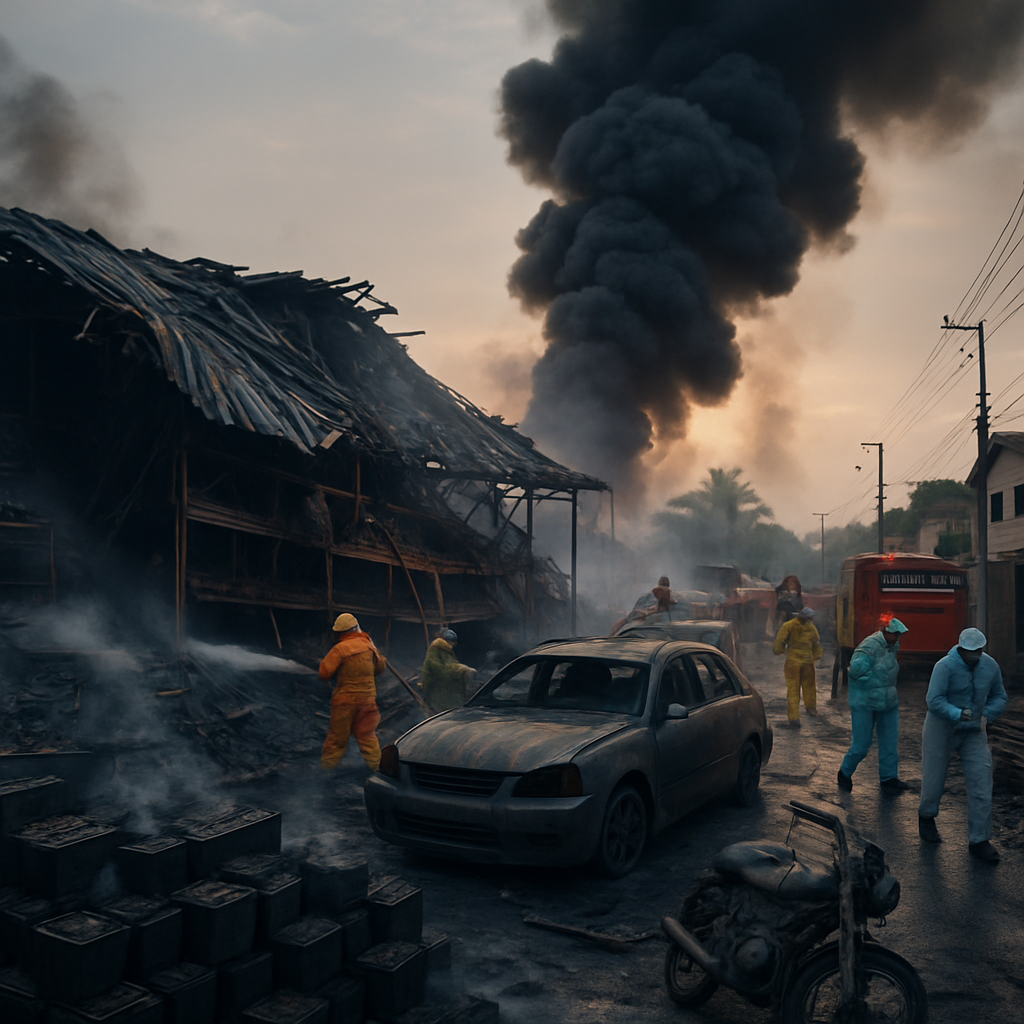
Before dawn on January 5, 2026, an otherwise quiet neighbourhood in Chonburi province was jolted awake by the roar of flames and the crack-pop of exploding batteries. A secondhand goods shop and its attached warehouse in Moo 2, Bo Win subdistrict — tucked down Soi Allay near Wat Bo Win in Si Racha district — was gutted by a fast-moving blaze that left the structure a smouldering shell and a haul of automotive parts reduced to charred ruin.
Fast response, fierce flames
The Pure Yeang Tai Sriracha Rescue Unit radio centre received an emergency call at about 4:30 a.m., and rescue coordinators quickly alerted local authorities. Si Racha District Administration, Bo Win Police Station and the Chao Phraya Surasak Municipal Fire Department were notified, and fire engines from several nearby jurisdictions — including the Bo Win Subdistrict Administrative Organisation, Laem Chabang Municipality, and Sriracha Municipality — raced to the scene. Volunteers from the Pure Yeang Tai unit helped clear access routes and support on-site operations.
Thick smoke and intense heat met firefighters on arrival. The warehouse, packed with car batteries, spare parts and other automotive accessories, presented a volatile mix of combustible materials that fed the flames and helped the fire spread rapidly. Despite the coordinated response, the fire burned for more than two hours before crews managed to bring it under control.
Damage and disruption
By the time flames were extinguished the house and warehouse were completely destroyed. Three cars and five motorcycles parked at the property were badly damaged. Residents nearby described loud popping noises during the blaze — likely the sound of batteries and other vehicle components rupturing under intense heat — prompting authorities to evacuate the immediate area as a precaution. Fortunately, surrounding buildings escaped major damage and no injuries were reported.
Officials say all goods stored in and around the property were lost. The site’s dual role as a residential property and a secondhand auto-parts business appears to have compounded the risk; a high concentration of batteries and spare parts inside an enclosed structure provided plentiful fuel for the inferno.
Investigation and safety reminders
Forensic teams are scheduled to examine the scene to determine the fire’s origin. Authorities have been cautious about drawing early conclusions; investigators will look into whether an electrical fault, the stored materials, or another factor sparked the blaze. A preliminary damage assessment is underway, but officials warn it cannot be finalised until the site cools and debris is cleared.
Local authorities and rescuers emphasised the incident as a stark reminder for business owners who store automotive equipment and batteries — especially those operating out of mixed residential-commercial properties — to review their fire safety plans. Simple but vital precautions include proper battery storage, clear separation between flammable materials and living spaces, functional smoke detectors, and accessible firefighting equipment. The advice echoes through today’s headlines: prevention beats reconstruction.
What neighbours saw
Witness accounts painted a vivid picture of the pre-dawn drama. Neighbours reported the sound of explosions and a mushrooming column of black smoke visible from blocks away. Emergency teams worked methodically to contain the blaze and safeguard adjacent homes. While the emotional and material toll on the shop owner is significant, the absence of physical injuries offers some solace amid the loss.
Looking ahead
As forensic investigators comb the smouldering remains to piece together what went wrong, community leaders have urged anyone running small-scale automotive or secondhand operations to prioritise fire risk assessments. The incident serves as a cautionary tale that a seemingly routine workshop or storeroom can become a hazard if flammable goods and batteries are not stored and managed correctly.
This story was reported by Khaosod. Authorities continue to assess the full extent of the damage and will release further details when the site has been secured and examined.


















Owner should have known better — storing so many batteries at home is reckless. Hope they pay for damages and don’t endanger the neighborhood again.
This is tragic but knee-jerk blaming isn’t helpful; small businesses often have nowhere else to store parts. Regulations and affordable storage options are the real issue.
Battery fires are terrifying because of thermal runaway; once one cell goes it can cascade quickly. Proper segregation and fireproof containment can stop spread, but many shops ignore standards.
Agreed, and firefighters risk their lives around these unpredictable explosions every time. Training and equipment matter.
I hear you, but ‘no place else’ isn’t an excuse for endangering homes. There must be a balance between survival and safety.
Huge respect to the crews who responded so fast — they probably saved nearby homes. Two hours to control a battery-fed inferno shows how dangerous this stuff is.
They were heroes, but why are mixed residential-commercial setups allowed to stock so many hazardous materials? Zoning is broken here.
Exactly — applauding the crews doesn’t fix the policy hole. Officials should be held accountable for enforcement.
Sounds like someone’s making a profit and cutting corners; arson for insurance wouldn’t surprise me. Anybody else smell something fishy?
Jumping to arson is irresponsible without evidence; forensics need to do the work. Electrical faults and improper storage are far more common.
Maybe, but most arsonists also know these weak spots and exploit them; I just don’t trust quick statements from ‘officials.’ Proof or shut up.
Social media already cooked up a dozen theories this morning; people want outrage, not patience. Let’s wait for the forensic report before verdicts.
My heart breaks for the owner losing their livelihood and home in one night. No injuries is a relief but rebuilding will be impossible for many.
If it’s the owner’s fault for mixing home and business, they should still get community help not hate. People need compassion and an actual plan.
Compassion plus consequences — yes, help rebuild but also require safer practices moving forward so it won’t happen again.
This is a textbook case of thermal runaway accelerated by dense storage and heat release from exploding batteries. Investigators should test for Li-ion versus lead-acid chemistries, containment failures, and nearby ignition sources. Better ventilation and separation into small, fire-resistive compartments could mitigate risk.
Most secondhand shops use lead-acid, which still spits acid and burns heavy, but recycled Li-ion is increasingly present and more volatile. Disposal and testing protocols are sorely lacking in many local markets.
I don’t get the chemistry but that sounds scary; what should shop owners actually do tomorrow? Put batteries outside?
Layman, prioritize removing energized batteries to a ventilated, non-combustible area and install isolation barriers; contact electricians for safe wiring inspections. Authorities should subsidize safety upgrades for small businesses.
I’ve warned neighbors for years about small workshops storing scrap; nothing changed. Time to push the municipality to enforce zoning and inspections.
We are reviewing this incident and plan to consult with safety experts before making policy changes, but knee-jerk bans could ruin legitimate livelihoods. Enforcement must be balanced and fair.
Balanced is fine, but ‘review’ is the word authorities use until another disaster happens; we need timelines and visible action. Don’t make us wait.
I’ve seen warehouses full of flammables right next to houses, it’s illegal in spirit if not in practice. Someone’s turning a blind eye for years.
Simple steps: separate batteries, keep fire extinguishers nearby, smoke alarms that actually work, and training for workers. These cost less than rebuilding.
We barely make enough margin to buy batteries, let alone full safety upgrades; telling us to do it is easy from an armchair. Who will pay?
Then the government or community must step in — fines alone won’t fix the root problem. Subsidies, shared safe-storage facilities, or cooperatives are options.
What about insurance? Will small owners be covered if their mixed-use property burns down? This could ruin families.
Coverage depends on policy specifics; many home-business owners are underinsured or have exclusions for hazardous stock. People should check their terms now.
Thanks — that sounds like another hidden crisis where poor people are hit hardest. Awareness campaigns are needed.
Beyond property, battery fires release toxic fumes and contaminated runoff; who’s responsible for environmental cleanup? This isn’t just about possessions.
Agreed — firefighting water can mobilize heavy metals and acids into soil and drains, requiring proper hazmat response. Long-term monitoring of nearby groundwater might be necessary.
If authorities ignore contamination, the community pays later with health problems and polluted land; demand transparency on testing results.
That’s so scary, I would have cried. Are the people okay?
No injuries reported, sweetie, but it’s okay to be scared — firefighters did their job. We should teach kids about battery safety too.
Okay thanks, I want everyone to be safe and not store bad stuff at home.