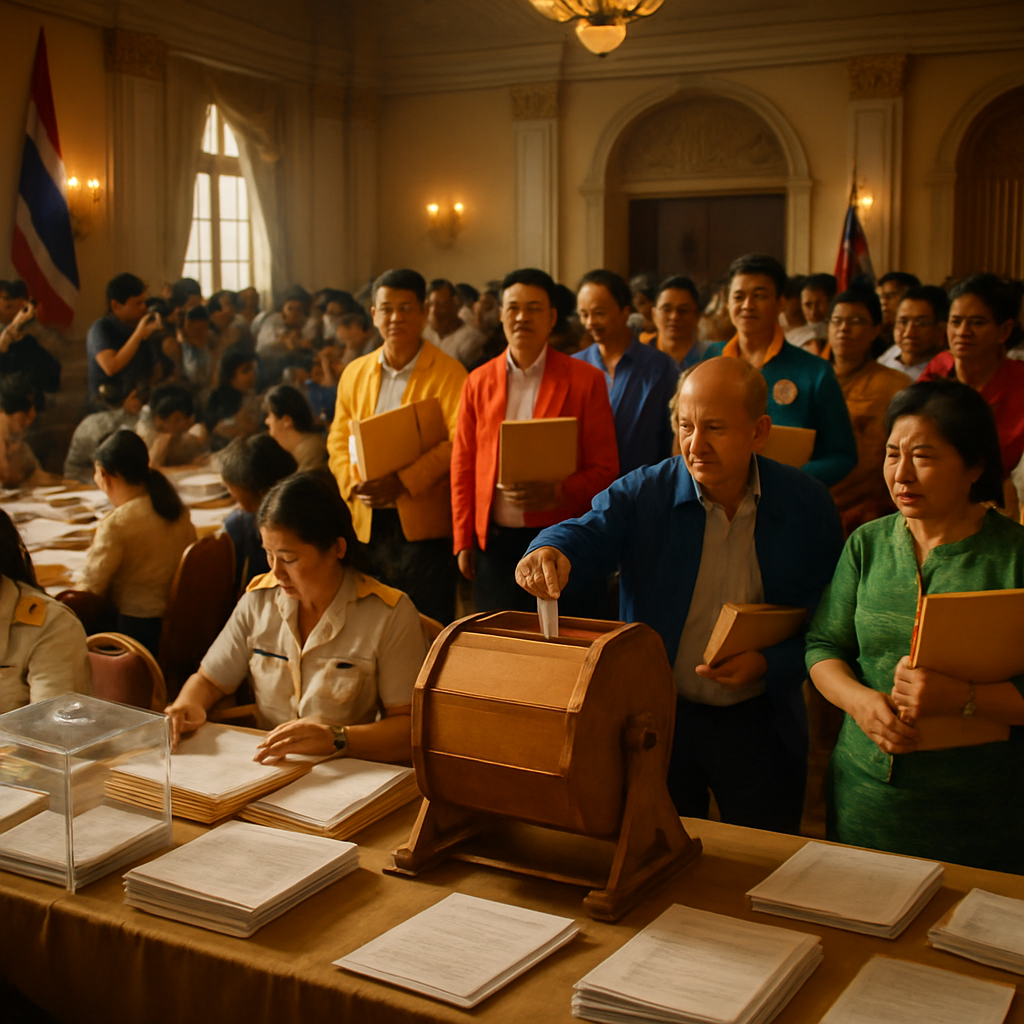
Thailand’s political stage warmed up considerably on a bright Sunday at the Government Complex in Laksi district, Bangkok, as representatives from 52 political parties filed their party-list names and prime ministerial nominees with the Election Commission. The registration was held under the watchful eyes of election officials at the Centara Life Government Complex Hotel, where the atmosphere mixed the businesslike precision of officialdom with the low hum of campaign season anticipation.
That tally of 52 parties is notable — an increase from the 47 that contested the 2023 general election — and it signals one thing clearly: competition has sharpened. More parties mean more voices, more policy debates and a busier ballot paper. Party delegates were asked to draw numbered lots to determine their position on the party-list ballot — a small ritual with outsized practical importance, since a higher or lower placement can affect how easily voters spot a party amid the crowded choices.
Caretaker Prime Minister Anutin Charnvirakul, who also leads the Bhumjaithai Party, showed up in person to record his party’s entries. Bhumjaithai registered two nominees for prime minister — Anutin himself and Foreign Minister Sihasak Phuangketkeow — a move that underscores the party’s flexible approach to leadership options this cycle. Anutin told reporters Bhumjaithai has been gearing up for the election since June and professed confidence about its readiness, while making a clear pledge on a sensitive issue: the party will not pursue amendments to Section 112, Thailand’s lese majeste law.
The law has been a flashpoint in recent years, and the refusal to reopen that debate is an attempt by Bhumjaithai to stake out a steady, non-confrontational position before campaigning intensifies. That stance is likely calculated to appeal to more conservative voters and to avoid reigniting divisive debate during an already fractious campaign season.
Not everyone agreed on the best way to handle Section 112. Natthaphong Ruengpanyawut, head of the People’s Party, urged political rivals not to weaponize the law during campaigning, warning that it could deepen political rifts rather than resolve them. The People’s Party is in an interesting transitional moment: it has absorbed several former Move Forward Party lawmakers after Move Forward was dissolved on the grounds that its campaign position on Section 112 posed risks to the constitutional monarchy. Where Move Forward had previously fielded a single prime ministerial nominee — which later contributed to complications when that candidate was disqualified — the People’s Party opted for a broader strategy, nominating three prime ministerial candidates to hedge its bets and sharpen its bargaining power.
Despite a recent history that saw People’s Party figures backing Anutin during post-election negotiations after the collapse of the Pheu Thai-led government, Natthaphong was unequivocal this weekend: People’s Party MPs will not support any prime ministerial candidate from the Bhumjaithai Party in the upcoming parliamentary vote. That illustrates the fluidity of alliances and the strategic repositioning happening behind the scenes as parties prepare for the February 8, 2026 general election.
Meanwhile, registration for constituency MP candidates got underway the day before and runs through December 31. Election authorities reported that 3,092 hopefuls registered on the very first day, a number that speaks to the popular enthusiasm — and perhaps the career opportunism — that surrounds parliamentary contests. Under Thailand’s current system, the next House of Representatives will be composed of 500 members: 400 constituency MPs elected directly by voters and 100 party-list MPs allocated proportionally. That mix ensures that both local campaigning and national party platforms matter deeply in determining the final political arithmetic.
Election officials say logistical preparations remain on schedule, even as political maneuvering grows more intense. The uptick in participating parties, the strategic nomination choices, and the high volume of constituency registrations together suggest the 2026 vote will be among the most competitive Thailand has seen in recent memory.
In practical terms, the coming weeks will be a busy choreography of paperwork, policy announcements and alliance-building. For voters and observers alike, the next acts of this drama will unfold in televised debates, campaign rallies and, eventually, in the voting booths. Whether the increased party count translates into clearer choices for the electorate or simply a louder cacophony of competing promises is a question only the ballot will answer.
For now, the Centara Life ballroom’s ritual of numbered lots, the careful signings at the Election Commission desk and the officials’ steady assurances that the machinery is ready are all reminders that democracy, in Thailand as elsewhere, is a mix of formal procedures and high-stakes human ambition. Source: Bangkok Post.














Fifty-two parties? That sounds like chaos, not choice. Voters will be overwhelmed and the ballot will be a mess.
More parties can mean more representation; better than a two-party chokehold. Complexity is the price of pluralism.
Pluralism is fine until it lets small deals and horse-trading run the country. Thailand needs workable coalitions, not endless bargaining.
I get the theory, but in practice it feels like strategic fragmentation. People won’t know who stands for what.
Ballot visibility matters a ton for farmers like me. If my party is lost in a sea of names, turnout and local issues suffer.
An increase from 47 to 52 parties shows civic energy, not decline. Parties are experimenting with platforms and will force debates.
Experimentation is great unless it allows opportunists to hop into office with vague promises. We’ve seen that before.
From a political science view, more parties increase coalition complexity and may produce unstable governments unless electoral rules adapt.
True, but instability can be a transitional phase toward healthier party competition if voters become more discerning.
Bhumjaithai refusing to touch Section 112 is a cowardly move disguised as stability. Some issues need honest debate.
Calling it cowardice ignores electoral calculus; parties weigh risks. But substantive debate on human rights and law reform is overdue.
Electoral calculus aside, silence on fundamental freedoms is a political choice too, and voters should judge it harshly.
Those numbered lots for ballot position are not trivial. A bad number can sink local candidates even if they work hard.
Ballot order effects are real, studies show it matters. Parties with less funding get doubly disadvantaged.
Exactly, and rural campaigns already struggle with money and media. This system favors big players.
Maybe that encourages parties to work harder on ground campaigns instead of buying billboards. Or maybe it just punishes small voices.
Anutin’s dual nomination makes sense — pragmatic and flexible. He knows how to play coalition chess.
Playing chess is one thing, selling policy to ordinary people is another. Bhumjaithai’s record on bread-and-butter issues is mixed.
Critics forget they championed local subsidies and agricultural bills that helped a lot of voters. Results matter in the end.
Move Forward’s dissolution and the People’s Party strategy show how legal rulings reshape party systems. This cycle is a case study.
Indeed, judicial interventions alter incentives profoundly. Political scientists will study how nomination hedging affects bargaining power.
But hedging with multiple nominees could just create confusing bargaining and backroom deals after the vote.
Agreed, yet in a constrained system parties adapt. The question is whether adaptation preserves democratic accountability.
Why do they have so many parties? Can’t they just pick a few? It’s confusing for kids and grandparents alike.
Because interest groups, personalities, and regional leaders all want representation. It makes elections noisy but more local voices matter.
I get that, but when my ballot looks like a phone book, I just pick the logo I like. Not great for democracy.
3,092 hopefuls on day one screams careerism. Many are in it for the perks, not public service.
Cynical, yes, but some of those candidates are genuine local activists. Net assessment is mixed.
Calling all soon-to-be MPs careerists is unfair. Still, vetting and public scrutiny need to be stronger.
Fair enough, but transparency in candidate backgrounds must improve or the pattern repeats.
Transparency requires civic media and watchdogs. That’s the missing ingredient in many contests.
Official assurances about logistics sound reassuring, but we’ve seen last-minute glitches before. I remain skeptical.
Skepticism keeps officials honest. But many staffers want smooth elections too; it’s not always sabotage, sometimes it’s capacity.
Capacity and funding are key. If they underfund precincts, voter experience will suffer regardless of intent.
People’s Party refusing to back Bhumjaithai shows the volatility of alliances. Promises now may mean nothing after negotiations.
Parties publicly draw red lines for leverage. After votes, practical deals often override pre-election rhetoric.
That’s the problem: rhetoric for voters, deals for power. It erodes trust in the long run.
As a rural voter I care about water, rice prices, and roads. All the party names mean little if promises don’t convert to action.
Electoral design shapes outcomes. With 100 party-list seats, small parties can punch above their weight and distort policy priorities.