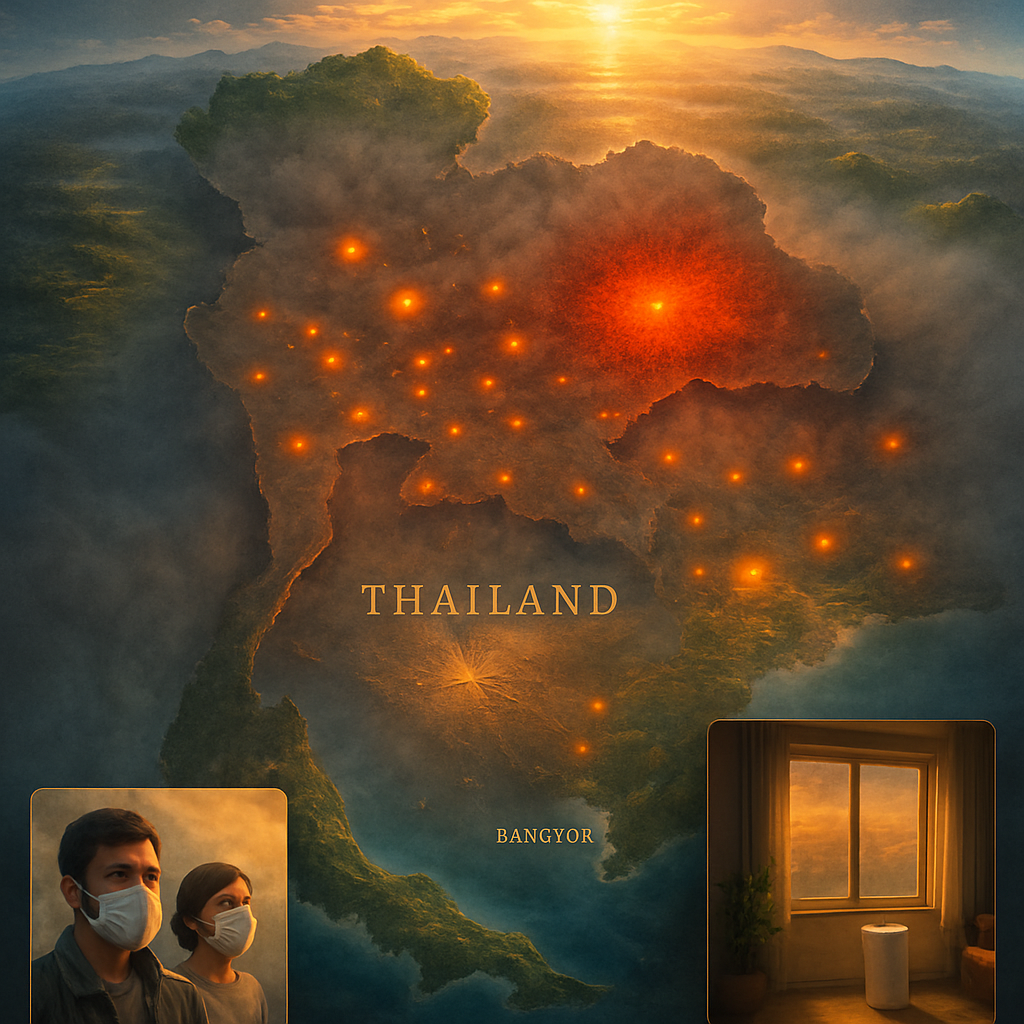
Thailand woke up on Sunday to a hazy panorama — not the kind that inspires poets, but the kind that nudges you to check your air quality app. The Geo-Informatics and Space Technology Development Agency (Gistda) reported at 8 a.m. that 38 provinces, mostly stretching across the Northeast and the Central Plains, were breathing an unhealthy helping of ultrafine dust. PM2.5 readings — those pesky particles 2.5 micrometres or smaller that slip deep into lungs — ranged from 37.6 to 75.6 µg/m³, nudging (and in many cases clearing) past the government’s safety threshold of 37.5 µg/m³.
Hotspot: Maha Sarakham tops the chart
Maha Sarakham took the unwanted crown with a PM2.5 level of 75.6 µg/m³ — a red-alert reading that poses serious health risks rather than just a gloomy view. The rest of the 37 provinces in this group were branded orange, meaning the air isn’t just annoying; it’s potentially hazardous for sensitive groups and warrants caution for everyone.
Provinces with elevated (orange to red) PM2.5
From the highest to the lower end of the orange band, the affected provinces included:
- Maha Sarakham (highest at 75.6 µg/m³)
- Kalasin, Khon Kaen, Sing Buri, Buri Ram, Surin
- Nong Bua Lam Phu, Nong Khai, Udon Thani, Ang Thong, Roi Et
- Chai Nat, Lop Buri, Saraburi, Nakhon Ratchasima, Chaiyaphum
- Suphan Buri, Si Sa Ket, Prachin Buri, Ayutthaya, Samut Songkhram
- Phetchabun, Sa Kaeo, Ubon Ratchathani, Loei, Uthai Thani
- Nakhon Sawan, Samut Sakhon, Nakhon Pathom, Chachoengsao, Chon Buri
- Kanchanaburi, Ratchaburi, Mukdahan, Sakon Nakhon, Phichit, Yasothon, Chanthaburi
Bangkok and a swathe of provinces fared better — but not perfect
In Bangkok and 18 other provinces, air quality was classified as moderate, with PM2.5 readings between 27 and 37.2 µg/m³. That’s better than orange, but not exactly the kind of air to go sprinting through without a second thought. Locations in this band included:
- Nakhon Nayok, Amnat Charoen, Nakhon Phanom, Pathum Thani, Phetchaburi, Trat
- Nonthaburi, Phitsanulok, Bangkok, Rayong, Samut Prakan
- Prachuap Khiri Khan, Kamphaeng Phet, Phuket, Tak, Nan, Krabi, Trang, Uttaradit
Clearer skies in the North and South
Not all corners of Thailand were under a grey veil. Eighteen provinces, mainly up north and down south, reported good air quality with PM2.5 measurements between 16.5 and 24.9 µg/m³. This pleasant list included Satun, Phayao, Phrae, Phangnga, Nakhon Si Thammarat, Bueng Kan, Pattani, Lampang and Lamphun, plus Surat Thani, Sukhothai, Narathiwat, Phatthalung, Yala, Chumphon, Ranong, Chiang Rai and Songkhla.
And for those who relish clean-breathing bragging rights: Mae Hong Son and Chiang Mai posted “very good” air quality at 10.6 µg/m³ and 12.8 µg/m³ respectively — enviably crisp numbers compared with the haze-hit regions.
What this means for you
PM2.5 doesn’t merely blur distant buildings; it can aggravate asthma, irritate eyes and throats, and increase risk for people with heart and lung conditions. When Gistda flags orange or red levels, consider these practical steps:
- Limit strenuous outdoor exercise — save that jog for clearer days.
- Use a high-quality mask (N95/FFP2) if you must be outside for extended periods.
- Keep windows closed and use air purifiers where possible.
- Check local air quality updates frequently — levels can change rapidly with wind and weather.
Why did this happen?
Thailand’s seasonal shifts, agricultural burning, traffic emissions and stagnant weather patterns all conspire to turn clean skies into hazy ones. The northeast and central plains are particularly vulnerable during temperature inversions and low wind periods that trap pollutants near the surface.
Gistda’s early-morning reading offers a snapshot — but remember: air quality is dynamic. If you live in or plan to travel through the affected provinces, make decisions based on the latest updates and take simple precautions to protect your lungs. After all, the best travel souvenir is a good memory — not a cough that stays with you for weeks.
Source: Gistda observations, as reported to local outlets and air-quality monitors.











Gistda posted the early-morning readings and 38 provinces showed elevated PM2.5 this snapshot. We’ll update the thread when new hourly maps or source reports come out.
This is ridiculous and predictable every year. The government should stop open burning now before more people get sick.
These PM2.5 levels are clinically significant and will increase cardiorespiratory events. Short-term advisories are necessary, but long-term emissions policy is urgent. Masks and purifiers help but are not a substitute for systemic reductions.
As a farmer I can tell you burning is the only quick way to clear fields after harvest. We have no subsidies or equipment to change practice. Blaming farmers ignores industry and traffic emissions.
I get that, but burning wrecks health and tourism too which hurts local economies. Could community machines or staggered burning be funded instead of blanketfires? The government must act or people will suffer.
Government promised machines before and nothing came. We can’t stop if our crops rot and bills pile up.
I checked the app and my kid has a cough since morning. Should I keep them home from school today?
Schools often follow local health advisories and may restrict outdoor activities at orange or red levels. Consider a well fitted N95 for short trips and keep outdoor play limited until readings improve. We will post updates when Gistda releases new hourly maps.
Air quality sensors are rigged to scare people and push overpriced masks. This smells like fearmongering to me.
The sensors are calibrated by scientists and cross-checked across stations and satellites. There is a large body of peer-reviewed evidence linking PM2.5 to morbidity. Denying that is both dangerous and irresponsible.
Bangkok looks better but still hazy sometimes and I can taste the smog when I run along the river.
Same here, my asthma flared last week after a morning run. I now only run indoors with a purifier and wear an N95 when necessary. Officials must limit traffic emissions too.
Indoors helps but purifiers are expensive for many families. The city should subsidize them for vulnerable households.
Temperature inversions are the main meteorological mechanism here, trapping emissions near the surface and causing spatially extensive PM2.5 episodes. Remote sensing from Gistda gives useful early-morning snapshots but diurnal variation can be large. I would like to see hourly data and source apportionment to quantify contributions from biomass burning versus vehicular exhaust. Policy responses need targeted controls informed by such analyses.
Sounds fancy but governments never act on these reports. Data gets buried under economic excuses.
Scientific evidence can be communicated in actionable terms if advocacy groups pressure policymakers. Transparent modeling and clear timelines help make the case. We should push for funded, peer-reviewed inventories.
I had a tour booked to Ubon and now I’m worried about the health risk. Do hotels care about this or just make money?
Many hotels post air quality advice and sell masks, but few have proper HEPA purifiers in rooms. If you are sensitive, choose places that advertise filtration and check recent readings before booking. A short trip can still be fine if you plan indoor activities on bad days.
Public hospitals are preparing for a rise in respiratory cases during haze episodes. We advise people with COPD, heart disease and young children to avoid prolonged outdoor exposure. The health ministry is coordinating with provincial authorities for targeted outreach.
Outreach is good but don’t scapegoat farmers for system failures. We need technical and financial support to adopt stubble management instead of burning. Otherwise health warnings feel like blame without help.
Why pay attention to pixels on a screen? I lived through worse and nothing happened. Maybe we’re all just too soft now.
That’s reckless thinking and ignores long-term harm. Chronic exposure is invisible but it damages people slowly.
Do N95 masks really help against PM2.5 or is that a scam? I don’t want to waste money on something useless.
High-quality N95 or FFP2 masks filter most PM2.5 when worn properly and sealed to the face. Cloth masks reduce large droplets but are much less effective for fine particulates. Fit and correct usage are crucial for protection.
Chiang Mai is breathing easy today and we feel lucky. But it is weird to brag while neighbors suffer.
Mae Hong Son was even better and quiet this morning. We should share tips on local practices that protect air quality.
Ban open burning during critical seasons and invest in green alternatives immediately. This requires political will and reallocation of agricultural subsidies to avoid punishing smallholders. Health is not optional and economic arguments that ignore human cost are immoral.
A ban without viable alternatives will punish smallholders and raise food costs. Invest in mechanization, composting programs and crop insurance first. Dialogue, not blanket bans, will work better.
Agreed on the need for support measures, but delaying bans prolongs health impacts. Conditional, time-limited bans with funded transitions can protect both health and livelihoods. We need accountability and clear timelines.
Why is Maha Sarakham the worst every year, is there a local industry causing this or just crops? Someone should investigate.
Gistda data points to seasonal agricultural burning and stagnant weather as main drivers in Maha Sarakham for this episode. Local agencies are expected to provide detailed source reports and we will share findings when available.
I can’t play soccer because the air is yucky.
I’m sorry, that must be disappointing for you. Maybe try indoor ball games for now and wear a mask if you go out.
PM2.5 at 75.6 µg/m3 corresponds to an AQI in the very unhealthy range with statistically significant increases in ER visits. Short-term exposure exacerbates bronchoconstriction and can precipitate myocardial infarction in vulnerable adults. Population-level interventions like emission inventories and targeted reductions have measurable benefits within a few years. Individual measures are stopgaps while systemic change is pursued.