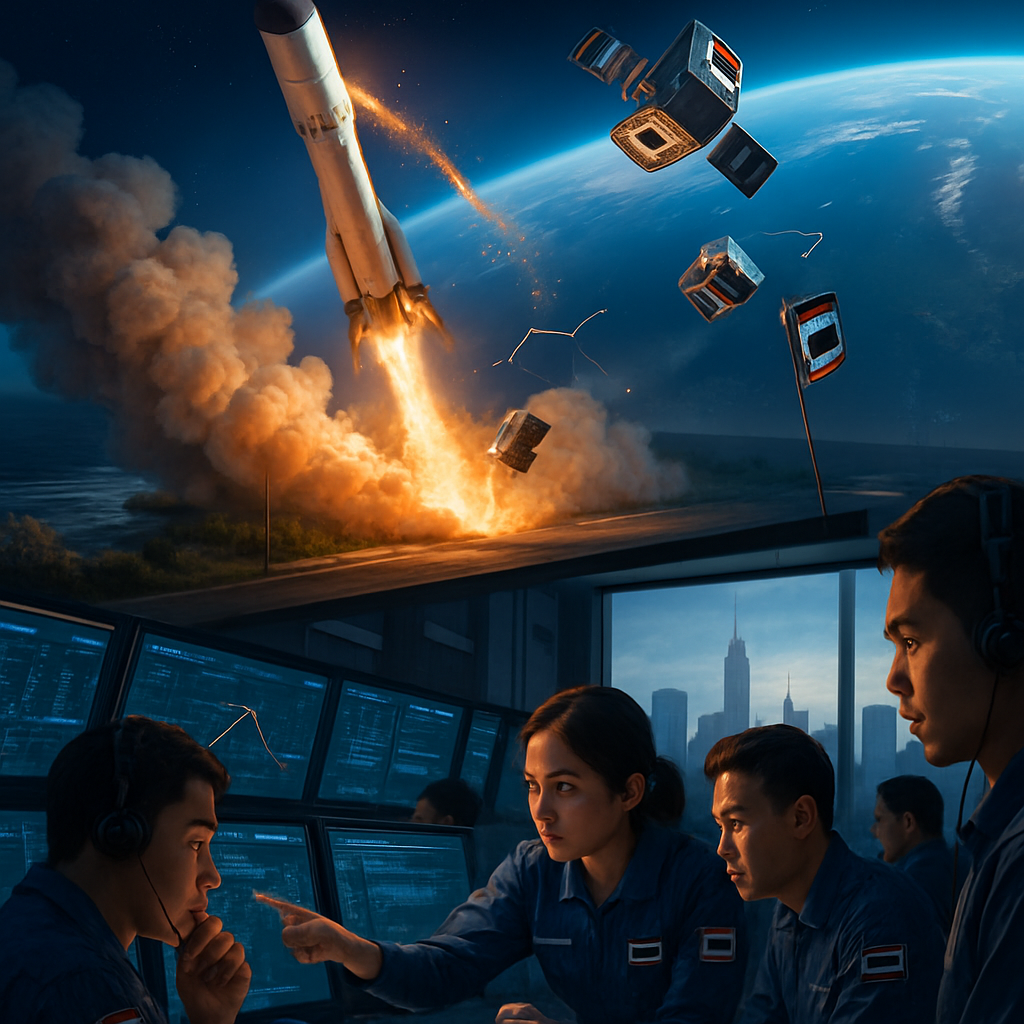
On January 12, Thailand’s push into the stars hit an abrupt and very public speed bump: the high-resolution Earth observation satellite THEOS-2A failed to reach orbit after a malfunction aboard India’s PSLV-C62 rocket. The launch, from the storied Satish Dhawan Space Centre at Sriharikota, lifted off at 11:47 a.m. Thai time — and roughly 380 seconds later an anomaly during the rocket’s third stage sent the mission off-course.
What went wrong — the short version
According to mission briefings, a disturbance in the rocket’s roll rate during the third stage caused PSLV-C62 to deviate from its planned trajectory. That wobble was enough to prevent THEOS-2A and the other satellites aboard from attaining the precise velocity and path needed to remain in orbit. In plain terms: the rocket didn’t follow the roadmap, so the passengers never reached their destination.
Who’s investigating?
The Thai Geo‑Informatics and Space Technology Development Agency (GISTDA), which led THEOS-2A’s development, confirmed the failure during its live broadcast and immediately began working with India’s space agency, ISRO. ISRO said it is collecting and analysing telemetry and flight data to isolate the cause. Collaboration between the two agencies is underway, and both have emphasised that such complex missions sometimes encounter setbacks — and that the hard work now is in understanding exactly what happened.
Why this mattered for Thailand
THEOS-2A was more than a single satellite; it was a concrete step in Thailand’s plan to build sovereign space capabilities. Designed in collaboration with Surrey Satellite Technology Ltd. (a UK-based subsidiary of Airbus), the craft was intended to provide high-resolution imagery to support urban planning, disaster response, agriculture monitoring and environmental management. More than 20 Thai engineers were directly involved in the payload and structure, a deliberate investment in homegrown expertise and a push to move Thailand further along the international space value chain.
What could have happened to the satellite?
When a rocket strays from its path late in ascent, outcomes range from being placed in a wrong — and possibly useful — orbit, to insufficient velocity to remain in space, causing re-entry and destruction. Until ISRO and GISTDA finish their joint analysis, the exact fate of THEOS-2A remains unresolved. Officials warned that the anomaly could have led to the satellite entering an incorrect orbit or failing to overcome gravity, both scenarios that would render the mission unsuccessful.
A step back, not the end of the journey
GISTDA framed the incident not as a final defeat but as part of the learning curve in a challenging field. The agency reiterated Thailand’s commitment to its space ambitions and confirmed plans to push forward with future missions, including THEOS-3. In the world of rocketry, progress has historically been punctuated by both spectacular successes and memorable failures — each one teaching engineers a little more about how to tame the physics of launch, staging and orbital insertion.
Big picture: collaboration, capacity and the long game
Beyond the immediate disappointment, THEOS-2A represented a wider strategy: to grow Thailand’s role in satellite design, manufacturing and application. Involving local manufacturers and Thai engineers in a project developed with international partners was a deliberate choice to transfer knowledge and build an industrial base that can support future missions.
Space programmes inevitably mix national ambition with international partnerships. Launching from Sriharikota aboard India’s reliable PSLV platform was itself a vote of confidence in regional cooperation. Now, that partnership will be tested in analysis rooms rather than launch pads, as India and Thailand examine telemetry, reconstruct the anomaly and plan how to move forward.
How the public saw it
The live broadcast of the mission made the failure visible in real time — raw and unfiltered — and the reaction was a mix of disappointment, support and curiosity. For many Thais, THEOS-2A was symbolic of a bold technological push; its loss may sting, but the narrative GISTDA wants to reinforce is resilience. Space progress is iterative, and public expectations are being guided toward patience and persistence.
What happens next?
- ISRO and GISTDA will continue analysing flight data to identify root causes.
- Findings will inform next steps: whether a replacement satellite is needed, redesigns are required, or procedural changes must be made.
- Thailand’s longer-term projects, such as THEOS-3, remain on the agency’s roadmap, albeit under the fresh lessons learned from this mission.
In short: the PSLV-C62 mission didn’t deliver its payload into orbit this time, but it has already delivered something else — a stack of data, hard-won experience, and a renewed collaboration between ISRO and GISTDA. If history is any indicator, the engineers will take that information, tune the systems and come back with better-tested hardware. Thailand’s space ambitions are unfinished, and for now they’re simply experiencing a delay, not a derailment.


















Be First to Comment