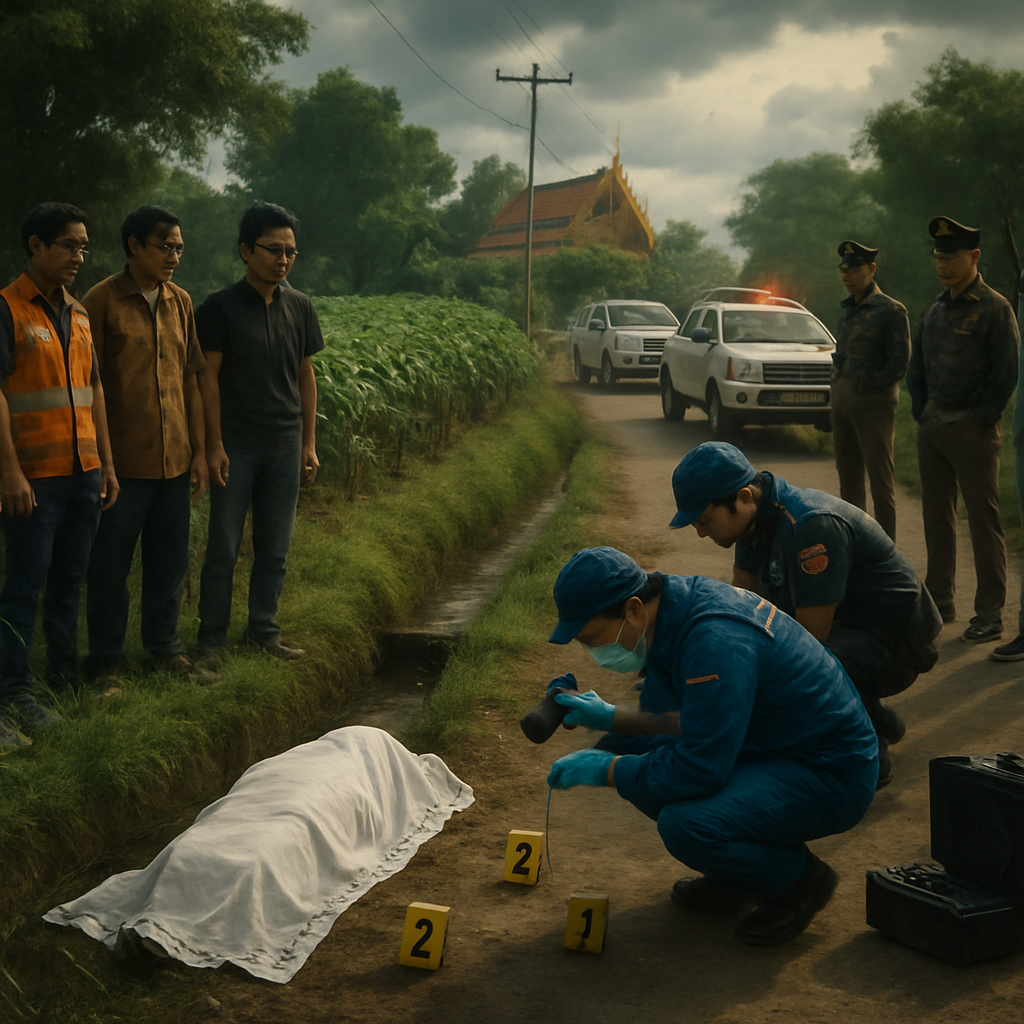
On a quiet Monday afternoon in Chon Buri province, an unsettling discovery punctured the stillness of rural Bang Lamung district. Around 12:30 p.m. on January 19, a man’s lifeless body was found in a roadside drainage ditch near Wat Phrom Phra Pha Nimit, along Thung Klom–Huai Yai Road in Moo 5. The scene—sandwiched between a country lane and a cassava plantation—looked ordinary at first glance. Up close, it told a story that left investigators and locals seeking answers.
Responding to the report, officers from Huai Yai Police Station arrived alongside forensic specialists from Region 2 in Chon Buri, medical staff, and rescue volunteers from the Sawang Boriboon Foundation. The landowner of the nearby plantation, who had been checking his fields, was the one to make the grim discovery and immediately raised the alarm.
The deceased was found lying face-up in a drainage channel, wearing only dark blue underwear. Forensic teams estimate the man was between 40 and 45 years old; his skin was described as dark and his nationality has not been confirmed. No identification was located on the body, and despite inquiries, local residents told officers they did not recognise him or recall seeing him in the area.
Forensics and first impressions
Initial forensic assessment provided a mixture of clarity and mystery. There were no obvious signs of external trauma or violence—no visible wounds that screamed foul play. What investigators did note were bite marks, primarily around the left shoulder, which are believed to have been inflicted post-mortem by animals. Based on the body’s condition, officials estimated the time of death to be roughly 48 hours before discovery.
To remove doubt and establish a definitive cause, the remains were transported to the Institute of Forensic Medicine at the Police General Hospital in Bangkok for a full autopsy. That deeper examination will be pivotal: toxicology, internal examinations and other forensic tests could confirm whether the death was natural, accidental, or the result of criminal activity.
Investigators keep all possibilities open
Police investigators have not closed any doors. In public statements, they emphasised that every avenue remains under consideration—natural causes, an accidental death, or foul play. Until lab results and autopsy findings arrive, the case remains open-ended. Detectives are also exploring the man’s background, reaching out to nearby communities and scanning missing-person reports, while hoping someone will come forward with identifying information.
In cases like this, small details can be pivotal: the pattern of any bruising or marks, the contents of the man’s stomach, clothing traces, and even the soil or plant matter on his body. Each leads forensic teams down different investigative trails.
Local reaction and broader context
The discovery has stirred a mix of curiosity and concern among residents in Moo 5 and surrounding areas. A rural community is not accustomed to anonymous deaths in ditches, and the sight of authorities at the roadside brought both unease and a reminder of how quickly ordinary places can become scenes of tragedy.
Authorities note this incident is not isolated in provincial Thailand. In a similar but distinct case last June, police in Phuket examined the death of an unidentified man found hanging from a mangosteen tree beside a small plantation in Kamala. While different in circumstance, both episodes underscore challenges investigators face when a body cannot immediately be identified: the race to determine identity, cause of death, and whether the public is at risk.
What happens next?
The next steps hinge on forensic results. Autopsy and lab work will either steer the investigation toward criminal inquiry or clear the scene of suspicion, each outcome reshaping how police pursue leads. If foul play is suspected, detectives will canvass more widely, comb through CCTV footage from nearby areas, and coordinate with regional law enforcement networks to track missing-person reports across provinces and borders.
Meanwhile, investigators are asking anyone with information—even the smallest observation from the days before January 19—to contact Huai Yai Police Station. A name, a vehicle description, or a recollection of a stranger in the neighborhood could provide the key to unlocking this mystery.
As forensic teams work in Bangkok and officers follow up locally, the man’s identity and the truth about his final hours remain suspended between science and witness statements. For the landowner who first spotted him and the volunteers who aided at the scene, the hope is simple: that answers come quickly, and that a family—if any is searching—will finally know what happened to their missing loved one.
Authorities have appealed to the public for help, and the community waits—watchful and expectant—until the forensics bring clarity to a quiet roadside tragedy.

















I was out checking the cassava when I found him and called the police right away, it was awful to see a body like that in the ditch.
Why do these cases always turn up near plantations — human trafficking or migrant labor gone wrong maybe? The police won’t tell us everything.
That’s scary, but what if it was just a lonely guy who got sick and no one found him? We shouldn’t jump to the worst.
Jumping to trafficking without evidence risks xenophobia; forensic results like toxicology and internal exams will clarify whether this was natural, accidental, or criminal.
I agree we shouldn’t assume, but seeing bite marks and no ID made me worry about the worst and I told officers everything I noticed.
Animals will scavenge anything left near fields, I’ve seen carcasses picked apart by dogs and wild pigs before.
So the animals ate him? That’s sad, I didn’t know animals did that to people.
We cannot conclude scavenging caused death until autopsy; bite marks can occur post-mortem and will be noted separately in the report.
Thanks for explaining, officer, some folks around here don’t trust police but I appreciate the clarity.
Forensic timelines based on decomposition are imprecise in tropical climates due to temperature and scavengers; investigators should run entomology alongside toxicology.
Is entomology even reliable? Maybe the whole thing’s staged to cover up a crime by someone powerful in the province.
Entomological evidence is well-established and can narrow time of death windows; making unfounded accusations without data undermines legitimate concerns.
Can someone explain what entomology means in simple terms? I’m not into science but I’m curious.
The quick removal and transport to Bangkok smells like the cops trying to hide something; why not do tests locally and keep the evidence here?
They likely sent the body to Bangkok because the institute there has better facilities and specialists, not necessarily to hide anything.
Please stop with the conspiracy talk, regional forensic labs are limited and centralizing complex tests is standard practice.
I hear you, but this province has problems with transparency and people are worried — I’m just asking questions aloud.
My cousin has been missing for weeks and seeing this makes me fear the worst; how will we know if this is him without DNA?
I’m so sorry, Mae, they should take fingerprints or DNA and share with missing persons databases so families can check quickly.
If possible, get photos and a recent dental record to give investigators; CCTV from nearby roads could also help track the man’s last movements.
Thanks for the tips, Alex and Rina, I’ll push the family to give anything they have to the police and follow up every day.
Could this be related to cross-border migration? People travel and work quietly in fields and sometimes authorities miss records.
Don’t assume foreign workers are guilty or disposable; we need facts and humane treatment while investigations proceed.
I didn’t mean to blame anyone, I just think investigators should check regional missing person reports and border crossings as they said.
Media will make this into a sensational story about monsters and corruption; please let facts come out before panic spreads.
Sensationalism sells but it also can pressure authorities to act faster; there’s a trade-off between accuracy and urgency.
Fair point, K. Som, but pressure should be constructive and not lead to misinformation about migrants or police.
We are following all leads and ask anyone with even small details to contact Huai Yai Police Station; community tips are crucial.
You say that every time, officer, but sometimes it takes weeks to follow up — the public wants timely updates and transparency.
I understand frustration, Saan; we try to balance investigation integrity with public communication and will post updates when appropriate.
As someone who visits Chon Buri often, these stories worry tourists and could hurt local businesses unless authorities reassure the public.
Local businesses rely on trust and safety, but scaring away visitors over one incident might be unfair; focus on solving the case instead of boycotting.
You’re right, Chanthira, I just hope the investigation is swift so people don’t jump to conclusions and damage livelihoods.