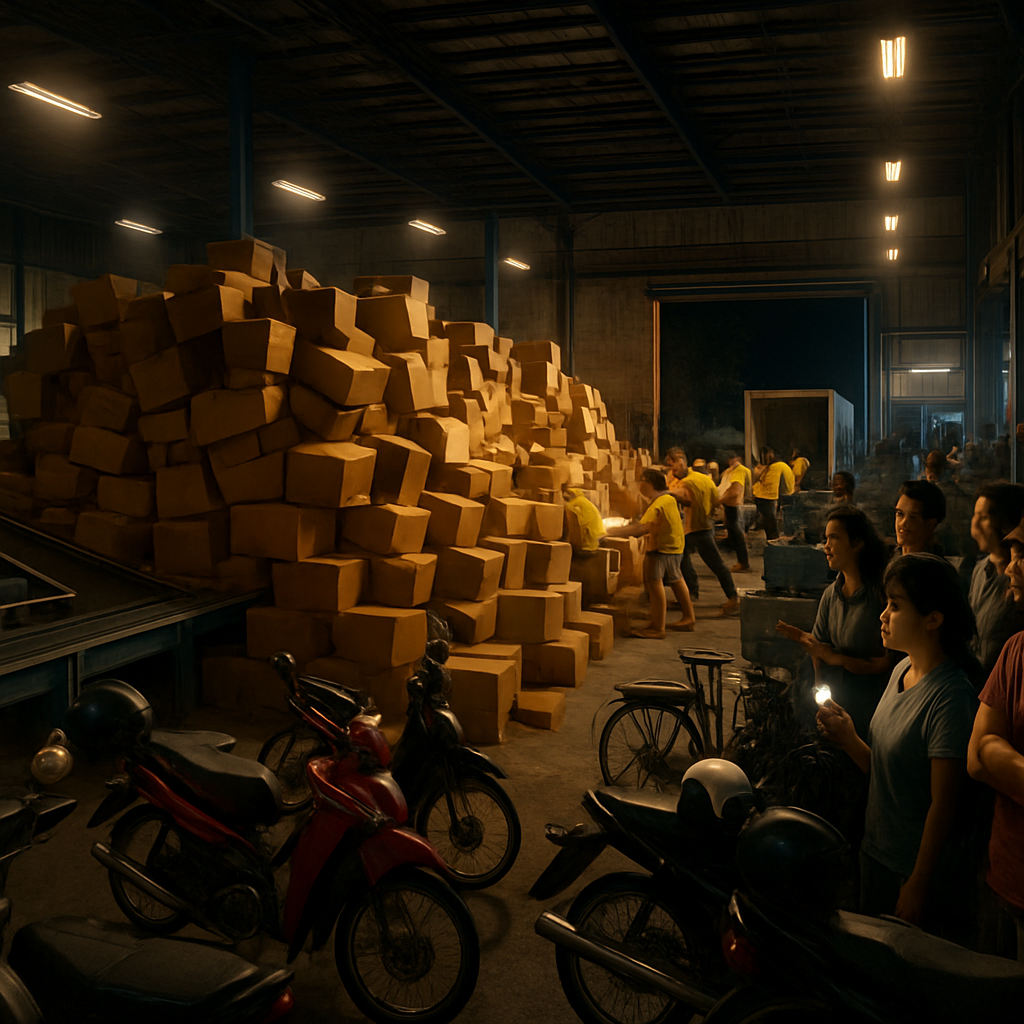
Chaos quietly stacked itself into neat cardboard piles inside a Yala warehouse on December 28, as tens of thousands of parcels sat waiting — some for days, others for an unknown stretch — while frustrated customers, reporters and local officials scrambled for answers. What began as delivery delays rapidly ballooned into a full-blown logistics crisis after a sudden mass resignation of delivery drivers and sorting staff effectively ground operations to a halt at a major shipping company’s regional hub.
Inside the backlog: a warehouse full of questions
Reporters who toured the facility found corridors of boxes crammed into sorting bays and storage areas, a visible sign that last-mile delivery had become last-mile limbo. With far too few hands left to process incoming shipments, the inflow of packages quickly outpaced any ability to move them onward. Customers told of missed delivery dates, tracking updates that froze mid-transit, and phone lines that went unanswered — or worse, looped back to generic promises of “we’re working on it.” Some consumers, tired of automated replies, drove to the warehouse themselves hoping to reclaim purchases that had vanished into the stacks.
What went wrong: the human factor
Sources inside the company and local residents attributed the meltdown to a sudden wave of resignations among delivery riders and sorting personnel. Whether driven by pay, working conditions, scheduling or a mix of grievances, the exodus exposed a hard truth about modern logistics: even the slickest systems still depend on people. When manpower evaporates, technology and conveyor belts can only do so much. With the essential human cogs gone, parcel sorting slowed to a crawl and last-mile delivery was pushed to the brink.
Public reaction and mounting pressure
Online, the incident lit up social media. Angry customers demanded transparency and compensation; critics pointed fingers at the company’s labor practices and emergency planning. Locally, officials said they were monitoring the situation closely. The scale of the backlog — measured not just in boxes but in household inconvenience, missed gifts and stalled small-business sales — elevated the problem from a corporate hiccup to a community concern.
What authorities and the company are considering
Behind the scenes, multiple emergency options are being explored. Reported measures under discussion include temporary staffing support (possibly through third-party providers), redistributing parcels to nearby hubs to balance workloads, and internal management reviews to identify bottlenecks and restore normal flow. The shipping company has not released a full public accounting of the incident but has said it is working to resolve the backlog “as quickly as possible.”
Why this matters beyond Yala
The Yala warehouse stoppage is more than a local news item — it’s a reminder of how fragile the modern supply chain can be when labor becomes the weak link. Online shopping has woven parcel delivery into daily life; consumers expect speed and predictability. When that expectation breaks down, the ripple effects touch small businesses that depend on reliable couriers, families waiting on crucial items, and the public trust in logistics brands. The incident underscores the need for contingency plans that go beyond algorithms: cross-training, scalable staffing agreements, and transparent customer communication protocols.
What customers want — and deserve
At the top of the public’s list are clear information, fair compensation for delays, and assurances that deliveries will resume without further disruption. People don’t just want their packages; they want to know what happened, why it happened, and how similar breakdowns will be prevented in the future. For many, the absence of timely updates has been as frustrating as the delay itself.
How this could be fixed — quickly and sustainably
- Short-term: mobilize temporary staff, re-route shipments to nearby hubs, and open a dedicated customer service channel with real-time updates.
- Medium-term: audit working conditions and workforce policies to address retention issues, and negotiate contingency staffing agreements.
- Long-term: diversify last-mile options (community lockers, pickup points, local micro-hubs) to reduce dependence on a single facility or workforce pool.
For now, Yala residents, affected customers and national observers are watching closely to see how fast the backlog can be cleared and whether the company transforms this setback into an opportunity for stronger operations. If handled transparently and decisively, the incident could prompt much-needed reforms across the industry. If ignored, it risks eroding consumer confidence just as deliveries become ever more central to daily life.
Whatever the outcome, December’s pile-up in Yala is a practical lesson: even in an age of slick tracking apps and overnight promises, the human element remains the backbone of logistics. When that backbone falters, the aftermath stacks up — cardboard tower by cardboard tower — until someone takes responsibility to sort it out.


















I reported from inside the Yala warehouse and saw corridors full of boxes and almost no staff to move them. This wasn’t a temporary hiccup — it looked like the entire last-mile operation had collapsed overnight. I’m posting updates as I learn more and want to hear what residents and workers experienced.
This is crazy, I needed a birthday present and it never showed up. Why would drivers all quit at once? Someone should explain simply so we understand.
The article highlights a systemic fragility: automation and optimization can improve throughput, but they cannot replace frontline labor resilience. A sudden labor withdrawal exposes supply chains to nonlinear risks that planners often underestimate. Policy responses should balance contingency staffing with worker protections to prevent recurrence.
Quick follow-up: a few small-business owners I spoke with lost same-day holiday sales, which could mean real losses not just annoyed customers. I’m trying to get comment from company HR and will share what they say.
Seems like lazy workers to me; if they can’t handle the job they should be replaced. Companies shouldn’t be held hostage by a few employees. If delivery is so essential then hire people who want to work.
Blaming workers is a cheap take and ignores how these places operate. Low pay, extreme schedules, and zero respect cause turnover — that’s not ‘laziness.’ If companies treated human beings like replaceable parts, mass resignations are entirely predictable.
I drove to the warehouse and saw elderly people asking staff about medicine parcels. This isn’t only about shopping, it’s about basic needs being delayed. Someone should be held accountable now.
Small businesses pay premium fees to get deliveries on time and now their reputations take a hit. Yala’s crisis is a warning: centralized hubs create single points of failure. Decentralize or pay the human workforce better.
My online store lost three orders this weekend because customers canceled when their packages never arrived. Customers don’t care about logistics excuses — they just want results. This will push some shoppers back to physical stores and local couriers.
As a former supply-chain analyst I worry that companies underestimate human factors in stress scenarios. Algorithms assume steady-state; resignations create nonstationary shocks that require flexible staffing protocols. Implementing cross-training and local pickup options would reduce risk quickly.
Also consider that third-party temp agencies often charge more and provide worse conditions. If Yala brings in temps without addressing root causes, the problem will return. Temporary fixes look good on press releases but do nothing for long-term stability.
This is exactly why I stopped using big couriers and switched to local pickup lockers. It’s not perfect but at least I can plan. Corporations never seem to learn until customers punish them.
Lockers are a band-aid for systemic issues; they shift costs to shoppers and local partners. The company should be fined for lack of transparency and forced to provide refunds for delayed deliveries. Regulation needs to catch up with e-commerce realities.
I agree with the fine idea but regulators move slowly. In the meantime, why can’t the city deploy temporary workforce support like they do for festivals? Emergency labor pooling would help fast.
Regulatory intervention can be effective but needs to be targeted: mandating minimum contingency planning, not just punitive fines, could improve resilience. Incentives for multi-hub distribution and community pickup points would reduce single-site dependency.
The company statement was vague and tone-deaf when I called. They offered generic ‘we’re working on it’ lines with no timeline. If leadership doesn’t show urgency, trust evaporates quickly.
Transparency matters more in crises because it shapes stakeholder responses. Clear incident timelines and compensation policies can reduce social backlash and legal exposure. Silence or obfuscation often increases reputational damage exponentially.
Also don’t forget the environmental cost; stuck shipments eventually mean more re-delivery attempts and wasted miles. Poor labor practices and inefficiencies both cost the planet and consumers.
People screaming ‘unionize’ in comments doesn’t solve immediate backlog. That said, organized labor might prevent sudden mass exits in future by giving workers a voice. It’s a trade-off with potential long-term stability.
I think legal action from affected consumers could push the company to act faster. Class-action threats often get corporate attention more than polite PR statements. Money talks.
Some of us depend on timely deliveries for medical supplies, not just gifts. If a delivery company threatens health or safety, authorities need to step in immediately. This is beyond business inconvenience.
In Europe many cities use micro-hubs and cargo bikes to handle last-mile deliveries, reducing dependence on giant warehouses. Yala should study those models instead of relying on a single massive sorting center. It would be cheaper in the long run.
Why is no one asking about recruitment and onboarding practices? Hiring more people won’t help if they aren’t trained. Cross-training, proper induction, and decent shifts matter as much as pay.
A friend who worked there said management dismissed concerns about safety and overtime. If true, that explains the resignations. People leave when they feel disposable.
Local officials were at the warehouse this morning but I saw no visible action besides taking photos. Political theater won’t clear boxes. Citizens need real plans and timelines, not press ops.
If Yala redistributes parcels to nearby hubs they still need drivers to complete deliveries. The bottleneck is last-mile labor, not just sorting space. Community lockers and scheduled pickups should be prioritized now.
I work in logistics tech and can confirm that many systems freeze when real-world exceptions spike. Companies should invest in exception workflows, not just route optimization. Human-in-the-loop systems are cheaper than mass refunds.
One more thing: customers demanding refunds and compensation will strain the company’s finances short-term, but ignoring worker demands will make the problem worse. It needs a balanced approach that includes workers at the table.
You can debate policy all you want but my family’s infant formula was delayed and that matters now. Public safety and basic necessities should be prioritized over PR. This becomes criminal if lives are endangered.
If companies are going to promise next-day delivery they should have to guarantee it or pay for damages. Simple as that. Otherwise stop advertising impossible timelines.