Andaman waste crisis: Democrats press Interior
Democrats name Phuket, Phang Nga, Krabi and Trang as Andaman tourism provinces drowning in landfill backlogs, and tell Interior to treat the stench as a national job.
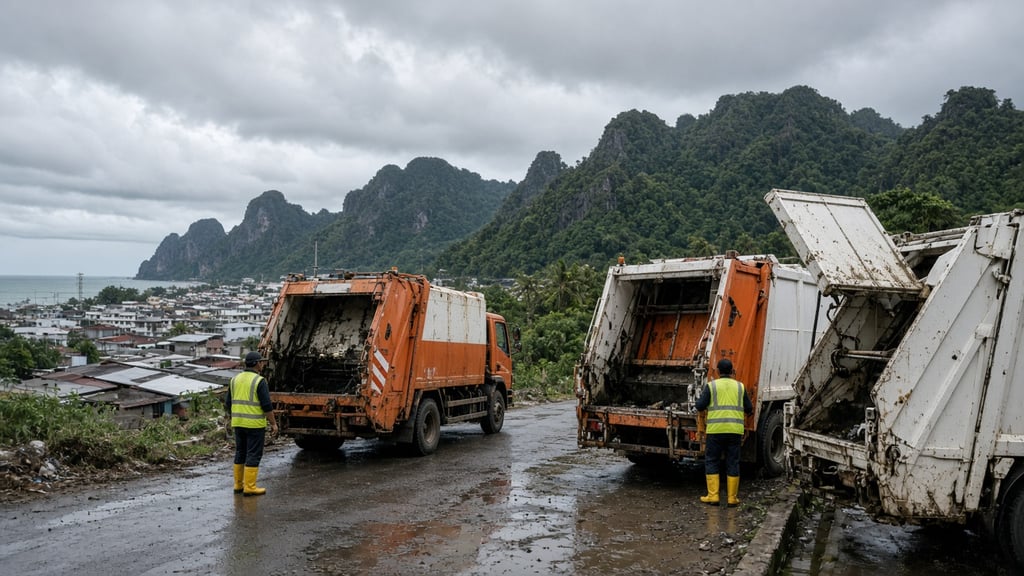
Democrat Party deputy spokesperson Duangruthai Buakaew used a 29 November briefing in Bangkok to press the Interior Ministry to treat overflowing southern landfills as a national job, not a nuisance that provincial waste boards can talk to death. She named four Andaman tourism provinces already living with the pile: Phuket, Phang Nga, Krabi, and Trang.
Phuket is Thailand's largest island, tied to Phang Nga by the Sarasin Bridge, with Krabi across Phang Nga Bay. Tourism replaced tin and rubber as the island's main income, and the Andaman Sea's beaches remain among the country's busiest visitor draws. The same geography that sells the region also traps its rubbish. Coastal towns have little spare land for sanitary pits, and trucks still funnel mixed waste into a handful of overloaded sites.
Phuket is the sharpest case. Municipal officers put daily generation at about 1,300 to 1,400 tonnes, with high season expected to push that toward 1,500 to 1,600. One incinerator at the Saphan Hin centre burns about 700 tonnes a day. A second furnace, rated at 500 tonnes, is not due until around mid-2027. Landfill cells designed for roughly 800,000 to 900,000 tonnes now hold an estimated 1.4 to 1.5 million. On 8 November, trucks dumped loads on the access road rather than wait, and Phuket City halted intake. Full acceptance resumed on 25 November. The pad that feeds the incinerator had swollen to about 12,090 tonnes against a 9,000-tonne design.
National flow tables and the island's stockpile do not match. For 2025 the Pollution Control Department recorded Phuket generating 1,320 tonnes a day and sending 1,200 tonnes to sites it classes as proper, with no leftover on the annual table. Municipal managers describe a multi-year mountain at Saphan Hin that those daily-flow columns miss.
Phang Nga's leftover is harder to dismiss. The same 2025 table shows 320 tonnes a day generated, 143 tonnes disposed improperly, and 133,618 tonnes leftover. Democrats said illegal dumping has reached a cemetery for tsunami victims, a charge that lands in a province still marked by the December 2004 Andaman tsunami. Krabi generates 566 tonnes a day, with 180 tonnes still going to improper sites and 52,110 tonnes leftover. Visitor numbers, not factories, drive that curve.
Trang, Duangruthai's home political ground, is the fourth name. Democrats pointed to the Thung Chaeng dump, described as a mountain of waste that fouls nearby villages. Trang City Municipality is still taking about 120 tonnes a day from a 26-body cluster, covering and compacting as a stopgap. Land-use permission expired in 2021, a new memorandum with Bang Rak subdistrict is still moving through councils, and a surplus of refuse-derived fuel near 20,000 tonnes is stuck in a legal argument over who owns it. The provincial administrative organisation plans a waste-to-energy plant. None of that is finished.
Democrats said unlicensed open dumps across the south still tip waste in the open, letting leachate soak soil and water, and accused provincial waste committees of holding meetings instead of moving machines and contracts. The demand was aimed at Interior, which supervises governors and local government. Prime Minister Anutin Charnvirakul currently holds that portfolio as well.
Rules on the books, furnaces still delayed
Interior is not starting from a blank page. Its municipal waste announcement of B.E. 2567, in force since 12 March 2024, already tells local governments to separate waste at source and dispose of the rest by sanitary landfill, composting or biogas, thermal treatment, conversion to fuel, or conversion to electricity. Moving waste across a local boundary needs the receiving body's consent. Those are the tools Democrats now say the south is not using fast enough.
No public Interior statement answering the 29 November briefing had appeared by publication. The ministry's chain of command on Phuket has not been idle. Governor Chotinarin Kerdsom set five measures on 12 November: unlock procurement delays with Department of Local Administration guidance, control trucks at the gate, bring the provincial environment office in on leachate risk, force source separation across all 19 local bodies, and sequence short- to long-term disposal. Mayor Suppachoke Laongphet has said a second incinerator alone will not save the island if hotels keep sending wet mixed loads.
Patong and Rawai are already piloting organic digesters and waste banks. A draft circular-economy bill would let local bodies in special tourism zones levy a visitor waste fee and keep the money locally, possibly collected through hotels. None of that substitutes for Interior clearing procurement rules that, Phuket officials say, stall excavation because official reference prices sit below the island's actual market.
What This Means for Expats and Travelers in Thailand
If you live or stay on the Andaman side this high season, the fight in Bangkok will show up as smell, slower collection, and new hotel sorting rules, not as a sudden beach tax. Phuket's central dump is taking waste again, but cells 4 and 5 are managed day to day, and night trucks still queue. Rawai trucks have spent two to three hours unloading. Karon, Patong, and Cherng Talay still depend on Saphan Hin. A second incinerator on the mid-2027 timetable would still leave a gap against peak loads unless food waste is pulled out first.
Ask your building or hotel where food scraps go, and separate them if a bin exists. Do not add garden waste or construction debris to household bags; those loads blocked the Phuket access road. In Krabi and Phang Nga, leftover tonnage means some waste still goes to improper sites, so dumping on a vacant lot is not a harmless shortcut. Trang visitors driving inland may notice the Thung Chaeng smell before they see a sign. A tourism waste fee is not in force yet. If the bill passes, it would likely appear as a line on a hotel bill in designated zones. Until furnaces or paid source separation actually move, Andaman towns will keep compacting yesterday's visitors into tomorrow's hillside.
No comments yet. Be the first to join the conversation.