Four Chinese men charged after Chiang Mai rental house raid in Saraphi
Police in Chiang Mai executed a court warrant at a rented house in Tha Wang Tan, Saraphi, after neighbors complained about suspicious activity. Four Chinese men now face Category 1 narcotics charges, with immigration action likely once the criminal file is finished.
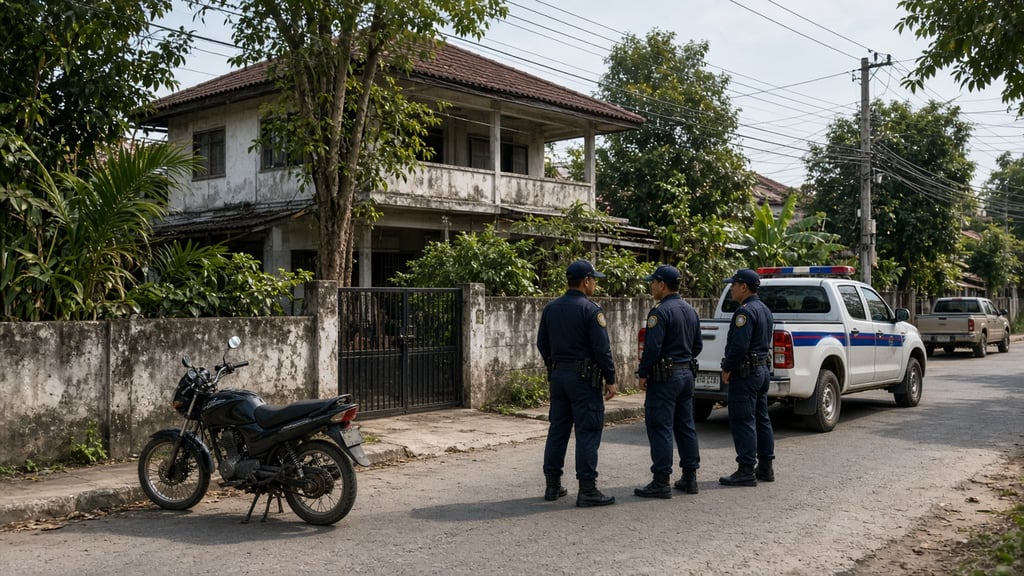
A rented house on a quiet soi in Saraphi's Tha Wang Tan subdistrict became a Category 1 narcotics case after neighbors told Chiang Mai police that foreign tenants were drawing suspicion. Officers from Police Region 5's Intelligence Analysis and Special Tools Sub-division took a search warrant from Chiang Mai Provincial Court and entered the property on 27 October 2026. Four Chinese men were found inside. They are now in the criminal process at Saraphi Police Station. For foreign nationals, a drugs file in Thailand is rarely only a police matter. Immigration action typically follows.
Chiang Mai News described the same warrant search after a tip that foreigners had rented the house and were acting in a way that worried residents. Local Thai coverage dated the court-backed entry to 26 October. Subsequent accounts placed the arrests on 27 October. The sequence is the one many peri-urban rental raids follow: a neighbor complaint, a judge's warrant, then a house search. It is not a street stop, and it is not a sweep of Chinese residents in Chiang Mai.
What officers reported at the house
Inside, police reported seizing Category 1 narcotics: crystal methamphetamine weighing about 26.7 grams including packaging, eight Yaba tablets (the local Thai report listed eight and a half), and three sets of equipment associated with use. The four men, described as being in their late twenties to around 40, were questioned through an interpreter. They said they had pooled money to buy the substances to use together in the house, rather than to sell them. Hospital testing returned positive results for methamphetamine for all four.
Investigators notified the men of the alleged offences and of their legal rights, then transferred them and the seized items to inquiry officers at Saraphi Police Station. The opening counts are possession and use of a Category 1 narcotic. Those remain allegations. A personal-use explanation does not by itself tell a court which penalty track applies.
How Thai law treats Yaba and crystal meth
Yaba and crystal methamphetamine sit in Category 1 of Thailand's Narcotics Code. The Office of the Narcotics Control Board states that Yaba is methamphetamine on the Ministry of Public Health Category 1 schedule. The Thai FDA Narcotics Control Division publishes the penalty table. Foreign citizenship does not create a lighter criminal scale.
Unauthorized possession of a Category 1 narcotic can bring up to two years in prison, a fine of up to 40,000 baht, or both. Use can bring up to one year, a fine of up to 20,000 baht, or both. A heavier track under section 90 covers unauthorized production, import, export, sale, or possession, with a baseline of up to 15 years and a fine of up to 1.5 million baht. Aggravating facts raise the range further. Category 1 drugs remain illegal for visitors and residents alike. The charge follows the evidence, not the passport.
After the drugs case: immigration
The Immigration Act B.E. 2522 (1979) lists classes of aliens who may be refused entry. Section 12(6) covers a person imprisoned by a Thai court, with narrow exceptions for petty offences and negligence. Section 12(8) covers a person indicated as likely to engage in drug trafficking. Section 12(11) covers prior deportation or removal at government expense. Immigration Bureau visa guidance repeats that a visa sticker does not override those prohibitions at the port of entry.
A foreigner who finishes a narcotics case is commonly passed from provincial police to immigration for removal. Overstay bans follow a published scale. Conviction-related entries on the prohibited-alien list do not. Consular officers can help with notification and visits. They cannot stop a Thai prosecution, and they cannot promise re-entry.
What This Means for Expats and Travelers in Thailand
Chiang Mai's rental market, especially in peri-urban tambons such as Tha Wang Tan, is full of houses let to foreigners on short, informal terms. Neighbor complaints are one of the ordinary ways a house comes to police attention. A warrant still has to come from a court. Landlords who skip TM30 reporting can find officers at the gate along with their tenants. If you rent, keep the lease in order, know who else has keys, and treat Category 1 drugs as illegal.
This arrest does not describe the Chinese community in Chiang Mai. The city has a large population of Chinese students, retirees, remote workers, and business owners. Four men in one rented house are four defendants. Treating every Chinese tenant as a proxy for this file is lazy, and it is not what the warrant targeted. If police arrive with a warrant, ask to see it, ask for an interpreter, and do not assume a tourist stamp is a shield. After any narcotics arrest, plan for two systems: the criminal court, then immigration. Re-entry is not a right once section 12 applies.



Comment verification
Step 1 of 3
Verify your email once to publish your comment. Your email is never shown publicly.
Enter the 6-digit code sent to .
Choose the display name shown next to your comments.