Chon Buri officers charge British teacher after alleged classroom work on a student visa
A 39-year-old British man was charged with working without a permit after a Si Racha school inspection. Immigration says a valid student visa is not a licence to teach.
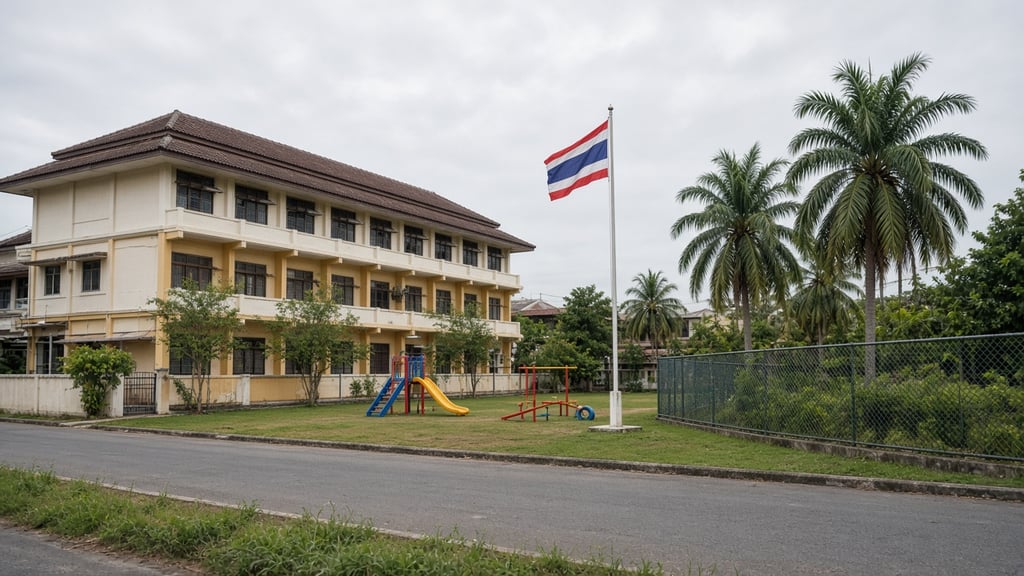
Chon Buri Immigration has charged a British national with working in Thailand without a work permit after officers said they found him teaching at an English-language school in Si Racha. The case was one of three enforcement actions in the district between 29 and 31 October 2026, with officers briefing the results around 1 November.
A valid visa and a work permit are separate documents in Thai law. Immigration and labour officials treat classroom work as employment even when the teacher holds a current student visa, a tourist stamp, or another stay permission that does not authorise paid work. That distinction is the core of the Si Racha file.
What officers said they found in Si Racha
According to Chon Buri Immigration and Si Racha Police, officers inspected an English-language school inside Central Si Racha at about 11am on 31 October after a complaint reached the district police. They said a 39-year-old British man was teaching at the time and invited him to Si Racha Police Station for questioning.
Immigration said the man held a student visa linked to Nakhon Khon Kaen College of Technology, with permission to remain in Thailand until 26 January 2027. Officers said he acknowledged teaching without a work permit. He was charged as a foreign national working without a permit and handed to Si Racha Police. The British man has not been named. The charge remains an allegation until a court or a fine settlement closes the case.
The same sweep produced two other arrests. In Bueng subdistrict, officers said they found a Cambodian woman working at a fresh market about 4,100 days beyond her permitted stay, roughly 11 years and three months. They also said they arrested a Lao man wanted under a Nong Khai Provincial Court warrant for defamation by publication. Immigration Division 3 said it would keep working with labour and security agencies on illegal employment and overstays.
The law: a visa is not a licence to work
Thailand's Immigration Bureau is blunt. Foreigners entering the country are not permitted to work, regardless of visa type, unless they are granted a work permit. The permit is issued by the Department of Employment at the Ministry of Labour.
For classroom jobs, a foreign teacher must hold a Non-Immigrant visa, not a tourist or transit stamp, and must apply for a work permit using form WP.25 at the employment office where the school is located. A student visa, typically Non-Immigrant ED, is for study. A student visa attached to a college in Khon Kaen does not authorise teaching in a Si Racha mall school.
The governing labour statute is the Emergency Decree on Managing the Work of Aliens B.E. 2560 (2017), as amended in 2018. Section 8 bars a foreigner from working without a permit. Section 101 sets a fine of 5,000 to 50,000 baht, then removal from the Kingdom. Officials also state that a worker in this position faces a two-year ban on applying for a new work permit.
A school that hires a foreigner without a permit faces a fine of 10,000 to 100,000 baht per worker. A repeat offence can bring imprisonment of up to one year, a fine of 50,000 to 200,000 baht per worker, or both, plus a three-year hiring ban. As of the briefing, officers have not publicly said whether the Si Racha school or its director faces a parallel charge.
The Ministry of Foreign Affairs path for lawful employment is the Non-Immigrant B visa. After entry, the holder must obtain a work permit from the Department of Employment, then use that permit to extend stay. Starting work while the paperwork is still in process is still work without a permit.
What This Means for Expats and Travelers in Thailand
If you teach, tutor, or cover a class while your Non-B visa and work permit are still being processed, Thai law treats that as work. A student visa, a retirement Non-O, a tourist exemption, or another stay stamp is not a substitute. Immigration's public guidance is that no visa type authorises employment until the Department of Employment issues a permit.
Before you accept a language-school offer in Chon Buri, Pattaya, Bangkok, or Chiang Mai, ask to see how the school files previous foreign-teacher work permits, confirm the job will be lodged at the provincial employment office, and do not start paid hours until you hold the permit or the matching e-WorkPermit record. If a recruiter says they need to collect teaching hours first, that is a labour-law problem, not a paperwork shortcut. If you already work on the wrong visa, stop and ask a licensed Thai lawyer or a provincial employment office. Government notices point the public to the Ministry of Labour hotline 1506, press 2, for illegal-employment reports.
A school that puts a foreign teacher in front of students without a permit can be fined per worker. Parents should care whether the school follows labour law. For holders of study visas, classroom side work is not a harmless extra.



Comment verification
Step 1 of 3
Verify your email once to publish your comment. Your email is never shown publicly.
Enter the 6-digit code sent to .
Choose the display name shown next to your comments.