Chiang Mai Holds Early Talks on a Doi Suthep Cable Car, With Nothing Approved
Chiang Mai's PAO and provincial officials sat with Austrian and Canadian cable-car specialists on 4 November to hear a concept aimed at cutting traffic and fumes on the Doi Suthep road. Both sides said studies, land use review, and public participation still come first.
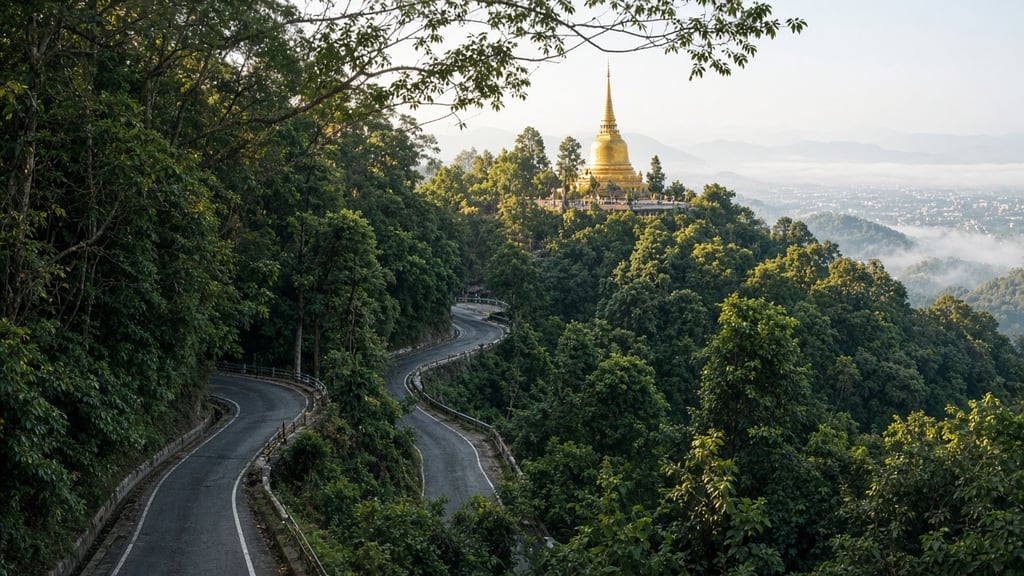
Chiang Mai's local government has opened a first-round conversation about a cable-car line up Doi Suthep, the forested mountain that frames the city and holds one of northern Thailand's most visited temples. The talks are early. Officials at the Provincial Administrative Organisation (PAO) and at City Hall have been explicit: no construction decision, route, fare, or timetable has been approved.
On 4 November 2026 at 11:00, PAO President Pichai Lertpongadisorn assigned Deputy President Somchat Wattanakla to host a study meeting with Austrian honorary consul Nikolaus Prachensky, advisers from Cable Car Solutions CNX, and related agencies. Specialists from Austria's Doppelmayr Group and Elevate, a Canadian cable-car investor, presented an initial concept.
The same day, Governor Thotsaphon Phueanudom assigned Deputy Governor Siwakorn Buapong to receive a parallel briefing at City Hall. Provincial officials said the idea would later go to the Joint Public and Private Sector Committee for Economic Development (JPBC) for comment. No lead agency has been named. Any workable form would need government, private partners, communities, and the temple in the same room.
A concept aimed at the mountain road, not a green light
Presenters framed the gondola as an environmentally lighter public-transport option that could ease congestion on the climb to Wat Phra That Doi Suthep, lower exhaust, and reduce crash risk on steep grades. They tied the pitch to Chiang Mai's Smart City and low-carbon city branding.
The PAO said it will take policy comments and study feasibility first, including environmental effects, land use, and public participation, before any further step. The provincial side added a sharper warning: hired-vehicle operators, residents, and other stakeholders would have to be surveyed under processes the law already requires. That is a study agenda, not a groundbreaking.
Neither meeting published station sites, tower counts, passenger capacity, ticket prices, or a funding model as official PAO specifications. Promotional material around the talks has floated a short aerial line and a ride of under ten minutes. Those figures belong to the pitch. Until the PAO and the province adopt them, they are not project facts.
A sacred mountain with a long memory
Doi Suthep is a granite peak in the Thanon Thong Chai Range, 1,676 metres high and about 15 kilometres from the city centre. Deciduous forest dominates below 1,000 metres; evergreen forest takes over above. A 1949 royal decree treated the woods as protected forest before the park existed.
Doi Suthep-Pui National Park was gazetted on 14 April 1981 and covers about 257 square kilometres. The Department of National Parks recorded 328,659 visitors in 2019. More than 2,000 vascular plant species have been documented there. Wat Phra That Doi Suthep, dated in legend to 1383, sits at roughly 1,073 metres. The paved road was built in 1935 under Khruba Srivichai. From the upper car park, visitors still climb 309 naga-lined steps, or take a short tram, and must dress modestly inside the wat.
A cable car to the temple is not a new thought. The idea surfaced in the 1970s and became a public fight in the 1980s, when a tourism plan sketched a roughly 3 kilometre line from the base to the monastery. Academics, monks, students, and neighbourhood groups argued that pylons would damage a national park, that the pilgrimage approach was part of the site's meaning, and that a private concession on public forest was the wrong bargain. Local opposition killed that plan. In 2014 the Rak Doi Suthep Group objected to a later idea stretching toward Doi Pui. Between 2015 and 2018 a housing scheme for justice officials on forested land was stopped after street protests.
What This Means for Expats and Travelers in Thailand
If you are visiting Chiang Mai this season, nothing about getting to Doi Suthep has changed. The Huai Kaew climb still clogs on weekends. Red songthaews, hired cars, motorbikes, and the Monk's Trail remain the options. The 309 steps, the dress code, and the temple tram at the top are still the last few metres.
Treat the story as a briefing, not a booking. An environmental impact assessment, national-park permission, land-use decisions, and public hearings would have to come before any pylon is poured. That process, if it starts at all, is measured in years. Ticket prices, disabled access, and whether red-taxi drivers keep a role are unwritten.
Long-stay residents should watch whether songthaew associations are folded into any study, and whether the JPBC meeting produces a named lead agency. Until those appear, the environmentally framed gondola is a conversation on a mountain that has already said no more than once.



Comment verification
Step 1 of 3
Verify your email once to publish your comment. Your email is never shown publicly.
Enter the 6-digit code sent to .
Choose the display name shown next to your comments.