Flash flooding shuts Pattaya Third Road at Moom Aroi junction
Sudden afternoon rain on 29 October 2026 put 70 to 80 centimetres of water on Pattaya Third Road at Moom Aroi and eight other city points. Pattaya City ran pumps at three stations. DDPM recorded no injuries.
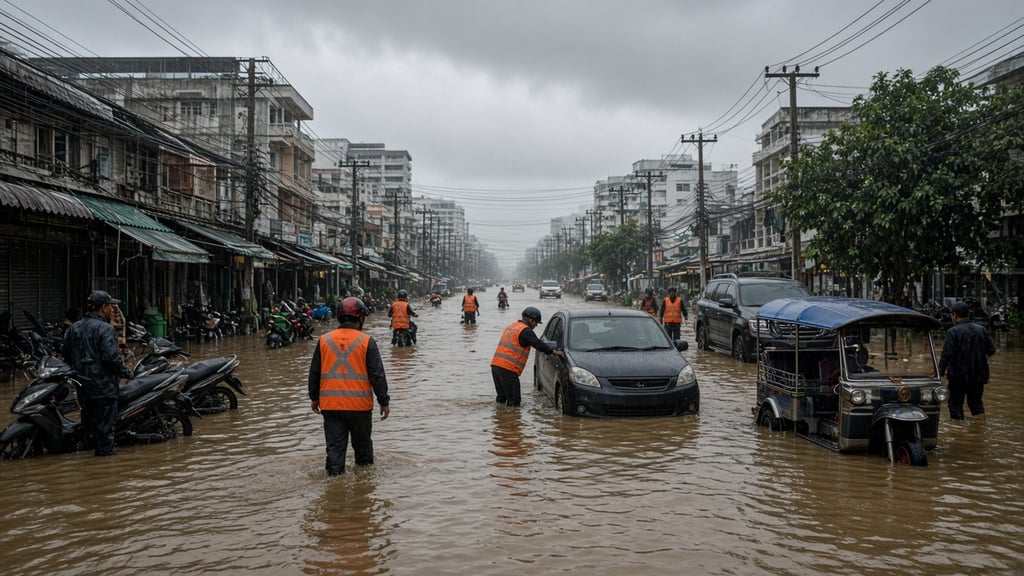
Afternoon rain on Thursday, 29 October 2026, turned Pattaya Third Road into a short brown canal. By 14:56, municipal officers reported that the Moom Aroi junction was closed to cars, vans, and motorcycles. Water sat high enough that even larger vehicles could not push through. Officers stayed on the junction to turn traffic and walk people around the deepest stretch.
The storm sat on the inland commercial grid, not the sand. Pattaya City is a special local government in Bang Lamung district, Chonburi province, about 150 kilometres southeast of Bangkok. Third Road runs parallel to Beach Road and Second Road, a few blocks inland, through shop-houses, hotels, and the old Moom Aroi food strip. When a cell dumps on that corridor, runoff collects at the low junctions first.
A Department of Disaster Prevention and Mitigation field report listed nine points with water 70 to 80 centimetres deep. Besides Moom Aroi, crews logged the railway-side road at the Khao Talo junction, the railway-side stretch behind Wat Tham Samakkhi, Sukhumvit Road before the Central Pattaya underpass, South Pattaya Sukhumvit in front of the highway police station, Sukhumvit before the Chaiyaphruek junction, Phet Trakun Road in front of Hollywood Pattaya, Soi Peniad Chang 4, and Soi Bua Khao.
Pattaya City sent municipal officers and volunteer disaster-prevention staff to those points. Crews started rain pumps and opened the floodgates at three pumping stations to speed drainage. Teams also checked houses along the flooded sois. Around 18:00 the water was falling, though Moom Aroi and the two railway-side stretches still held standing water. Officials expected another 30 to 60 minutes before traffic could run normally. The DDPM report recorded no injuries and no deaths.
A forecast that already named Chonburi
This was not a surprise cell. The Thai Meteorological Department's 05:00 forecast on 29 October called for scattered thundershowers with gusty winds across the East, mostly in Chon Buri, Rayong, Chanthaburi, and Trat, with overnight lows of 22 to 25 degrees Celsius and daytime highs of 32 to 35. The previous day's bulletin had already flagged isolated heavy rain in the same eastern group. An advisory issued on 17 October had warned that late-October rain in the East could trigger flash floods in low ground. Motorists can read the department's daily eastern bulletin on the TMD 29 October forecast before they lock in a taxi.
Why Third Road keeps filling
Pattaya has a documented flood habit. The city's public record notes repeated monsoon inundation, including 27 August 2021, when officials described the deepest water in a decade and some roads under as much as two metres. Planning papers have long listed flood works among the large-ticket items, including a 9.5 billion baht flood-management and sewage-upgrade programme tied to earlier Neo Pattaya infrastructure plans. The 29 October event was shorter and shallower than 2021. It still closed a core commercial junction for the afternoon rush.
Mayor Poramet Ngampichet had already ordered a 24-hour watch at known flood points after the mid-month TMD warnings, including the railway-side junction near Khao Talo, Sukhumvit in South Pattaya, and Third Road near the old Moom Aroi junction. The watch did not stop the water. It did put officers on the junctions within minutes of the first reports. For a beach city of about 116,000 registered residents and a much larger daytime population of workers and visitors, even a three-hour closure on Third Road and Sukhumvit is a city-scale delay.
What This Means for Expats and Travelers in Thailand
If you are staying between Second Road and Sukhumvit, treat afternoon cells in late October as a traffic event, not a beach event. Hotels on Third Road and Soi Bua Khao can lose street access even when Beach Road looks only wet. Ask the desk for a back-soi pickup, or wait. Grab taxis and songthaews will refuse the deepest junctions, which is the correct call.
Do not ride a motorbike through water you cannot see the bottom of. Seventy centimetres is above most scooter engines and enough to float a light bike. Walk it, or leave it. Photograph the waterline if a parked car takes water, call your Class 1 insurer before you restart the engine, and do not assume compulsory motor cover (Por Ror Bor) will pay for your own vehicle.
Keep a short list of the city's repeat flood points: Moom Aroi on Third Road, the railway road at Khao Talo, Wat Tham Samakkhi, South Pattaya Sukhumvit at the highway police station, and the Central Pattaya underpass. Those names appear in DDPM reports whenever an eastern thunderstorm sits on Bang Lamung. If TMD's morning East bulletin says scattered thundershowers with gusts in Chon Buri, move appointments off the 14:00 to 18:00 window or budget a long way around.
Visitors on short visas still need to reach U-Tapao or Suvarnabhumi on their booked day. A flooded Third Road does not cancel an immigration stamp, but it can erase a two-hour airport buffer. Check the Pattaya City page and TMD before you lock a taxi for a flight. If you live here, the practical upgrade is not a bigger SUV. It is knowing which sois become ponds, and refusing to drive them.



Comment verification
Step 1 of 3
Verify your email once to publish your comment. Your email is never shown publicly.
Enter the 6-digit code sent to .
Choose the display name shown next to your comments.