Andaman hotel crews take a rare day off the floor as high-season staffing tightens
More than 500 workers from 13 Phuket and Krabi hotels met for football, badminton and chairball, a staff gathering that sits beside a still tight Andaman labour market.
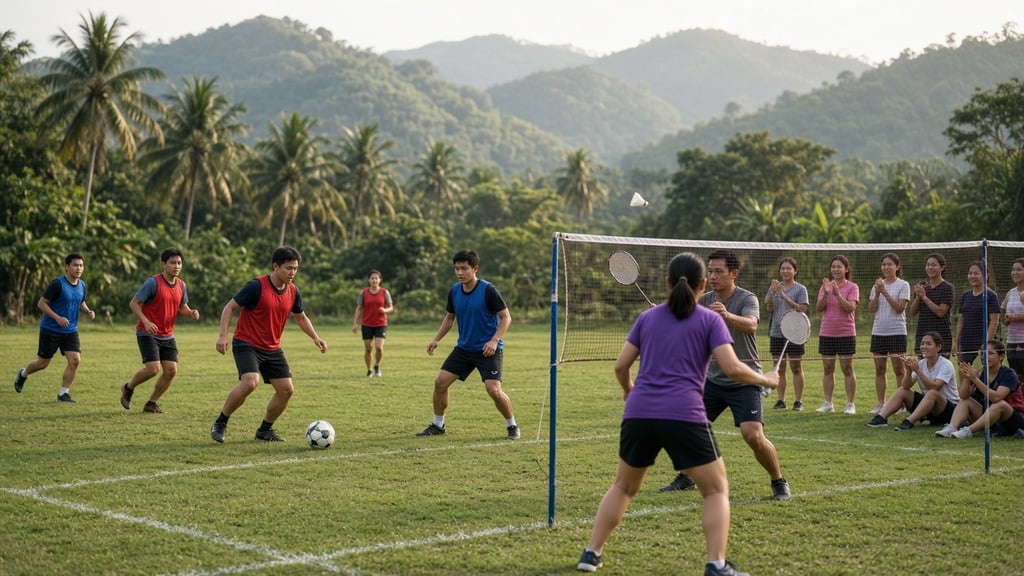
More than 500 hotel workers from 13 properties in Phuket and Krabi left the service floor for a sports field this month, competing in football, badminton, chairball and volleyball at the 2026 Andaman Sports Day. The gathering is now an annual fixture among large branded hotels on the Andaman coast, and it arrives as high season tests whether those same houses can keep rooms, restaurants and spas fully staffed.
Earlier editions already drew hundreds of associates. In 2018 roughly 500 staff from nine hotels took part. This year's roster stretched from Patong, Mai Khao, Nai Yang and Merlin Beach to an island resort off Phuket and Phulay Bay in Krabi. JW Marriott Phuket Resort and Spa took the overall title, with Courtyard by Marriott Phuket, Patong Beach Resort second and Le Meridien Phuket Beach Resort third. Courtyard Patong won women's chairball and mixed volleyball. Le Meridien took men's football and men's doubles badminton. JW Marriott Phuket won women's and mixed doubles badminton. Chairball, a Thai school sport between netball and basketball, remains a workplace staple, especially among women staff.
A welfare event inside a tight Andaman labour market
Phuket's wealth once came from tin and rubber. Tourism now dominates. Hotel-room counts still do not settle on one official figure. One widely cited estimate puts inventory near 60,000 rooms, and more than 100,000 foreigners are thought to have settled on the island. That guest-facing economy depends on a Thai and migrant workforce that is harder to recruit than visitor totals imply.
The National Statistical Office's 2022 business census counted 1,738 accommodation establishments in Phuket and 48,802 people working in them, about 27 percent of the provincial workforce in that survey. Food and beverage service added another 27,613 workers.
Labour Minister Julaphan Amornvivat used a September 2026 visit to Phuket to set four priorities: filling tourism and service vacancies, upskilling staff, speeding lawful migrant work-permit processing, and improving social-security access so formal jobs remain worth keeping. A hotel job fair a month earlier drew more than 1,000 seekers for more than 2,500 openings across 100 companies. Governor Chotinarin Kerdsom told the same meeting that skilled, service-minded workers remain central as Phuket pushes toward higher-value and wellness tourism.
A Thai Hotels Association and Bank of Thailand survey of 123 accommodation businesses in August 2026 found occupancy at 64 percent, with operators expecting 52 percent in September. A larger share of hotels reported labour shortages than in July, and those gaps were already hitting service quality even when bookings continued.
TAT Phuket figures presented in October show why staffing still matters in a slightly softer year. From January to September 2026 the island received 10.25 million visitors, down 1.57 percent, and recorded 399.96 billion baht in tourism revenue, about 1 percent lower. Hotel occupancy averaged 58.91 percent. International guests still supplied more than 92 percent of that revenue, led by Russia, China and India.
Pay and hours remain uneven on the same island. Reporting this month described base pay near 10,000 baht a month at some four-star desks, long high-season shifts, and service-charge packages at larger hotels that can dwarf the basic wage. A June 2026 study of migrant hotel workers from Myanmar, Laos and Cambodia described long hours and limited promotion paths. Industry voices have called the recovery K-shaped: well-funded four- and five-star houses recovered faster than smaller operators. A staff sports day of this scale is easier to stage at the top of that K.
What This Means for Expats and Travelers in Thailand
Guests arriving in Phuket and Krabi between November and March should expect Andaman high-season pressure on rooms, transfer desks and restaurants. Staffing shortages reported in 2026 have not generally closed hotels, but they show up as slower service, thinner breakfasts and fewer people on the floor at mid-tier properties. Large branded resorts that can rotate hundreds of workers onto a sports field still compete for the same housekeepers, cooks, spa therapists and English-speaking front-office staff as everyone else, including Krabi's smaller luxury pocket.
If you live here, the terms that matter are service-charge rules, overtime and days off around December and Chinese New Year, not the lawn games. The Ministry of Labour is still matching northern vocational graduates and lawful migrant workers to Andaman vacancies, while social-security coverage remains shaky for people who bounce between hotel contracts and informal gigs. Travelers who tip in cash and treat delayed food service as a labour squeeze rather than a personal slight will read the season more accurately. The sports results will fade. The question is whether Andaman hotels can keep trained people through the peak.



Comment verification
Step 1 of 3
Verify your email once to publish your comment. Your email is never shown publicly.
Enter the 6-digit code sent to .
Choose the display name shown next to your comments.