Lightning strike on Chiang Mai field hut kills one, injures villagers
Lightning hit a rice-field hut in Mae Chaem district where harvesters had sheltered from a leftover storm, killing one man and injuring at least eight others.
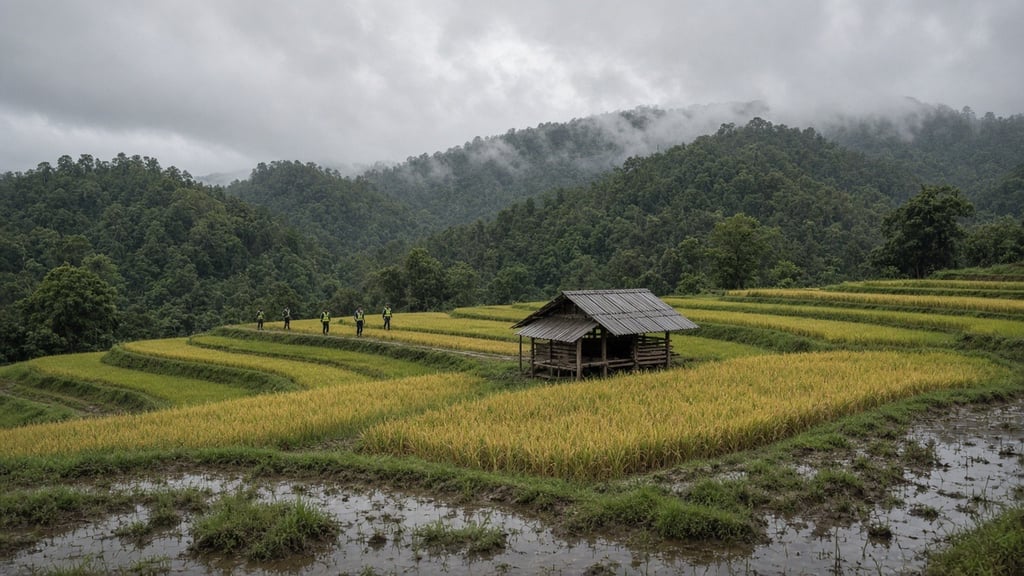
A leftover thunderstorm on Thursday, 6 November 2026, turned a rice-field shelter into a fatal trap in Mae Chaem, west of Chiang Mai city. Villagers cutting hill rice in Ban Mai Phatthana Santi, Village 14, Mae Na Chon, crowded into a small hut when rain arrived mid-afternoon. Around 17:00, lightning struck the building. One man died. At least eight other people were injured, three of them seriously.
District chief Kriangsak Buntapuan coordinated the first response. Officers from Mae Chaem Police Station and Border Patrol Police Unit 332 reached the paddies and had to wade the swollen Mae Chaem river. The hamlet sits in high country with weak mobile coverage.
The group belonged to the local Paganyaw, or Karen, community that farms these slopes. They had been harvesting hill rice. An isolated wooden hut with a metal roof is the usual place to wait it out. Thai disaster agencies tell people to leave that kind of open-sided shelter.
Officials identified the man who died as Chanthip, a local resident. Injured villagers went first to Theparat Wetjanukul Hospital in Mae Chaem town. Three people in more serious condition were later moved, one to Nakornping Hospital in Chiang Mai and others toward Chom Thong.
Why a field hut is the wrong shelter
Thailand's Department of Disease Control counted 283 people struck by lightning nationwide from 2020 to 2024, many of them dying at the scene. The pattern is farmers, afternoon storms, and open shelters such as bamboo rice-field huts. The Department of Disaster Prevention and Mitigation tells people to treat a corrugated metal field hut as a hazard, not a refuge. A hut standing alone in a paddy is often the tallest object for hundreds of metres.
Safer options are a fully enclosed permanent building or a hard-top vehicle with the windows up. If neither exists, crouch low, keep the feet together, and stay off the wet ground rather than lie flat. The 30-30 rule is simple: if thunder follows a flash by 30 seconds or less, move to real shelter; wait 30 minutes after the last thunder before going back out.
Mae Chaem is not a blank on a tourist map. Wikipedia's district page lists about 2,714 square kilometres of highland, with Doi Inthanon inside the boundary. About 50,000 rai are planted in rice. Harvest in early November is the busiest outdoor week of the year.
Harvest season meets leftover storms
The monsoon has usually broken by November, but the North still throws isolated thunderstorms across the ridges. Rice terraces at Ban Pa Bong Piang, in the same district, turn gold in late October and early November. Those stays are working farms, not hotels. Thursday showed that a pretty hut in an open field is still an electrical target when thunder sits overhead.
Rescue showed the geography too. Weak phone signal, a river to cross, and a district hospital that must send the worst cases down-mountain. For a visitor on a terrace trail after 16:00, it is the same system, only slower if nobody knows you were out there.
What This Means for Expats and Travelers in Thailand
If you trek Doi Inthanon, Mae Chaem, or the Pa Bong Piang terraces in November, treat leftover storms as seriously as July rain. Check the Thai Meteorological Department forecast before you leave Chiang Mai. Leave the city early enough to be off the ridges in daylight. If thunder is close, stop walking the dikes. Do not wait inside a field hut, a trail pavilion, or under a single tall tree. Get to a homestay with four walls and a proper roof, or sit in a closed vehicle.
Book a village house, not a shed in the middle of a paddy, if storms are on the chart. Ask the host where they go when thunder starts. Carry a torch and a charged phone, and tell someone your route, because coverage in Mae Na Chon dropped out for the people who needed it most on Thursday. If you hear thunder, put the metal trekking poles down. Do not film the storm from a ridge.
This is not a visa stamp story. It is a North Thailand living story. Retirement, DTV, and long-stay residents who drive the west side of Inthanon for the weekend should pack the same caution as farmers: the harvest view is gold, the weather is not finished, and an isolated hut is not cover. Donate through official district channels if you want to help the families.



Comment verification
Step 1 of 3
Verify your email once to publish your comment. Your email is never shown publicly.
Enter the 6-digit code sent to .
Choose the display name shown next to your comments.