Suvarnabhumi X-ray Stops 473 CITES Turtles Hidden as Leather Belts from Mexico
Five Mexico-origin parcels declared as leather belts held 461 mud turtles and 12 Mexican musk turtles when wildlife officers opened them in the Suvarnabhumi free-zone cargo warehouse. The 1.44 million baht haul is a CITES case, not a pet-shop story.
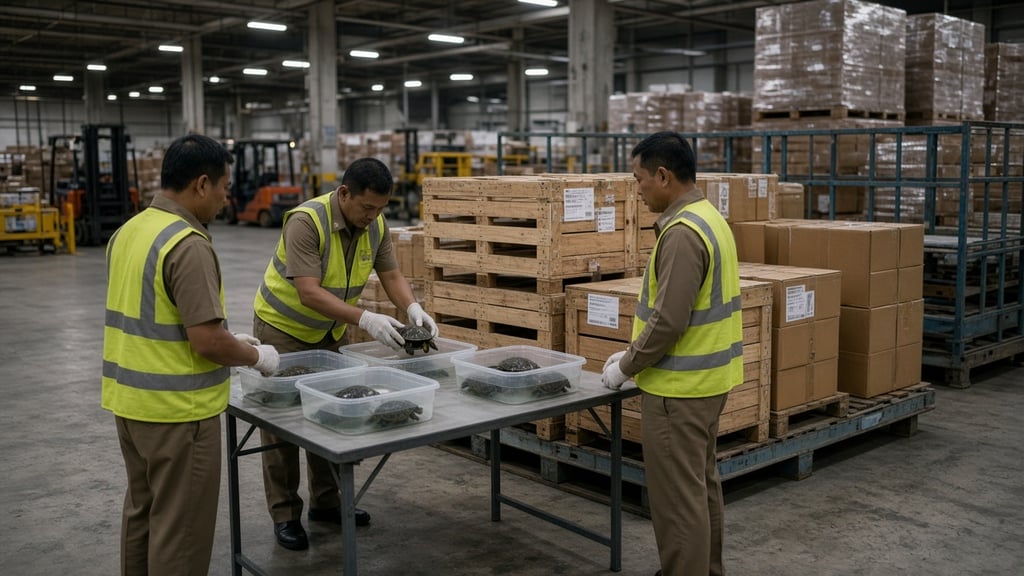
Five express parcels in the inbound cargo warehouse of Suvarnabhumi Airport's free zone on 3 November 2026 were declared as leather belts. They were not. Wildlife officers at the airport checkpoint, working with Customs, the fisheries checkpoint, and the Natural Resources and Environmental Crime Suppression Division, opened the boxes with Thai Airways cargo staff and found 473 turtles of the family Kinosternidae, some still alive and some already dead.
The consignment had been flagged as high-risk cargo on Korean Air flight KE657. The parcels originated in Mexico and were addressed to recipients in Thailand. X-ray images did not match a stack of belts. The Department of National Parks, Wildlife and Plant Conservation later confirmed the haul. Thai Customs Enforcement counted 461 mud turtles of the genus Kinosternon and 12 Mexican musk turtles of the genus Staurotypus, and put the seized animals at about 1,443,000 baht.
That split is the story. Kinosternon is a New World mud-turtle genus whose greatest species richness is in Mexico. Adults are typically 10 to 15 centimetres long, small enough to pack by the dozen in an express carton. Staurotypus, the giant musk turtles of Mexico and Central America, grow far larger, up to about 36 centimetres. CITES lists Kinosternon cora and Kinosternon vogti on Appendix I (commercial trade banned) and the rest of Kinosternon plus both Staurotypus species on Appendix II (permits required). Mexico's own numbers show why this cargo exists. Between 2010 and 2022, PROFEPA recorded 19,597 Kinosternon confiscations, including 10,132 animals intercepted at Mexico City Airport in 2020 that were bound for export.
The boxes did not clear into Bangkok by accident of geography. Airports of Thailand operates the Suvarnabhumi Airport Free Zone at 999 Moo 7, Racha Thewa, Bang Phli, Samut Prakan, with the wildlife checkpoint listed in Building S1 alongside fisheries, plant quarantine, and animal quarantine. Wikipedia's wildlife-trade overview already flags that cargo campus as a notable hub. TRAFFIC counted 18,854 tortoise and freshwater-turtle seizures in Thailand from 2008 to 2013, more than half of them at Suvarnabhumi, and later more than 14,000 live animals confiscated there between 2010 and 2020.
Thailand has been a CITES Party since 1983. DNP is the lead management authority. The 2019 Wild Animal Conservation and Protection Act created a controlled category for non-native CITES species and requires a Director-General licence to import them. Importing protected or controlled wild animals without that licence, under section 23, carries up to ten years in prison, a fine of up to one million baht, or both, under section 93. The same file also cites the Customs Act B.E. 2560, the Animal Epidemics Act B.E. 2558, and the Royal Ordinance on Fisheries B.E. 2558. Suvarnabhumi Airport Police Station has the criminal brief. DNP's wildlife health unit has the surviving animals. Minister Suchart Chomklin, briefed by DNP Director-General Yongyut Nakaviroj, said investigators would chase the sender, the Thai recipients, and anyone else in the chain. Customs found no import permit.
What This Means for Expats and Travelers in Thailand
If you keep exotic turtles in a Bangkok condo, a Chatuchak stall, or a Facebook group, ask for the paper trail. A Kinosternon or Staurotypus that arrived without a DNP licence and a CITES permit is not a quirky pet. It is evidence. Buying it after the fact can still put you in the possession and trade net under the 2019 Act. Chatuchak has been documented for years as an open-air wildlife market sitting a short drive from the same airport that just opened these boxes.
If you ship or receive cargo through the Suvarnabhumi free zone, a false commodity code is its own offence. A parcel in your name is your problem even if you claim you only agreed to collect it for a friend. X-ray officers are now being told to treat high-risk origins as a priority. That includes Mexico-origin express freight that used to slide through as fashion accessories.
Travelers are not the primary target of a cargo-warehouse raid, but they sit next to the same airport. Do not accept a favour to carry a box of live animals, dried shells, or "leather goods" for someone you met online. Live turtles have a poor survival rate in cramped consignments, and the survivors can carry pathogens from wetlands into a condo tank. The legal path is a CITES permit obtained before the animal moves, presented and validated at Customs. There is no walk-up window at arrivals for 473 mud turtles.



Comment verification
Step 1 of 3
Verify your email once to publish your comment. Your email is never shown publicly.
Enter the 6-digit code sent to .
Choose the display name shown next to your comments.