Pattaya Puts 2.75 Billion Baht Into a Four-Phase Drain Plan After September Floods
Pattaya City Council on 5 November heard a 2.75 billion baht, four-phase drainage programme for 2027 to 2030, covering 15 square kilometres and more than 37,300 households after September flooding.
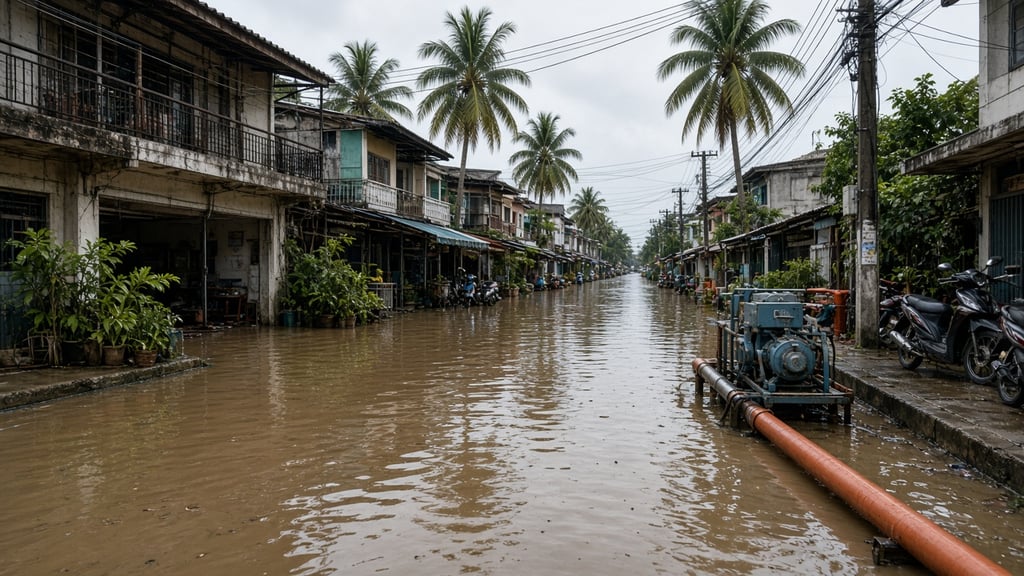
Pattaya City Council spent 5 November 2026 on a monsoon question: why inner sois still pond after a short, hard rain. Councillor Banjong Bantoonprakyuk, Constituency 3, pressed Mayor Poramet Ngampichet on the September storms that put water on roads and into houses. The mayor answered with a four-phase drainage programme of about 2.75 billion baht, scheduled from 2027 through 2030.
The money is special funding, not a city-wide rebuild. Officials have said a complete overhaul of the drainage network would run to about 21 billion baht, beyond Pattaya's municipal purse. Since 2022 the city has done piecemeal drain jobs. The new package is meant to cover 15 square kilometres (about 9,375 rai) of South Pattaya, Central Pattaya, and Thepprasit Road, and to cut flood risk for more than 37,300 households.
That geography matters. Wikipedia's city profile describes Pattaya as a special local government in Bang Lamung, Chonburi, on the Gulf of Thailand about 150 kilometres southeast of Bangkok. The municipal area is 53.4 square kilometres, with about 116,400 registered residents and an urban population around 351,000. Downtown sits low against the gulf, so heavy rain plus a high tide leaves water few clean paths to the sea.
Climate records on the same page show why September is the usual stress test. Pattaya is tropical wet and dry, rainy from May to November. Long-term averages put September at about 214 millimetres of rain and October at about 225 millimetres, the two wettest months of a 1,106 millimetre year. On 27 August 2021, torrential rain left major roads under water as deep as two metres, the worst flood in a decade.
What the pipes can take today
City engineers say the existing network can generally handle rainfall of up to 70 millimetres an hour. When a cell dumps more than that, water sits. Typical depths of 10 to 20 centimetres can take 30 minutes to three hours to clear. The four-phase works are designed to lift that hourly capacity to about 130 millimetres, assuming contractors are selected.
The city's Water Crisis Centre already tracks ponding and warns residents which roads to avoid. Officials count a drop in major flood-prone spots from 24 to about nine, with another three or four smaller patches still listed. Remaining names are familiar after a storm: the railway road near Soi Noen Plub Wan, Pattaya Third Road, and South Pattaya Road.
Those names also show up in national disaster reporting. The Department of Disaster Prevention and Mitigation logged a heavy-rain event in Pattaya, Bang Lamung, with water 70 to 80 centimetres deep on the railway road, Sukhumvit, Pattaya Sai 3, and Soi Buakhao. Staff, volunteer teams, rain pumps, and gates at three pumping stations were put to work. By about 18:00 the water was falling, with no injuries recorded. That is the picture the 2.75 billion baht is supposed to change.
Four phases, two construction windows
Phase one, listed for 2027 to 2029, would upgrade drainage on lower South Pattaya Road, Pattaya Second Road at Soi 18, and lower Chalerm Phrakiat Road. Phase two would take the upper sections of Chalerm Phrakiat Road and South Pattaya Road. Phase three, 2028 to 2030, covers Sukhumvit Road, the railway-side road, and the Land Office road. Phase four would run from Sukhumvit Road out to Sukhumvit Pattaya Soi 69 and Soi Kor Pai.
None of that is in the ground yet. Terms of reference are being drafted and contractor selection has not started. Residents should treat 2027 as a start-of-works year, not a finish line. The first two phases are the ones most likely to close lanes in the tourist core. The later pair would touch the railway corridor and the Sukhumvit edge.
What This Means for Expats and Travelers in Thailand
If you keep a condo or a long-stay lease in South or Central Pattaya, the practical news is delayed relief plus construction. The 2027 start means at least one more full rainy season on the current 70 millimetre pipes. After that, expect lane closures on South Pattaya Road, Second Road Soi 18, and Chalerm Phrakiat Road as the first two phases go in. Juristic persons should ask for access plans, not only a completion year.
Short-stay visitors will feel this as flooded taxi ranks and stalled motorbikes before they feel a finished tunnel. National disaster logs put 70 to 80 centimetres on Sukhumvit, Sai 3, and Soi Buakhao. That is enough to kill a rental scooter engine and close a ground-floor restaurant for an evening. Until 2029, Water Crisis Centre alerts remain more useful than the 2.75 billion baht headline.
Do not confuse this package with the 21 billion baht city-wide number. Naklua, Jomtien, and many inland sois are outside the 15 square kilometre footprint. If your street is not on the four-phase list, this announcement does not drain it. Watch the terms of reference and the contractor notices on the city site. A soi is in the programme when it appears in a tender, not when it appears in a council answer.



Comment verification
Step 1 of 3
Verify your email once to publish your comment. Your email is never shown publicly.
Enter the 6-digit code sent to .
Choose the display name shown next to your comments.