San Kamphaeng raids halt 40,000-baht supplement pitches on Korean Chiang Mai tours
Chiang Mai Tourist Police, public health officers, and the Department of Tourism used court warrants at two Ton Pao businesses after Korean visitors said group tours diverted them into VIP rooms selling unregistered products as disease treatments.
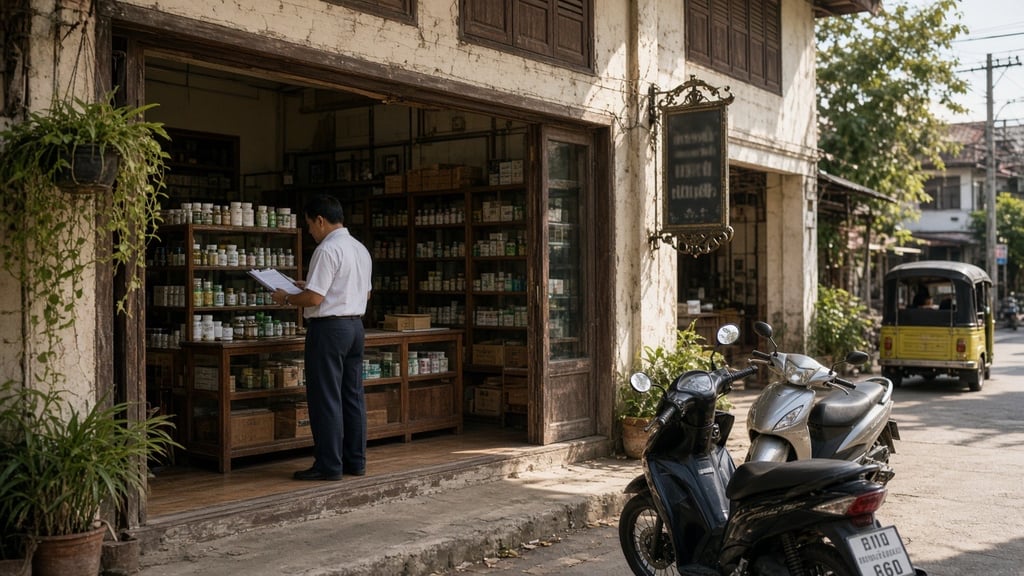
Chiang Mai Tourist Police, provincial public health inspectors, and a Department of Tourism legal officer used Chiang Mai Provincial Court search warrants on 7 November 2026 to enter two businesses in Ton Pao, San Kamphaeng. South Korean visitors said packaged group tours had diverted them into closed sales rooms where health supplements were pitched as treatments for serious illness, at advertised prices of up to 40,000 baht a box. Several travelers only inspected the packaging after returning to South Korea and found no valid Thai Food and Drug Administration registration. That delayed report produced the warrants. Officers then found a Korean-language sales talk already under way in a VIP room.
What officers found at the first shop
The first warrant named Jin Kwang Gemology Co., Ltd., in Moo 2, Ton Pao. Inspectors catalogued four supplement lines. Two were classified as regulated medicines or controlled foods with no Thai FDA (อย.) registration, and those lots were seized. Inside, officers found 61-year-old South Korean national Oh Ki Sung presenting products to a Korean tour group. He could not produce a work permit. Investigators recorded that he had been delivering the same talk for more than a month and was not a licensed traditional-medicine practitioner. He was charged with working as a foreigner without a permit, or outside permitted conditions. Two other workers were arrested on matching employment charges: a 27-year-old Myanmar national and a 26-year-old woman listed as holding no Thai nationality. All three were taken to San Kamphaeng Police Station.
A licensed factory, unregistered stock
The second warrant named Bio-Korea Trading Co., Ltd., also in Ton Pao. The plant held a lawful food-production licence, but stock on the sales floor had not been manufactured there. Of eight medicinal and food items checked, four carried valid Thai FDA numbers, one had incorrect อย. labelling, and three unregistered controlled products, including items marked AGAR THAI 2026, were seized for laboratory testing. Officials said further charges would follow if tests showed impurities or undeclared active substances. Tourist Police also asked whether South Korean capital sat behind the two shops through Thai nominee shareholders. Under the Tourism Business and Guide Act B.E. 2551, a limited company in the sector must have at least 51 percent Thai capital and a Thai majority on the board.
Undeclared shop stops on two tour programmes
Department of Tourism officers pulled work orders for two operators, identified only as Company M and Company J. Neither published programme listed the San Kamphaeng shops. Taking paying guests off the advertised itinerary without advance notice is a licensing offence, and legal staff said they were preparing to suspend both licences. A declared temple or market stop is lawful if it matches the booking. An undeclared detour into a VIP sales room is not. It is the same structure long used in gem and tailor diversions: the bus already has the passenger, the shop pays a commission, and the visitor is far from pharmacies where prices and อย. numbers can be compared in daylight.
How Thai law treats disease-cure claims
Thai FDA labelling rules for food supplements require a boxed warning that the product has no effect in preventing or curing diseases. In March 2026 the agency restated a consumer test it calls the 3 Checks: confirm the Thai FDA number, confirm the source, and read the advertising claims. Disease-treatment promises sit at the top of the enforcement list because some illegal products have been found spiked with undeclared medicines. The San Kamphaeng problem combined an undeclared tour stop, a closed-room pitch in the visitors' own language, a presenter without a work permit, and a unit price that would be extraordinary even for a genuine imported formula.
What This Means for Expats and Travelers in Thailand
If a guide or driver adds a health specialist stop that is not on your voucher, refuse and call Tourist Police on 1155. The hotline runs 24 hours and staffs eight languages. The Thailand Tourist Police application takes reports in Korean, English, Chinese, Japanese, and Russian, and routes them to the same 1155 centre. Before paying for any supplement, look for an อย. number on a Thai-language label. No number, no sale. Check who made the product and whether the talk claims to treat disease, which food supplements are not allowed to do.
If you already paid, keep the receipt, the box, and the tour voucher. File with Tourist Police first, then email [email protected]. In Chiang Mai, the provincial public health consumer-protection unit takes health-product complaints at 0-5321-1048, extensions 102 to 105, and through e-complaint.fdacmi.com. Book only Department of Tourism-licensed agencies and treat any unscheduled shop as a commission stop until proven otherwise. Korean nationals can reach the Embassy of the Republic of Korea in Bangkok on +66-2-481-6000 during office hours, +66-81-914-5803 after hours, or the 24-hour consular call centre in Seoul on +82-2-3210-0404. If the bus leaves the published programme for a VIP room, and a stranger starts talking about curing disease, walk out and dial 1155 before anyone opens a payment terminal.



Comment verification
Step 1 of 3
Verify your email once to publish your comment. Your email is never shown publicly.
Enter the 6-digit code sent to .
Choose the display name shown next to your comments.