Thailand Clears 106.8 Billion Baht to Double-Track the Southern Railway to Malaysia
Deputy Transport Minister Sanphet Boonyamanee confirmed on 7 November that three double-track sections from Chumphon to Padang Besar are heading for 2027 tenders, with Songkhla Lake and Koh Lanta road bridges on a 2029 track.
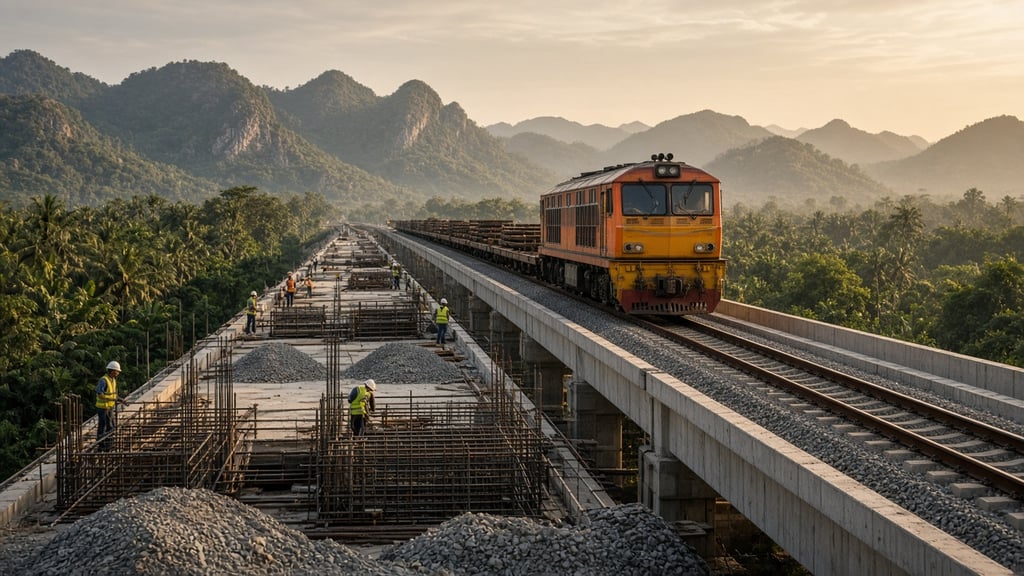
Thailand is putting real money behind a faster southern railway. On 7 November 2026, Deputy Transport Minister Sanphet Boonyamanee confirmed that a 106.8 billion baht second phase of double-track work will run from Chumphon through Hat Yai to Padang Besar, with two major road bridges in Songkhla and Krabi moving in parallel.
The file sits under Deputy Prime Minister and Transport Minister Phiphat Ratchakitprakarn. The numbers are not new. At a mobile Cabinet meeting in Songkhla on 1 September 2026, chaired by Prime Minister Anutin Charnvirakul, ministers approved three State Railway of Thailand contracts covering about 504 kilometres. Sanphet's addition this week is a timetable: tenders and contract signing in 2027, then civil works, with a finish line in 2033.
Three Contracts From Chumphon to the Border
Phase 1 of the southern double-track, roughly 420 kilometres between Nakhon Pathom and Chumphon, has carried trains since 2024. South of Chumphon the main line is still mostly one track. Northbound and southbound services duck into passing loops, which is why a Krung Thep Aphiwat to Hat Yai overnight run still lands in the 14 to 16 hour band even though Hat Yai Junction sits only about 929 kilometres from Bangkok.
Phase 2 splits into three sections. Chumphon to Surat Thani is about 168 kilometres and 36.89 billion baht, through fiscal 2032. Surat Thani to Hat Yai Junction is the heavy lift: about 291 kilometres and 61.53 billion baht, through fiscal 2033. Hat Yai Junction to Padang Besar is the short international connector, about 45 kilometres and 8.37 billion baht, aimed at fiscal 2031.
Those slices add up to 106,798.32 million baht. The package also funds signalling so the second track can carry extra passenger and freight paths rather than two slow rails side by side. The Padang Besar stub meets Keretapi Tanah Melayu at the official border station, still the standard rail door toward Penang and Kuala Lumpur.
Flood Viaducts, a Deferred Songkhla Branch
Hat Yai's November 2025 floods forced a design change. Along roughly three kilometres between R.1 Canal and U-Tapao Canal, SRT is dropping the earth embankment for a viaduct so monsoon water can pass under the railway. A raised structure is meant to keep trains moving when the city is not.
The old Hat Yai Junction to Songkhla town branch, about 29 kilometres, is not in this round. Encroachment issues pushed it later. Visitors bound for Songkhla city should not expect a restored urban rail spur with the double track. The live border move is west to Padang Besar, not east to the lake.
Songkhla Lake and Koh Lanta Are Road Projects
Sanphet folded the railway into a wider southern list of 14 transport schemes worth about 362.6 billion baht, from Andaman port studies to Phuket and Samui expressway plans still at mixed stages. Two road bridges are nearest to a start-of-work notice. A roughly seven-kilometre crossing of Songkhla Lake, budgeted around 4.6 billion baht, is designed to shrink the Songkhla-Phatthalung drive from nearly two hours to 15 to 30 minutes. In Krabi, a 1.78 billion baht, 2.24-kilometre bridge to Koh Lanta is meant to replace the vehicle ferry that still backs up at peak season.
Construction contracts for both bridges were signed on 31 August 2026. The Department of Rural Roads planned notices to proceed for 14 November 2026, with opening targeted in 2029. Neither structure carries trains. Expats on Lanta, and tourists routing through Krabi, will still reach the Southern Line by van or bus at Surat Thani or Trang. The island gain is a more predictable road by the end of the decade, not a station on the beach.
What This Means for Expats and Travelers in Thailand
Do not plan a 2027 timetable miracle south of Chumphon. The next several years are more likely to bring construction holds and slipped dates. The useful change for travelers is already north of Chumphon, where double track has been running. Once Phase 2 opens, the realistic prize is fewer loop waits, denser daily paths, and overnight sleepers that miss breakfast less often, not a high-speed hop. The line stays metre-gauge and diesel-hauled.
Hat Yai remains the interchange for Malaysia. Today's Hat Yai to Padang Besar hop is about 45 minutes on a 45-kilometre single track. Double-tracking that stub will matter more for freight slots and extra international connections than for shaving the local run. Passport control at Padang Besar is a proper checkpoint. It is a tool for planned Malaysia travel, not a workaround for Thai visa rules.
Surat Thani station stays the rail drop for Koh Samui, Khao Sok, and many Krabi vans. The 168-kilometre Chumphon-Surat section is the first Phase 2 slice that could tighten that overnight. Until 2029, Koh Lanta still means the ferry. Until 2033, treat Bangkok-Hat Yai as a long sleeper, book the lower berth, and keep a cheap flight in your back pocket when the monsoon sits on the line.



Comment verification
Step 1 of 3
Verify your email once to publish your comment. Your email is never shown publicly.
Enter the 6-digit code sent to .
Choose the display name shown next to your comments.