Koh Samui Villa Stays Come With a Local Concierge, and a Licence Test
Bophut-based Sublime Samui Villas packages island houses with airport transfers, concierge help and owner management. Guests and owners still need to check Hotel Act status and TM30 reporting.
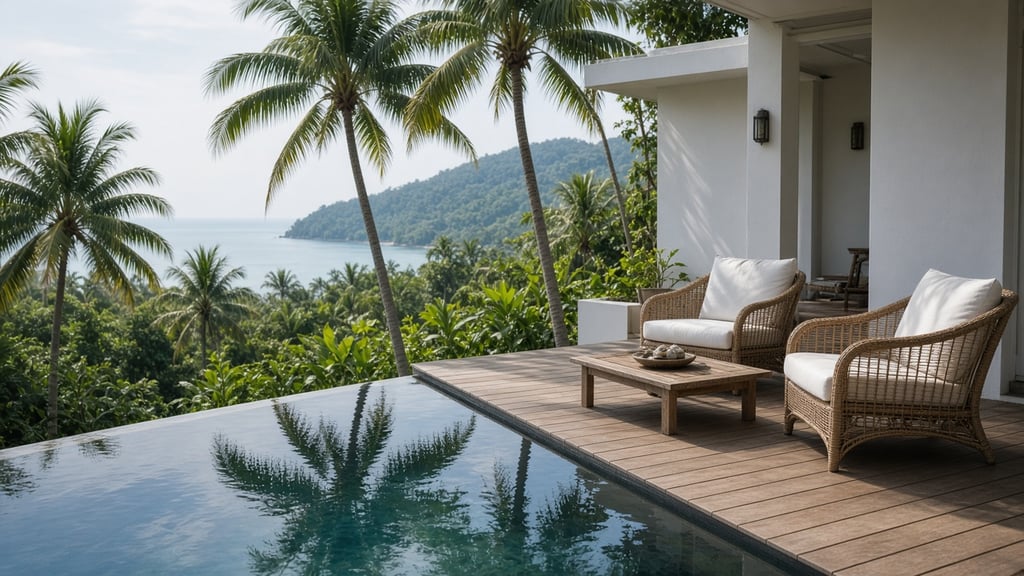
The operator pushing private villa stays from Bophut this season is Sublime Samui Villas, a local rental and management firm that has worked the island since 2016. The offer is a house, not a hotel wing, plus a team that meets guests at Samui Airport and stays reachable until departure.
Nightly and weekly villa lets sit inside the Hotel Act B.E. 2547 (2004) unless the property is a genuine monthly residence or has completed the small-accommodation notification.
A Bophut office and an island-wide inventory
Sublime Samui Villas lists its office at 63/9 Moo 5, Bophut, Koh Samui, Surat Thani 84320, on the island's north coast. The company site describes beachfront houses, hillside retreats, and family residences. Koh Samui is Thailand's second-largest island after Phuket, covering about 229 square kilometres in Surat Thani Province.
Its concierge page lists airport transfers, private chefs, grocery provisioning, boat trips, restaurant bookings, and family kit such as high chairs. For overseas owners, the management package adds marketing, weekly inspections, staff payroll, monthly profit-and-loss reports, and an annual audit that Thai company law still expects. The product is a local desk that can find a driver at 6am and a plumber at 2pm. Ask whether it is licensed.
The island is full, and villas are part of the pitch
Samui International Airport handled 2,781,564 passenger arrivals in 2024. Bangkok Airways later reported about 3.0 million passengers and 33,823 flights through the same airport in 2025. The Ministry of Tourism and Sports counted 9,099,605 visitors to Surat Thani Province in 2025, with an occupancy rate of 77.71 percent.
The Tourism Authority of Thailand's villa-booking promotion runs from 3 November 2024 to 27 November 2026 with a 20 percent discount. That is official tourism marketing, not a licence. A TAT campaign does not replace a hotel registrar's stamp.
The Hotel Act is not a brochure footnote
Section 4 of the Hotel Act defines a hotel as accommodation set up as a business to provide temporary lodging for payment. Section 15 requires a licence from the hotel registrar unless a statutory exclusion applies. Operating without one can bring imprisonment of up to one year, a fine of not more than 20,000 baht, or both, plus a daily fine of not more than 10,000 baht.
Ministerial Regulation No. 2 B.E. 2566 (2023), published on 30 August 2023, widened the small-accommodation route. Premises with no more than eight guest rooms and capacity for no more than 30 guests may fall outside the hotel definition, but only after the owner notifies the registrar, a competent official inspects, and a written acknowledgement is issued. The acknowledgement is valid for five years from the date of notification. A three-bedroom pool house can fit the numbers and still be illegal if nobody filed.
The Act also excludes accommodation charged exclusively on a monthly or longer basis. Mixed books (nightly in high season, monthly in low season) do not get that exclusion. On Samui, many estate programmes hold a licence at the management-company level. A pretty website is not a registrar file.
TM30 follows the guest, not the brand
Section 38 of the Immigration Act B.E. 2522 (1979) requires the house owner, possessor, or hotel manager who takes in a foreigner on a temporary stay to notify the local immigration office within 24 hours. The Immigration Bureau's electronic channel is tm30.immigration.go.th. Failure sits on the host, with a fine of up to 2,000 baht, but the guest later needs the receipt for a visa extension.
A licensed hotel or a professional villa desk should file this as routine. Travellers should ask, before arrival, who files TM30 and how the receipt will be delivered.
What This Means for Expats and Travelers in Thailand
If you are booking a Samui villa for a week, treat the operator like a hotel: ask whether the property is licensed or has a current small-accommodation acknowledgement, who meets you at the airport, and who files TM30. Ask whether the quoted rate includes the 7 percent VAT and service charge that licensed hotels print. Unlicensed houses can be cheaper until a complaint, a neighbour, or a district inspection lands.
If you own a villa, or are buying one through a lease and a Thai company, the management brochure is the easy part. The hard part is building-use, fire kit, staff social security, and the registrar. A Bophut desk that can market on booking sites is useful. It does not convert an unlicensed nightly let into a lawful hotel. Monthly residential leases remain the cleaner path for long-stay expats who do not want to run a hospitality business. Check the licence, keep the TM30, and decide whether you are buying a holiday or a regulated lodging business.



Comment verification
Step 1 of 3
Verify your email once to publish your comment. Your email is never shown publicly.
Enter the 6-digit code sent to .
Choose the display name shown next to your comments.