Thailand Expands Automated Passport Gates to 33 Nationalities After September Rollout
Immigration Bureau data shows daily automated-gate use nearly tripled after 18 September, as 33 visa-exempt and e-Visa nationalities gained access at Suvarnabhumi. First-time visitors still go to a staffed counter.
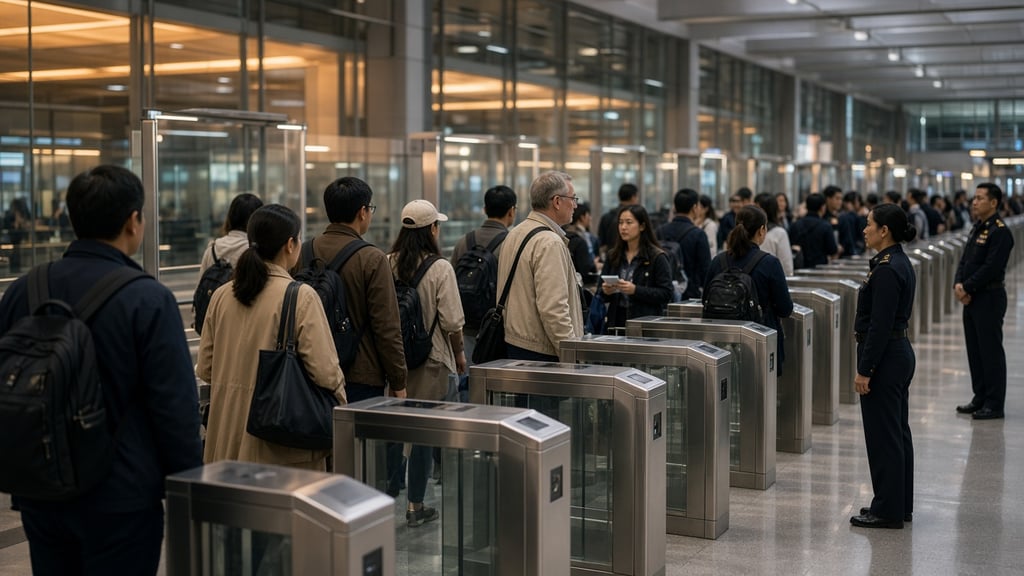
Thailand has expanded automated passport control from two eligible places of issue, Singapore and Hong Kong, to 33 countries and territories. The Immigration Bureau framed the change as a way to shorten waits and ease congestion at international checkpoints.
Immigration Bureau Order No. 196/2026, dated 24 August 2026, authorised the wider Automated Border Control (ABC) rollout, with the expanded service started on 18 September 2026. Eligible travellers are those entering under visa exemption arrangements or with an electronic visa, subject to TDAC checks.
On 4 November, Immigration Bureau commissioner Pol. Lt. Gen. Noppasin Poolsawat said average daily usage rose 185.6 percent, from 744 passengers before the expansion to 2,125 afterwards. From 18 September to 31 October, 94,760 foreigners used the gates.
Singapore led that count, followed by Hong Kong and South Korea. Japan accounted for 9,538 automated clearances in the same window. Malaysia recorded 6,943. The bureau, working with Airports of Thailand, also recorded 21,684 Singaporean users, 14,259 from Hong Kong, and 9,615 from South Korea.
Why Suvarnabhumi needed the extra lanes
The order landed on a known bottleneck. In mid-August, officials walking Suvarnabhumi said the airport handles about 190,000 passengers a day in peak season, with 5,000 to 6,000 people reaching the immigration hall in a single peak hour.
The bureau had already agreed in principle to add 31 nationalities to the two already served. Government briefers put the extra eligible pool at about 6.5 million passengers a year, plus roughly 900,000 people on certain long-stay visas.
By 2 November, the National Tourism Policy Committee heard that the Auto Gate pool covered about 57 percent of 2025 arrivals. TAT had flagged a September second phase after a July Suvarnabhumi inspection, when automated channels were still limited to eligible Singapore and Hong Kong passports.
Who is on the 33-place list, and who is not
The Government Public Relations Department published the eligible countries and territories after the November briefing. In Asia: South Korea, Singapore, Japan, Hong Kong, and Malaysia. Middle East: the United Arab Emirates. Oceania: Australia and New Zealand. Americas: Canada. Europe: Austria, Belgium, the Czech Republic, Denmark, Finland, France, Germany, Greece, Hungary, Ireland, Italy, Latvia, Luxembourg, Malta, the Netherlands, Norway, Poland, Portugal, Slovakia, Slovenia, Spain, Sweden, Switzerland, and the United Kingdom.
The list does not include the United States, China, India, Taiwan, Russia, the Philippines, Vietnam and Indonesia. Several of those markets are among Thailand's largest visitor sources. Canada is the only country in the Americas on the roster. Being visa-exempt is not the same as being machine-eligible.
Travellers who complete TDAC registration are told, by email, whether they qualify. In practice, eligible travelers receive an email if the file looks clean. An eligible passport is necessary, not sufficient. The public rule set for this expansion is visa-exempt or e-Visa traffic, not every retirement, work, or education sticker in the booklet.
How the glass doors actually decide
First-time visitors typically still use staffed counters so officers can capture biometrics. Return visitors whose faces and fingerprints already sit in the system are the ones the machines can finish. A new passport with no Thai entry record can send even an eligible nationality back to a human.
Wikipedia describes eGates as self-service barriers that match a live face or fingerprint to the chip in a biometric passport, then open a gate if the identity holds. Thai nationals have used automated lanes since 2012. Singapore and Hong Kong later gained reciprocal access. Since 15 December 2023, any e-passport holder can use automated channels on departure if they have not overstayed.
Suvarnabhumi currently operates 39 arrival ABC gates and 67 departure gates. The bureau said it is expanding the service to Don Mueang and Phuket. Phuket already opened automated departure channels in mid-June for eligible e-passport holders. That is not yet a live 33-nationality arrival lane. Travellers landing in Phuket or Don Mueang should still budget time for a staffed booth.
What This Means for Expats and Travelers in Thailand
If your passport is on the 33-place list, complete TDAC before you fly and look for the eligibility mail. Keep the same passport you used on an earlier Thai entry. Screenshot the TDAC QR and the ABC email. Do not join an ABC queue on a first visit just because a seat-back card said 33 nationalities.
Long-stay expats should not assume a retirement, education, or work visa will clear the machines. If your landing stamp needs a conversation, use the staffed lane. Airline crew should stay in the crew channel. The ABC gates are built around passenger TDAC files, not general declarations.
Residents holding US, mainland Chinese, Indian, Taiwanese, Russian, Filipino, Vietnamese, or Indonesian passports will see shorter halls only if enough eligible return visitors peel off to the glass. Reciprocity and refusal-rate filters, not chip quality, explain why Canada is in and the United States is out. Until Don Mueang and Phuket name a start date, treat Suvarnabhumi as the airport where this actually works.



Comment verification
Step 1 of 3
Verify your email once to publish your comment. Your email is never shown publicly.
Enter the 6-digit code sent to .
Choose the display name shown next to your comments.