Thailand Sets November Launch for WORPT Tourist Crypto-to-Baht Payment App
Wipay and Waan Exchange are rolling out WORPT, a tourist-only wallet that converts USDT and USDC into Thai baht for PromptPay QR payments. A public launch event is set for 13 November 2026.
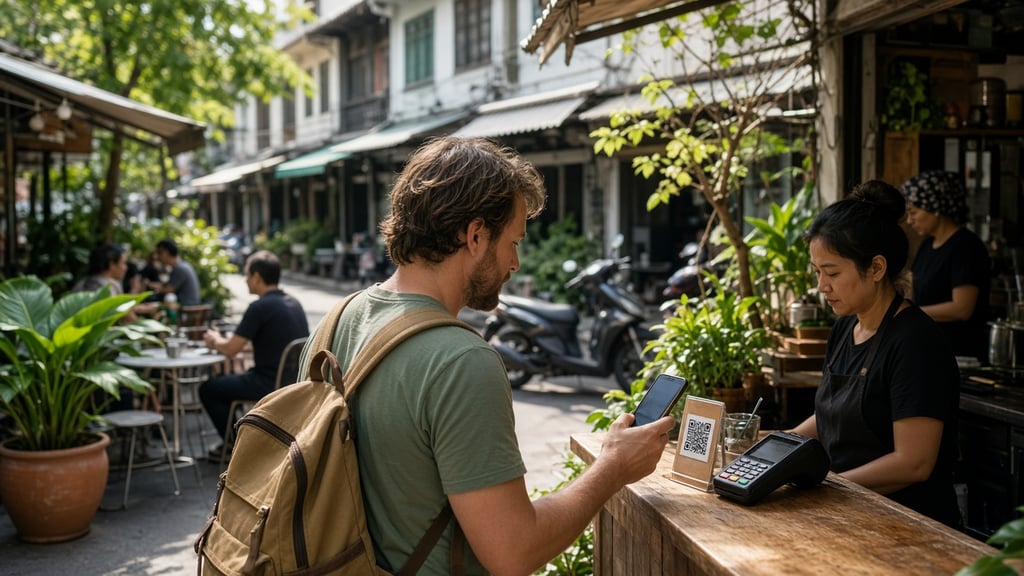
Thailand is lining up a tourist-only payments app that turns idle crypto into baht at the same QR stickers already covering cafe counters, hotel desks, and night-market stalls. WORPT, jointly operated by Waan Exchange Co., Ltd. and Wipay Co., Ltd., converts supported US dollar stablecoins into Thai baht and settles through Thai QR PromptPay so shops are paid in local currency, not tokens. Operators have set a public launch event for 13 November 2026. A late-October company notice said the app is already listed on major stores, while the formal unveiling, retail tie-ups, and prepaid cards are still being staged for that mid-November date.
This is not a scheme for grocers to accept bitcoin at the till. The Securities and Exchange Commission built TouristDigiPay as a conversion sandbox: a licensed digital-asset firm sells crypto for baht, then a Bank of Thailand-supervised e-money provider credits a tourist wallet. WORPT splits that stack between Waan Exchange, an SEC-licensed digital asset exchange and broker, and Wipay, a BOT-licensed e-money house. Tourists spend baht on existing rails. Crypto never lands on the merchant's phone.
How the tourist wallet is meant to work
Eligibility is tight. WORPT's published rules limit sign-ups to foreign individual tourists, not Thai citizens, who hold an NFC-capable passport with at least six months of remaining validity, entered the kingdom for tourism, and have lawful temporary stay. United States nationals are excluded. Onboarding uses passport and face verification. Users deposit USDT or USDC on the Ethereum network (ERC-20) from a non-custodial wallet, convert at the live rate, and pay by scanning the Thai QR codes already used for PromptPay. Other coins are not on the first list. Accounts cannot be opened with fewer than three days of permitted stay remaining.
The conversion fee is 1.5 percent including VAT. The in-app baht balance cannot exceed 100,000 baht per person. Operator terms cap combined monthly spending at 300,000 baht across the wallet and any later Visa prepaid card. Cash cannot be withdrawn from the Wi Wallet account. High-risk merchant categories, including gold, gems, jewellery, foreign-exchange shops, and digital-asset dealers, are blocked under anti-money-laundering rules used by the SEC, the BOT, and the Anti-Money Laundering Office. Jailbroken phones and VPN use can get an account refused.
Physical Visa prepaid cards are slated for mid-November, with pickup and hotel delivery listed from 28 November 2026. Virtual cards are described as a later release, with operators pointing to early 2027. Until those cards exist, the live path is QR only. A shared baht balance is supposed to feed both channels once cards arrive, so users would not need a second top-up.
The sandbox Thailand built first
The SEC opened TouristDigiPay on 25 September 2025 after the rules took effect from the Government Gazette on 24 September 2025. Licensed exchanges, brokers, and dealers could apply through 26 December 2025, but only after tying up with an e-money partner and sitting through a joint pre-consultation with the SEC and the Bank of Thailand. Approved operators get up to 18 months of testing from the approval date. Services are reserved for foreign tourists who are temporarily in Thailand. Conversion must stay separate from speculative trading. Identity checks have to meet Anti-Money Laundering Office standards, and firms must report, keep an exit plan, and verify the source of the digital assets they convert.
The Bank of Thailand had already published a Tourist Wallet standard in July 2025: NFC passport plus biometrics, Thai QR spending, baht credited to the shop in every case, monthly limits, and almost no cash-out except when an account is closed. BOT payment research on 2024 tourist spending found cash still made up 78 percent of transaction value, with cards at 20 percent and e-money at 2 percent. Cross-border QR sat at 0.2 percent. A regulated conversion layer is the state's attempt to pull some of that cash, and some idle crypto, onto rails Thai SMEs already use, without asking a noodle stall to custody tokens.
What This Means for Expats and Travelers in Thailand
Short-stay visitors who already hold USDT or USDC may skip some booth foreign exchange if they accept the 1.5 percent conversion cut, the 100,000 baht wallet cap, and the NFC passport gate. Compare that fee with airport kiosks and hotel desks before assuming it is cheaper. Ethereum network fees sit on top of the conversion charge. You still need a working smartphone, a successful face check, and a supported stablecoin. A 100,000 baht ceiling is enough for many beach weeks and not enough for a long hotel stay plus medical bills. Keep a card or cash backup. Americans on a holiday stamp are out under the published terms, even if every other box is ticked.
Long-stay expats should read the eligibility line twice. The product is framed for foreign tourists on a temporary tourism stay, not for work-permit holders, retirement extensions, or people who already bank in Thailand. Thai citizens are out. If you live here, PromptPay, a local account, or another tourist-wallet product that is not tied to this sandbox may still be the practical option. Treat November 13 as a public launch date, not as proof that every 7-Eleven QR will take a crypto-funded scan on day one. Shops will see baht. You will see an app. The 18-month clock can still be extended, tightened, or stopped.



Comment verification
Step 1 of 3
Verify your email once to publish your comment. Your email is never shown publicly.
Enter the 6-digit code sent to .
Choose the display name shown next to your comments.