Tourist Police Lead Walking Street Sweep as Pattaya Tests Nightlife Staff
Tourist Police Division 1 led a 7 p.m. inspection of South Pattaya entertainment venues on 29 October, with random urine screening of staff and a national brief to keep drugs and illegal firearms off Walking Street.
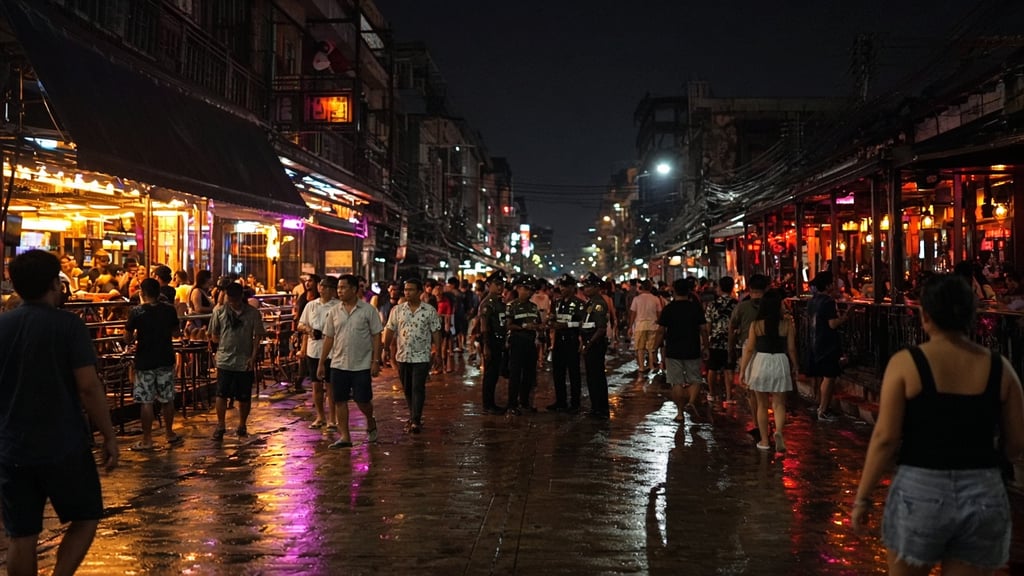
Tourist Police Division 1 walked onto South Pattaya's pedestrian strip at 7 p.m. on 29 October 2026 and treated the entertainment rooms as a workplace, not a parade route. Officers joined Banglamung district officials, the inspection committee attached to Pattaya City Police Station, local tourist police, and narcotics officers under Provincial Police Region 2. The stated targets were illegal drugs inside staffed venues and illegal firearms carried into those rooms.
Pol. Maj. Gen. Surapong Thaiprasert, commander of Tourist Police Division 1, led the field group. Banglamung permanent secretary Phichanon Thaweesuk and Amporn Kaewsaeng, chair of the station inspection committee, were on the street. The visit followed a national brief from Assistant National Police Chief Pol. Lt. Gen. Trairong Phipan, whose line puts narcotics suppression and firearms screening first in tourist nightlife corridors.
The practical tool was random urine screening of venue staff at several businesses along Walking Street in Nong Prue, Banglamung, Chonburi. Initial public notices did not list positive or negative results, and they did not record any firearms seizure. For anyone who works the strip or drinks there, the tests happened and the outcome sheet has not been published.
Why Tourist Police took the lead
Walking Street, Thanon Khon Doen in Thai, runs from Beach Road toward the Bali Hai end of South Pattaya. The city closes the roadway to vehicles from 19:00 until 03:00, the same window in which inspection teams can move at walking pace with the crowd. Official closing time for bars and clubs is 04:00. Seafood rooms, live music, sports bars, discos, and go-go venues make the strip one of the densest foreign-facing nightlife zones in the country.
Tourist Police already treat that pavement as a standing beat. In September 2026 the force publicised drone patrols over Pattaya Beach, Walking Street, and Bali Hai Pier. In June it demonstrated mobile cameras on the same strip after a water-safety visit at Laem Bali Hai and Koh Larn. The 29 October operation adds a layer cameras cannot supply: urine tests of people serving drinks, working doors, and running the floor.
The bureau's public channel remains hotline 1155, advertised as 24-hour help in eight languages. Royal Thai Police directories list 1155 beside 191. A Division 1 sweep is the tourist-facing arm of the police checking the street it is paid to keep safe.
Staff screening sits inside a longer campaign
Random urine checks of people who work around tourists are already Tourist Police practice. On 29 November 2024 the bureau and the Office of the Narcotics Control Board opened a nationwide round covering 78 points and 1,445 people in the tourism circuit, including transport drivers, boat operators, and venue security. The public purpose was visitor confidence and accident prevention. Pattaya now applies that logic to bartenders and hosts, not only door guards.
Ten nights earlier, on 19 October, more than 50 officers from Banglamung district, Pattaya City Police, Immigration, and Tourist Police inspected three entertainment venues. That team checked staff identity cards, documents held by foreign visitors, fire equipment, and licences, and it also ran drug tests. Officials said they found no illegal items and no positive screens. The 29 October Walking Street visit did not repeat those clean-sheet figures. It only confirmed that staff screening is still on the calendar.
Pattaya's entertainment standard is often described as 5-Free: venues are expected to keep out drugs, weapons, human trafficking, underage involvement, and other prohibited activity. The 29 October clipboard put drugs and firearms at the front.
What This Means for Expats and Travelers in Thailand
If you work in a Walking Street bar, treat random urine screening as a workplace event. A positive result can become a criminal matter under Thai narcotics law, and it can put the venue's licence at risk if 5-Free rules are used as a closing trigger. Foreign staff should keep a work permit or passport copy on hand. Thai colleagues should have identity cards ready. Do not assume a cannabis shop receipt is a defence inside a nightclub.
If you are visiting, the sweep does not close Walking Street. Police, district officers, and narcotics teams may be in the same room while you order a drink, usually after 7 p.m. Leave cannabis products, party pills, and any weapon at home. If you are stopped, keep your passport available and call 1155 for language help.
Long-stay residents who use Pattaya as a weekend circuit should read this as a high-season pattern, not a one-night stunt. Immigration officers joined the 19 October checks. Tourist Police Division 1 led on 29 October. Both visits sit under a national police brief. Plan around slower door queues, ID checks at entry, and the chance a favourite room goes dark if a later result sheet is not as empty as the last one.



Comment verification
Step 1 of 3
Verify your email once to publish your comment. Your email is never shown publicly.
Enter the 6-digit code sent to .
Choose the display name shown next to your comments.