Anutin Handed Trump a Handwritten Tariff Note
PM Anutin says he personally lobbied President Trump at APEC with a handwritten note on jasmine rice and maize as Washington proposed an 18% tariff ceiling.
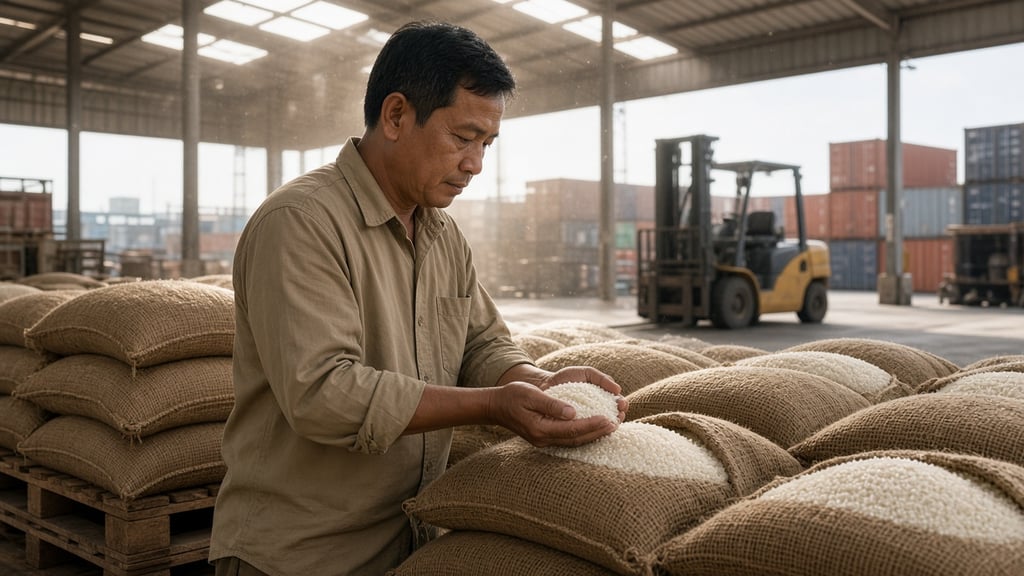
Bangkok's latest move in the United States tariff fight was not another legal brief. Prime Minister Anutin Charnvirakul told viewers on 28 November that he had already taken the argument to President Donald Trump in person, with a handwritten note passed across the table at the APEC meetings in Shenzhen.
The note was not a substitute for the unfinished Agreement on Reciprocal Trade. Deputy Prime Minister and Commerce Minister Suphajee Suthumpun asked him to put two extra product asks in front of the president: jasmine rice and maize. Anutin handed the note over. Trump read it and put it in his suit pocket. After the session, Anutin walked to a USTR official seated behind the principals and asked for a follow-up.
That personal lobbying account is new. The 18% figure now attached to it is not. Thai officials had been working to a 19-20% band after the 17 November joint statement in Manila. Anutin presented the one-point shave as proof that Bangkok had pushed, not waited. The legal clock, however, still sits in Washington.
An 18% Proposal Is Not a Signed Schedule
Washington proposed up to 18 percent Section 301 tariffs on Thai goods on 25 November 2026. The Office of the United States Trade Representative set additional duties of up to 18% on covered Thai goods under Section 301 of the Trade Act of 1974, net of existing Section 301 tariffs, and left room for 25% if consultations fail. Written comments and hearing requests are due by 5 January 2027. Public hearings are listed for 25 January in Washington.
USTR's Thailand report cites industrial targeting, market-access barriers, preferential lending, labour protections, and failure to address global excess capacity, especially in electronics, automobiles, machinery, and electrical equipment. The 18% proposal is framed as accounting for the Framework for a United States-Thailand Agreement on Reciprocal Trade, not as a reward for a pocketed scrap of paper. Until the ART annexes are signed, 18% is a ceiling under consultation, not a customs code. USTR published the figure three days before Anutin's Saturday programme.
Anutin used the same broadcast to reject claims that his government is hiding the deal. Trade texts, he argued, are bargains neither capital can dictate alone. That is a fair description of a reciprocal agreement still with the lawyers. It is a weaker claim if the political story is that a handwritten note moved the rate.
Why Rice, Maize, and the Surplus Matter
Jasmine rice and maize already sit on Thailand's 78-line exemption request, a US$4.95 billion package that also covers cassava, orchids, tuna, shrimp, rubber gloves, and jewellery. Commerce has said 2,120 lines, about half the value of Thai shipments to the United States, already sit on exemption lists. The remaining exposed slice is why a one-point shave from 19-20% to 18% matters to Eastern Seaboard factories, and why a 25% snap-back would not be a rounding error. Maize is politically split besides: growers want US duties off their grain, while feed mills already look toward American maize because domestic output of about 5 million tonnes falls short of roughly 9 million tonnes of feed demand.
The surplus is the harder number. Thailand posted a US$5.04 billion surplus with the United States in October and US$57.53 billion for January-October, even as the country ran a global merchandise deficit of US$56.04 billion. October shipments to the US jumped 42.9%. That bilateral gap is the political fuel Washington cites when it talks about overcapacity and reciprocity. A personal note on two farm lines does not shrink a US$57 billion imbalance, and it will not by itself protect the electronics and auto-parts plants that dominate the Section 301 file.
What This Means for Expats and Travelers in Thailand
Nothing at the supermarket checkout in Bangkok, Chiang Mai, or Phuket changes this week. The 18% figure is a US import duty proposal on Thai goods entering America, not a Thai tax on residents. What it does change is the planning horizon for anyone whose income, job, or supply chain is tied to US orders.
Exporters and the factories that employ them now have a dated calendar: 5 January to file, 25 January to be heard, and a 25% fallback if the Reciprocal Trade legal text stalls. US-based importers of Thai rice, pet food, gloves, or electronics who want a line carved out need to use that docket, not wait for another summit anecdote. Residents who work in the Eastern Economic Corridor, or who remit from plants filling US shelves, should treat 18% as the working assumption and 25% as the stress test.
The other side of reciprocity is already visible at home: US pork, feed maize, and aircraft purchases are the concessions Bangkok keeps having to explain. Anutin also kept EU free-trade talks on a 2027 horizon and said OECD accession still has 24 steps. Those tracks will shape standards and market access long after one APEC hallway.
Comment verification
Step 1 of 3
Verify your email once to publish your comment. Your email is never shown publicly.
Enter the 6-digit code sent to .
Choose the display name shown next to your comments.