BDE Sees Thai Space Sector at 18.6bn by 2030
BDE forecasts Thailand's space industry at 18.63 billion baht by 2030, led by new satellites, LEO ground stations and a first commercial spaceport plan from 2028.
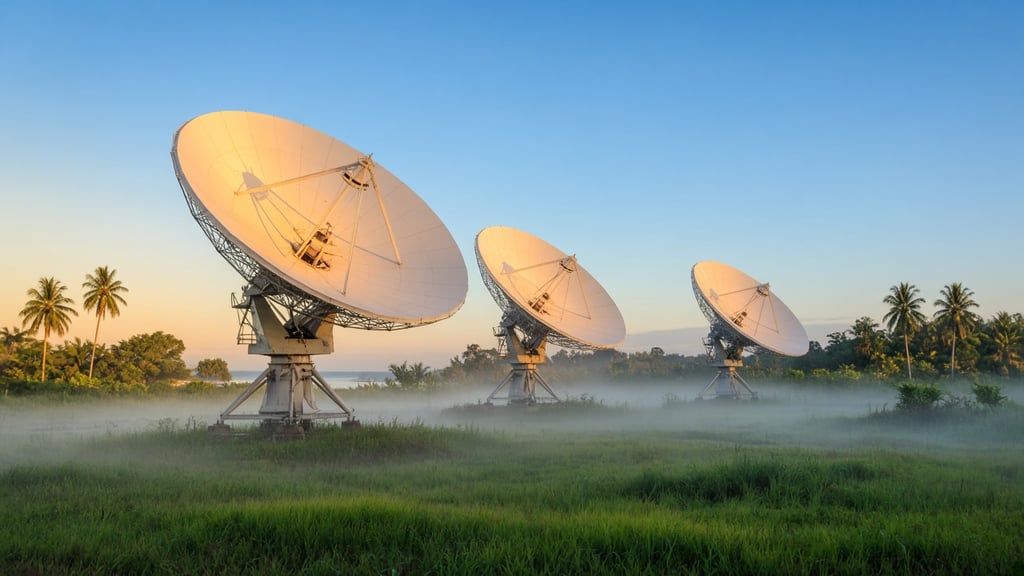
Thailand's space industry is on course to reach 18.63 billion baht in economic activity by 2030 if a slate of new satellites and a first commercial spaceport stay on the government's timetable.
The Office of the National Digital Economy and Society Commission, known as BDE or สดช., mapped the sector from satellite hardware and orbital-slot rights through ground stations to communications, Earth observation and navigation services.
BDE puts the 2026 economic value at 10.97 billion baht, rising to 18.63 billion baht in 2030, a compound annual growth rate of 14.17 percent.
That is faster than the global space-market average of about 9 percent a year. Secretary-General Wetang Phuangsap presented the study as a value-chain reading, not a GDP print, and said the activity total must not be added to a separate capital-spending forecast.
A small industry growing faster than the world average
Downstream services still bring in most of the cash. In 2026 they account for 6.10 billion baht, or 55.6 percent of the total, split between satellite communications at 3.75 billion baht, Earth observation at 1.32 billion and navigation at 1.03 billion, growing about 11.7 percent a year.
Upstream work, including satellite hardware, launch infrastructure, orbital-slot rights and research, is the fastest-growing slice at 17.0 percent a year.
In 2026 upstream already stands at 4.49 billion baht, or 40.9 percent of the chain. Midstream ground stations and satellite operations are a thin 386 million baht, just 3.5 percent, yet they are forecast to grow 16.8 percent a year as foreign low-Earth-orbit constellations buy Thai gateways.
New satellites, LEO gateways and private orbital services
The baseline assumes Thaicom 9, 10 and 11 from Gulf Space Technology, GISTDA's THEOS-3 Earth-observation satellite, and the Royal Thai Air Force's NAPA 3 and 4 smallsats launch on schedule, with NBTC orbital-rights winners paying as billed. Foreign LEO operators are already in the model: Globalstar and OneWeb through Thai partners, Amazon LEO in talks, and China's SpaceSail and GalaxySpace in tests.
The forecast assumes Thailand begins a spaceport development plan in 2028, with about 1.8 billion baht of spaceport investment booked in 2030.
Launch and insurance bills in the same year are put near 1.87 billion baht. Capital spending is seen rising from 3.32 billion baht in 2026 to 9.14 billion baht in 2030, about 2.75 times. In 2026, 73 percent of that money still sits in satellite hardware, 22.9 percent in ground systems and about 4 percent in orbital rights, much of it paid to foreign contractors.
Eastern and southern sites, and a law that is not yet law
Candidate sites include Koh Juang and Koh Jan in Chonburi for vertical launch, Laem Son On in Songkhla, and U-Tapao for horizontal launch and logistics.
GISTDA's study with KPMG Phoomchai ranked the Chonburi islands as a low-population vertical option, flagged community impact at Laem Son On, and treated U-Tapao as the Eastern Economic Corridor logistics play. A three-phase roadmap runs from studies and the Space Affairs Act, through bidding and suborbital tests, to commercial orbital flights aimed at an ASEAN hub.
The Draft Space Affairs Act, approved in principle by Cabinet in 2021, is still not in force after Council of State review in 2025 and later amendment requests from BDE.
A Senate subcommittee heard BDE and the NBTC in September 2026 on licensing and a space-activities fund. Without that statute, launch rules remain early-stage, which is why spaceport money appears late. Thailand's ASEAN pitch is a near-equatorial coast and a water downrange over the Gulf, against neighbours that are also spending. Delay is the obvious way to lose the slot.
BDE warns that most upstream money still leaves the country because Thailand depends on foreign manufacturers and launch providers.
Ground-station readiness is uneven. If a satellite or the spaceport slips, both activity and investment come in below the 2030 line. The bet is to use government demand as an anchor market, thicken Thai shops around GISTDA's Si Racha test centre, and sell gateway time so more of the 18.63 billion baht sticks at home.
What This Means for Expats and Travelers in Thailand
For most foreign residents the near-term effect is not a rocket pad. It is whether licensed low-Earth-orbit broadband finally reaches islands, boats and mountain districts that fibre still misses.
That is not the same as bringing an unlicensed dish through Suvarnabhumi. Spectrum and landing rights still sit with the NBTC and BDE. Cities already have dense fibre and 5G. The watch is island and marine coverage, plus customs scrutiny of satellite terminals. A pad, if built, is a late-decade civil-works story, not a 2027 tourist stop.
Earth-observation spend is more immediate. THEOS-class imagery already feeds flood, farm and haze work that shapes travel warnings. Jobs around Si Racha and U-Tapao are the industrial hook if Thai suppliers stay in the bill of materials. The 18.63 billion baht headline is a planning ceiling. The law, the launches and the ground stations have to show up on time.

Comment verification
Step 1 of 3
Verify your email once to publish your comment. Your email is never shown publicly.
Enter the 6-digit code sent to .
Choose the display name shown next to your comments.