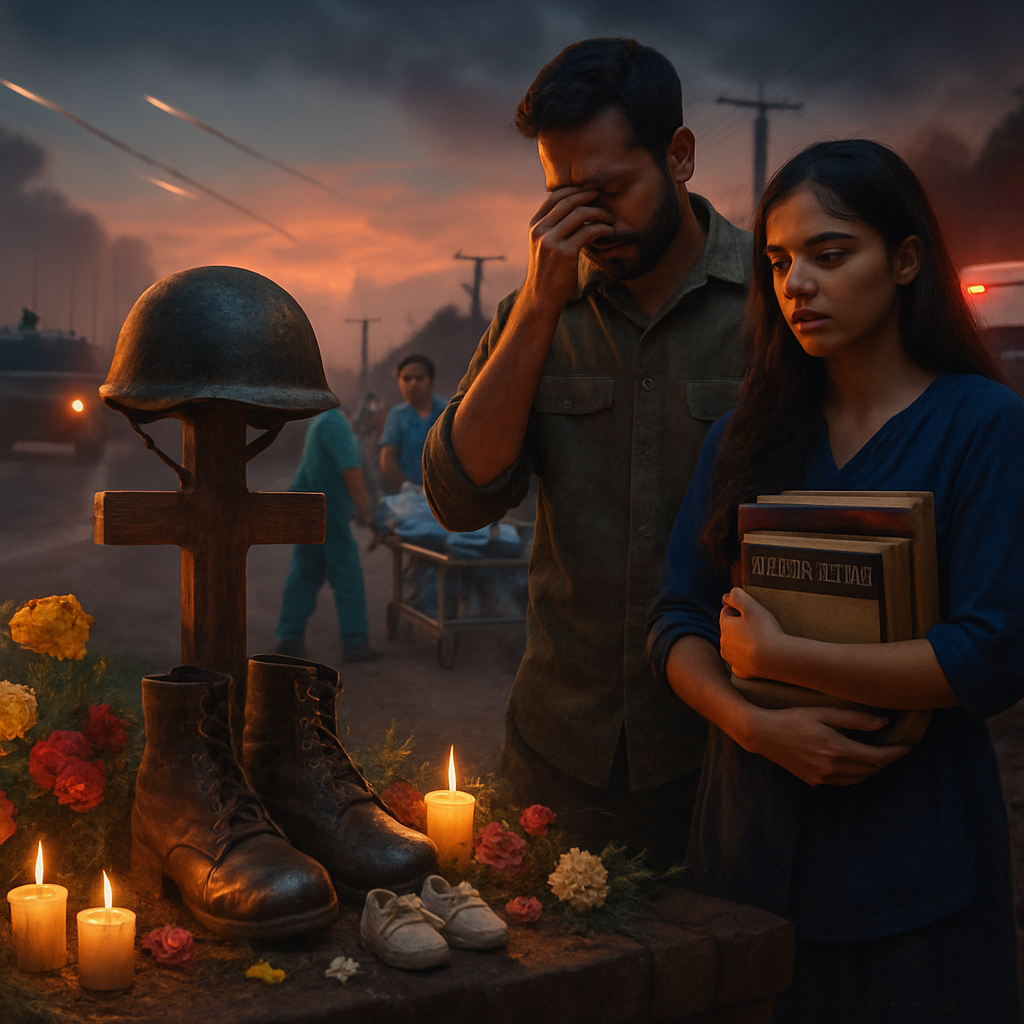
On December 11, Cambodia paused to mourn one of its own. Mut Saveun, a 43-year-old soldier assigned to the 67th Tank Battalion and four months pregnant, was publicly honoured by officials after she was reportedly killed during a frontline clash with Thai forces the day before in the Boeung Trakoun area. The Minister of Women’s Affairs posted a message of sorrow, praising Saveun’s bravery and promising that her sacrifice would live on in the hearts of the Cambodian people.
The details emerging from the border skirmish paint a picture that is equal parts tragic and puzzling. Saveun—described by officials as coming from a military family—left behind a husband and a daughter who is currently in her second year studying English literature at university. The image of a pregnant woman serving on a tense frontline understandably raises questions about how and why she came to be stationed there. Cambodian authorities emphasised that Saveun died defending the line, and that her courage, sacrifice and love of country will be remembered long after the headlines fade.
The loss of Saveun is part of a broader flare-up between Cambodia and Thailand that has turned deadly. Cambodian officials say the confrontation in Boeung Trakoun on December 10 was one episode in a series of clashes that day. Two more Thai soldiers, stationed in Si Saket and Sa Kaeo, were also reported killed, bringing the total number of Thai casualties to seven. Cambodian forces, according to accounts from the border region, allegedly launched BM-21 rockets toward Phanom Dong Rak Hospital in Surin that morning, forcing medical staff and patients to evacuate—a chilling reminder of how quickly civilian infrastructure can be dragged into military exchange.
Beyond the immediate human cost on both sides, the incident underlines how fragile border stability can be between neighbours with a long, complicated history. Tanks, rockets and frontline posturing are grim realities, but so are the familial and everyday stories that are suddenly interrupted. Saveun’s daughter, studying literature and likely dreaming of essays and academic life, now confronts a loss that rewrites her family story.
The escalation even drew attention from the United States: at a Pennsylvania rally, former President Donald Trump said he intended to intervene by phone. “I hate to say this one, named Cambodia-Thailand, and it started up today, and tomorrow I am going to have to make a phone call,” he told the crowd. “Who else could say I’m going to make a phone call and stop a war [between] two very powerful countries, Thailand and Cambodia?” Whether that call would have any practical effect or was a rhetorical flourish remains a matter for diplomats; the remark, however, illustrates how quickly local conflicts can attract global attention in an age of instant media.
For people on the ground in border provinces such as Surin, Si Saket and Sa Kaeo, the headlines are not abstractions. Rockets near hospitals, military exchanges that spill over into civilian zones and the movement of troops and armoured vehicles up and down dusty roads all feed into a climate of fear and uncertainty. Hospitals evacuating patients is particularly stark: medical facilities are meant to be safe havens, not collateral victims. When they become targets, intentionally or accidentally, the humanitarian stakes rise sharply.
As national leaders trade statements and, in some cases, make grandiose promises of intervention, the focus returns inevitably to the people directly affected. Saveun’s case is a poignant reminder of the human faces behind military statistics. Her family—her husband and daughter—now have to navigate a future none of them expected. Her colleagues in the 67th Tank Battalion will carry the memory of a comrade who, according to official statements, stood her ground and paid the ultimate price.
There are still unanswered questions. Why was a pregnant woman deployed to a frontline position? Who will investigate the clash and determine what happened in Boeung Trakoun? What protections are in place to shield civilians and medical staff from the spillover of military confrontations? Accountability and transparency will be essential if the two nations are to de-escalate and restore some measure of safety along their shared border.
For now, the country mourns, and the region watches. Tributes to Mut Saveun call for remembrance and respect for her sacrifice, while diplomats and leaders juggle public pressures and strategic considerations. In the end, the smallest personal stories—families, students, nurses, hospital patients—are what most urgently demand care and attention. If anything positive can be sought from this tragedy, it is the hope that Saveun’s death will prompt a hard look at how frontline decisions are made and how civilians can be better protected when tensions flare between neighbours.
The border remains a fragile line on a map and, to those who live near it, lines of livelihood and life. In the wake of December’s violence, many will be waiting to see whether mourning turns into momentum for restraint—or whether the flames of conflict will spread further.

















This is monstrous — a 43-year-old pregnant soldier killed on the frontline? Why was she there at all, and who signed off on that deployment?
As a Thai citizen, I don’t want this to turn into a blame game. Borders are messy and each side has stories, but sending rockets near hospitals is unacceptable either way.
I agree hospitals should never be targeted. I’m just asking for accountability in my country — families deserve answers about why a pregnant woman was put in harm’s way.
Operational decisions in tense border regions often lack transparency, especially in states with weak civilian oversight. This looks like both a command failure and a humanitarian crisis.
Trump saying he’ll call to stop a war sounds like a circus trick, not diplomacy. This is dangerous grandstanding that could inflame tensions.
People underestimate showmanship in diplomacy. A call from a powerful figure can calm things if it’s backed by real leverage and proper channels.
Showmanship without follow-through is hollow. If it’s real, show the plan; if not, stop turning a funeral into fodder for campaign applause.
There are multiple legal and ethical questions: deployment of pregnant personnel, potential targeting of medical facilities, and cross-border use of BM-21 rockets that might violate international humanitarian law.
I don’t get all the law stuff, but if rockets hit hospitals that’s just wrong. People can’t get help.
Exactly — the law is meant to protect civilians in precisely that scenario. Investigations should focus on intent and command responsibility.
Investigations sound great, but which body would be trusted to investigate? Neither side will likely accept a biased inquiry.
Why does the media always focus on one dramatic face like ‘pregnant soldier’ instead of the larger pattern of border negligence?
Because human stories sell. But you’re right, the pattern deserves attention — this isn’t a single isolated mistake.
Exactly, feel-baiting distracts from systemic failures. We need policy change, not just sympathy posts.
As someone with family near the border, this terrifies me. Hospitals should be safe and now people are being evacuated like it’s normal war.
My cousin works in a Surin clinic; she said they spent the night moving patients. It’s devastating to watch everyday life be uprooted.
Thanks for sharing, Narin. These are not ‘military statistics’ for us — they’re neighbors and lives.
Both governments are playing brinkmanship. This won’t stay local if domestic politics push leaders to show toughness.
Brinkmanship theory fits, but local grievances and historical border disputes make this a combustible mix. De-escalation requires third-party mediation.
Third-party mediation sounds ideal, but who has enough clout and neutrality? ASEAN tends to be quiet in these moments.
Sometimes the only neutral option is a UN or respected regional power, but that risks politicizing the response even more.
If pregnant soldiers are being deployed without protocol, military leadership should be held to account. Where are the checks?
I’m a nurse who has worked in border clinics. Protocols exist on paper but break down under pressure; frontline commanders make on-the-spot calls.
That’s the problem — too much discretionary power with little oversight. Families deserve transparent investigations.
This story smells like propaganda. Both sides will spin it to rally domestic support, especially highlighting a ‘heroic pregnant mother’.
That doesn’t negate the human tragedy. Even if it’s used rhetorically, someone is dead and civilians were endangered.
True, it doesn’t erase the loss. I’m just wary of how narratives get weaponized to justify further escalation.
The US jumping into commentary, even rhetorically, complicates things. Foreign interference — invited or not — can escalate or defuse unpredictably.
Trump says he’ll stop a war with a phone call? That made me laugh, but it’s scary if leaders think it’s that simple.
Laughter aside, the optics matter. A call without coordinated diplomacy could be dismissed or exploited politically.
I’m shocked at the use of BM-21 rockets near medical facilities; that suggests either reckless tactics or deliberate terrorizing of civilians.
From what locals told me, things escalated fast and both sides accused each other. It’s hard to find unbiased on-the-ground reporting.
Which is why independent investigators and journalists need protection to get to the truth before propaganda fills the vacuum.
Why would a pregnant lady be fighting? That makes no sense. People should not fight near hospitals.
Sometimes families have military traditions. But kids are right — medical places must be off-limits.
I hope the kid in the story can still finish school. Losing a mom is really sad.
This is a stark reminder that gender and caregiving roles are changing in militaries, but policies haven’t caught up to protect those who should be exempt.
If policy forbids pregnant deployment, then there’s a criminal chain of command. If not, it’s a moral failure to send them to danger.
Either way, we need transparency and a re-evaluation of rules to prevent similar tragedies.
My uncle fought in border skirmishes years ago. Small fights like this always threaten to blow up; it’s the civilians who pay the price.
Personal stories matter. Politicians treat these flare-ups like chess, but people die and hospitals get evacuated.
Exactly. I’m not for one side or the other, I just don’t want kids and patients in the crossfire.
Medical staff were forced to evacuate patients — that’s a failure of the principle of medical neutrality. Accountability mechanisms are overdue.
How do you enforce medical neutrality when both sides claim the other fired first? It becomes a he-said-she-said with dead people.
Independent, protected investigations and satellite/open-source verification could help, but politics often block them.
Historical border disputes between Thailand and Cambodia are thick with grievances; this incident might be symptomatic of unresolved issues rather than a single failure.
We all carry history, but using that to excuse today’s deaths is childish. We need solutions, not ancient grudges.
Agreed, but acknowledging history is part of crafting durable peace. Ignoring it invites repetition.
My cousin was among those evacuating patients. She said people were crying and doctors couldn’t do normal work. This is a humanitarian emergency.
Those firsthand accounts are crucial. They break through the sterile casualty numbers and show the real human cost.
Yes, please don’t reduce this to politics. The evacuees need aid and protection now.
I doubt a single call from anyone will stop this without pressure and monitoring on the ground. Words alone won’t prevent rockets.
True, but diplomatic moves can buy time for negotiations. It’s a first step, not a cure-all.
Fine, but make sure the first step isn’t just a press stunt. Send observers, not soundbites.
Why is nobody asking why a 43-year-old pregnant woman was in a tank battalion? That sounds like poor record-keeping and bad judgment.
Exactly — age and pregnancy should trigger review of duty assignments. It’s negligent if she was deployed without proper assessment.
Her family deserves answers and maybe reparations if this was negligence, not just patriotic platitudes.
I worry about how fast social media will weaponize this story. The daughter will be pulled into politics while grieving.
That’s already happening. People are politicizing her death on both sides. It’s cruel.
We should at least protect the family’s privacy and demand sober reporting, not clickbait.
ASEAN’s non-interference norm will make regional mediation awkward. Without an assertive regional response, flare-ups keep recurring.
ASEAN can be limited, but sometimes quiet diplomacy behind the scenes is more effective than public grandstanding.
Quiet diplomacy is fine but it needs teeth — monitoring, verification, and consequences for violations.
I just hope the daughter gets support. She was studying literature and now everything changed. The human collateral is the worst part.
Yes! The daughter should be helped. She didn’t deserve this.
Community and university support services should step up, but often they are slow in crisis times.
We must demand an independent probe with international observers. Otherwise, both sides will continue to point fingers and nothing will change.
International observers are key, but both capitals must agree or the probe will be blocked. It’s politically fraught.
Then start pressuring them publicly. Silence equals complicity in protecting bad practices.
This could escalate if nationalist rhetoric ramps up. Leaders should prioritize calming speeches, not hawkish ones.
Leaders respond to domestic audiences. Without real incentives to de-escalate, calm words ring hollow.
Incentives can be diplomatic or economic. Sanctions, aid, or mediation offers can shift calculations away from escalation.
I served on peacekeeping missions. The first step is protecting civilians and medical staff; let the lawyers sort accountability after lives are safe.
Agreed — immediate humanitarian measures should precede long legal processes, but both must happen in parallel for justice and prevention.
Exactly. We need safe corridors, medical teams, and temporary observers while investigations commence.
Border people just want to farm and live. When tanks roll through fields, livelihoods are destroyed and food security is hit.
You nailed it. The economic ripple effect will hit poor communities hardest and last longest.
We need compensation funds and reconstruction plans once things calm down, not just promises.