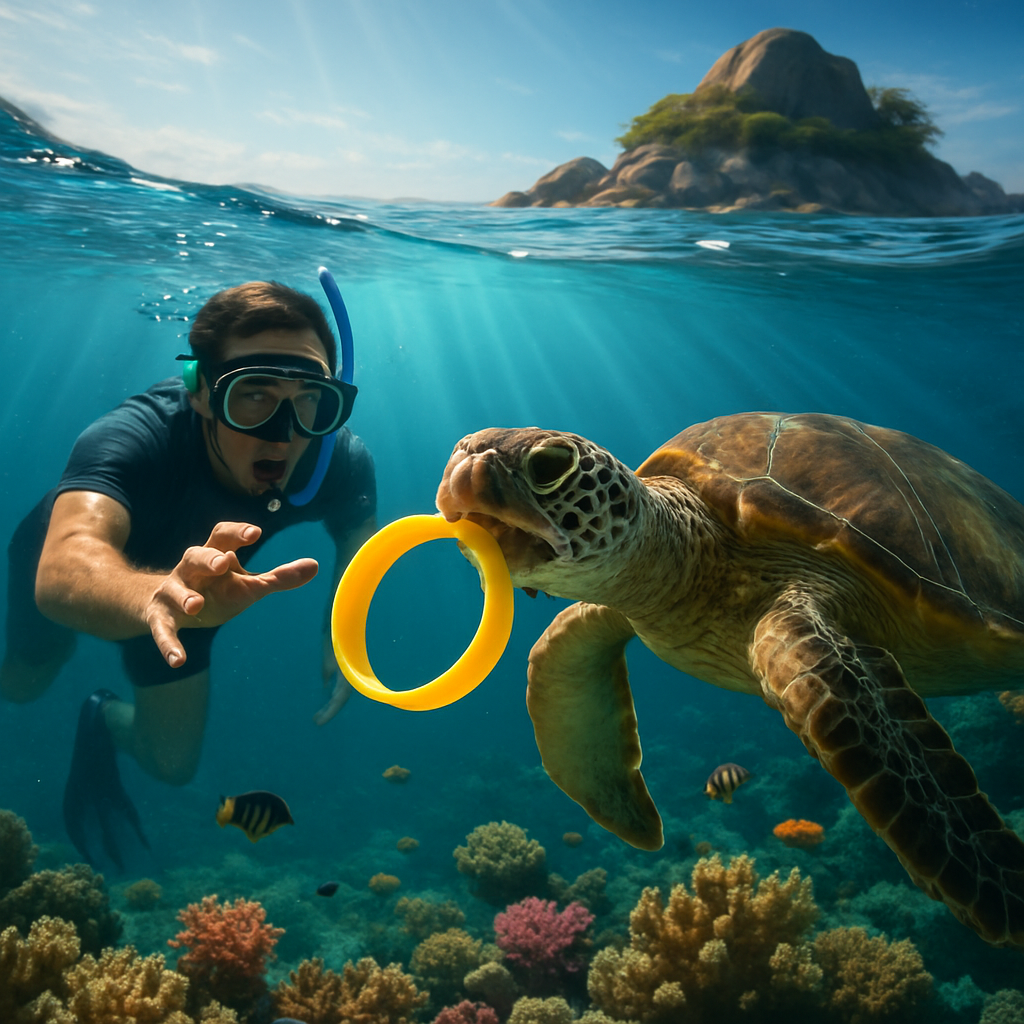
What started as a baffling viral clip has become a cautionary tale from the turquoise waters of Mu Ko Similan National Park: a tourist can be seen offering a yellow wristband to a curious sea turtle — and the turtle promptly swallows it. The footage, shared by Supawinee Tangphithak, set off a chain of events that ended with veterinary teams, X-rays, and a nationwide appeal for information about the person who fed the animal.
The incident reportedly took place during a diving trip in Phang Nga. In the video, an unidentified diver dangles a bright yellow wristband in front of the turtle. The animal investigates, accepts it, and — in an instant that made viewers wince — swallows the band whole. Supawinee later realised what had happened only after watching the footage at home, which meant she could not identify the suspect from memory.
Authorities acted quickly. Officials tracked down the turtle and transported it to the Phuket Marine Biological Centre for examination and care. Pinsak Suraswadi, Director-General of the Department of Marine and Coastal Resources, provided an update on the animal’s condition: veterinarians used an endoscope, X-rays and a barium swallow test to locate the wristband lodged in the middle section of the digestive tract — a position that can interfere with normal digestion and pose risks over time.
Here’s the surprising bit of good news: the veterinary team believes the turtle can likely pass the wristband naturally within 30 to 40 days. Throughout that waiting period the animal is under close observation. A full health check — physical exam plus blood tests — showed the turtle has no external injuries, is responding normally, and has blood values within the expected range. In short, the little sea voyager is holding steady for now, but this could have been a far grimmer outcome.
Why all the fuss over one wristband? Because foreign objects in marine animals can cause severe problems: internal blockages, injuries to the digestive tract, infection, reduced nutrient uptake, and sometimes death. The Department of Marine and Coastal Resources used the case to issue a reminder that feeding or touching marine life is not just unwise — it’s dangerous for the animals and often illegal. Even well-meaning interactions can have tragic consequences.
Meanwhile, the identity of the person who fed the wristband remains unknown. The Department of National Parks, Wildlife and Plant Conservation has appealed to the public for help. Anyone with information is asked to call the hotline on 1362. Authorities have also announced a reward for information that leads to the arrest of the tourist responsible.
There are a few takeaways packed into this story that are worth repeating, preferably far from any dive shop or snorkel boat:
- Do not feed wild animals. Food (and non-food objects) from humans is not part of their diet and can cause harm.
- Keep personal items secured. Bright, dangling wristbands and similar items can attract curious wildlife and lead to accidents.
- If you witness animal mistreatment, report it immediately to local authorities or conservation hotlines — footage can be crucial evidence.
The episode has stirred public concern and a flurry of online commentary, with many users calling for stricter enforcement of wildlife protection rules in popular marine parks. The Similan Islands are a crown jewel of Thailand’s marine biodiversity; preserving that treasure requires cooperation from visitors and operators alike.
For now, marine biologists and veterinarians are doing everything they can to help this particular turtle ride out the next month or so and pass the wristband naturally. It’s a reminder that human actions — sometimes impulsive and light-hearted — can ripple through an ecosystem in ways we don’t expect. If you were on that dive or have any information that could help identify the person who fed the turtle, call 1362 and let the authorities know. A reward awaits information that leads to an arrest.
In an age of viral videos and instant sharing, let this be a lesson in responsibility: the most memorable dives are the ones where the only thing we leave behind is a smile — and perhaps some photos — not a piece of plastic in a turtle’s belly.

















This clip made my stomach drop. Who thinks dangling shiny stuff in front of wildlife is okay? People need to be held accountable, not cheered for likes.
Totally agree—it’s not a harmless prank, it’s animal cruelty even if he didn’t mean harm. The reward for info is the right move, but enforcement has to follow.
Exactly, Maria. Posting a reward is good PR but if the park keeps letting boats go unchecked, nothing changes.
As someone who dives there yearly, I can say enforcement is inconsistent. Some operators educate clients, others treat animals like props.
Why do people think a turtle will ‘play’ with a wristband? That’s just scary and ignorant.
From a conservation perspective, this is symptomatic of a broader human-wildlife interaction problem. Even if the wristband passes naturally, ingestion events increase morbidity risk across populations.
The footage should be used in mandatory briefings for all dive operators, not just as viral content. Training divers saves animals and reputations.
Agreed. Operators profit from close encounters and then shrug when guests do dumb things. Regulations need teeth.
I want to see operators fined if their guests do this while on their boat. Liability should be real.
Fines could work but corrupt officials can be bribed. We also need community pressure and social shaming.
Medical teams did well here: endoscopy, X-rays, and barium swallow are textbook. The hopeful prognosis shouldn’t distract from the legal and educational gaps this incident reveals.
As a vet colleague, I agree. Conservative management can be successful, but monitoring is resource intensive and not scalable if incidents increase.
So vets are paying the bill while tourists act like it’s a joke? That’s insane.
Public funding and park fees should support response capacity, Lucas. Recovery costs are a conservation cost, not a tourism subsidy.
This makes me so sad. I remember turtle night dives and how gentle they are. People ruined it for one animal for likes.
It’s always ‘for likes.’ Social media rewards attention-grabbing behavior in nature without consequences.
If this person is found, they should face the maximum penalty. Letting viral clips slide sets a precedent and normalizes abuse.
Maximum penalty? That’s dramatic. Maybe educate first, jail last. Not every offender is malicious.
Education helps, but with evidence of direct harm like ingestion you can’t just say ‘oops.’ There must be deterrence.
Deterrence only works with consistent legal follow-through. Rewards for tips are fine, but what if they never press charges?
People need to understand biology: a wristband can block digestion and cause slow starvation or infection. It’s not something to gamble with.
Right. And even if the turtle passes it, microscopic plastics can still leach chemicals and affect its health long term.
Exactly — acute events are visible, but chronic impacts of plastic ingestion ripple across lifespans and populations.
Call me practical: enforce wristband rules on tourists. Bright accessories should be banned on park boats if they attract animals.
Would love that. No dangling things, no feeding, you get a safe guided encounter and that’s it.
Also, tour briefings should be recorded and guests sign that they’ve been warned. Make it official.
This is also a cultural issue. Some tourists come from places where feeding animals is normal, but leaving in a wristband is negligence, not culture.
We must avoid xenophobia while enforcing rules. Education targeted at tourists is key—multilingual signs, short videos, and penalties.
Yes, and involve local dive instructors as ambassadors. They can model behavior and correct mistakes immediately.
People love to say ‘it was a mistake’ but the clip shows hesitation and curiosity from the diver. That looks intentional to me.
I watched it twice; the hand lingered. Hard to claim innocence when you’re baiting an animal with a plastic band.
If we can ID the diver then we can make an example. That’s what changes behavior—visible consequences.
Is there any chance the wristband could take years to cause illness? The article makes it sound like a waiting game.
Worst-case, foreign bodies can cause chronic obstruction, ulcers, or infection over months or years. This turtle was lucky to get quick medical attention.
Thanks, that’s scary. Tourists must wake up to the long-term damage they cause.
I was on a dive last year and the guide yelled at a guest for touching a coral. Operators can and should put people in line quickly.
Good guides make all the difference. Certification bodies should make enforcement training mandatory.
Some will say ‘it’s just a band’ and move on, but the viral nature of the clip is a chance to change norms. Use it.
Public shaming can backfire, but targeted legal action and education combined with the media spotlight can be effective.
Agreed, shame has to be paired with constructive policy change, otherwise it’s just noise.
I worry about scapegoating the tourist when the industry profits from commodified wildlife. Responsibility is shared all the way up the chain.
True — dive shops, charters, and even agencies selling packages should share liability and educate clients.
Exactly. If operators face real penalties for repeated guest violations, they’d change practices fast.
Why are wristbands even allowed on dives? They flip off, dangle, and now this. Simple rule: remove nonessential gear.
Make a rule, enforce a rule. It’s that simple but people hate being told what to do.
Some rules are worth being told. Protecting wildlife is one of them.
I hope the person who filmed comes forward as a witness. Viral fame should be used to help, not just to post and forget.
Supawinee shared the clip but couldn’t identify the diver later. Still, the public might help if the clip is circulated carefully.
This story will be used by anti-tourism folks to say all visitors are bad, which is unfair. Most people respect wildlife.
Right, Priya. Don’t tar all tourists. Target the bad actors and fix the systems that allow them to act out.
And let’s uplift examples of responsible tourism to show change is possible.
Spent 40 years underwater and seen disrespect many times. Enforcement and peer accountability on boats would have stopped half of these incidents decades ago.
Peer accountability works when people care. Social norms matter more than laws sometimes.
That’s the point—build better norms before more turtles get hurt.
I can’t stop replaying the turtle’s confusion. It humanizes the damage and makes me furious.
That emotional response is why this clip could change behavior if handled well by conservation groups.
Let’s hope they use the attention to fund education, not just outrage.
Law enforcement in parks is underfunded. Rewards help, but systemic investment in rangers and surveillance is the long-term solution.
Funding translates to better monitoring, faster responses, and prevention. It’s an investment in ecosystem services and tourism sustainability.
If the wristband passes and the turtle survives, cool. But don’t let ‘survival’ be the metric for acceptable behavior.
Agreed. We set a low bar when survival equals success. We should aim for no harm at all.
Prevention beats rescue every time.
Why not require ID on boats and brief mandatory conduct rules before each dive? A five-minute drill could prevent this.
IDs are great, but privacy concerns arise. Still, voluntary registration with legal warnings would help.
Privacy can be balanced. The priority is animal safety while in protected waters.
I hope the dive shops learn fast. This kind of negative press can tank local tourism if ignored, and that’s bad for conservation funding too.
Exactly. Responsible shops market themselves on ethics, not just price. That’s the future of dive tourism.
Some people will defend the diver saying ‘it was curiosity’ or ‘the turtle wanted it.’ Both are excuses. Animals don’t need our novelty.
Excuses are common. The better approach is to use the outrage to fund signage, training, and clear penalties.
If you ever find yourself wanting to ‘interact’ with wildlife for a clip, ask: is this for the animal or for my ego? Most of the time it’s the ego.
Well said. A quick self-check could stop a lifetime of harm for an animal.
And if you see someone doing it, speak up. Silence protects the harmful behavior.