Banglamung dump tests show extreme antimony and cadmium in Nong Prue
Field XRF scans at a mixed industrial and household dump in Nong Prue, Banglamung, hit 720,000 ppm antimony and 190,000 ppm cadmium. PCD has filed a police complaint and ordered a source hunt.
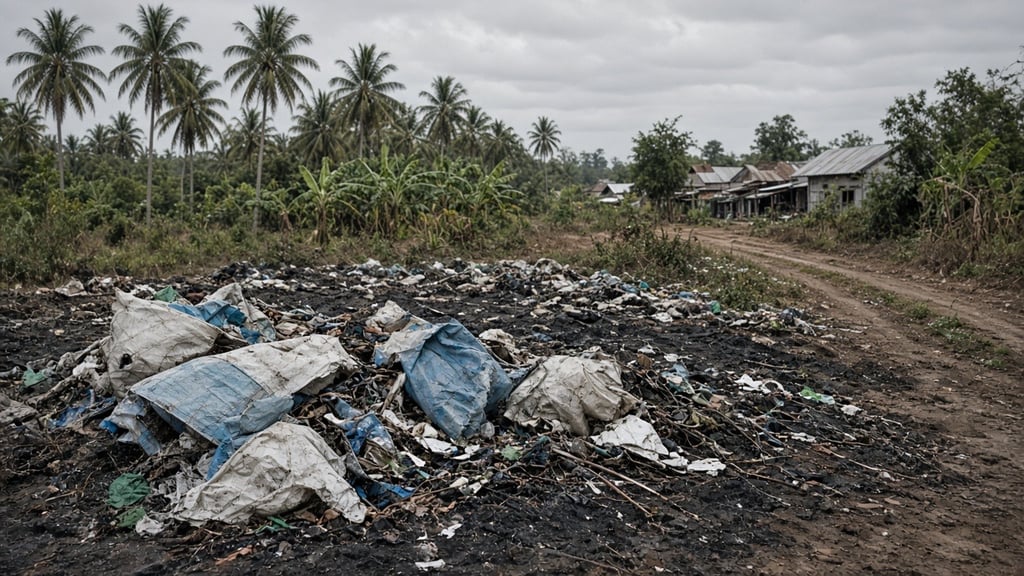
Inspectors working a patch of land in Nong Prue, Banglamung, have recorded some of the highest field readings of antimony and cadmium publicly disclosed in Chonburi this year. The Pollution Control Department says the mix of household rubbish and factory residue, buried across more than seven rai, is now a criminal and environmental case, not a routine landfill complaint.
The site sits on Soi Nong Mai Kaen 17, on a plot of about 10 rai in a district that feeds workers, villas, and weekend traffic toward Pattaya. Village environment volunteers flagged the ground on 28 October 2026. That same day, Environment and Pollution Control Office 13 walked the sois with a joint Eastern Seaboard task force set up by Natural Resources and Environment Minister Suchart Chomklin.
What the field tests showed
Officers found cable insulation scraps, plastic offcuts, industrial bulk bags packed with residue, and burn marks. More than seven rai of the ten-rai plot had been used as a dump, with community waste mixed into the industrial material rather than kept in a licensed facility.
Handheld X-ray fluorescence scans at four points returned antimony as high as 720,000 parts per million, cadmium at 190,000 ppm, and lead at 360 ppm. Those antimony and cadmium figures are not trace contamination. They describe concentrated process waste: 720,000 ppm is 72 percent antimony by mass, and 190,000 ppm is 19 percent cadmium.
PCD Director-General Surin Worakitthamrong said the field profile fits Type 3 hazardous substance listing 5.2, chemical wastes, under the Ministry of Industry hazardous-substance inventory issued in B.E. 2556 (2013). Laboratory samples were due to be taken on 29 October by the Chonburi Provincial Industry Office so prosecutors can rely on more than a handheld scan.
Air checks at the same four points found volatile organic compounds at 0 ppm. Inspectors still reported a chemical smell on site. Deputy Government Spokesperson Lalida Perisvivatana briefed the same figures on 29 October and said laboratory work must confirm the handheld results before the waste is locked into a final legal class.
Why these two metals showed up together
Antimony is scarce in ordinary Thai topsoil. Roughly half of global antimony demand goes into flame retardants, especially antimony trioxide blended into plastics and cable compounds. Cable sheathing scraps in a rural pit are a classic fingerprint of informal wire stripping, not garden refuse.
Cadmium is slower and meaner. It accumulates in kidneys and bone, with a biological half-life measured in decades. Japan's historic itai-itai outbreak came from rice grown in cadmium-tainted irrigation water. Burning or crushing cadmium-bearing waste can also inflame the lungs. The 190,000 ppm in these bags is factory-strength material, not a soil stain.
Lead at 360 ppm is far below the antimony and cadmium peaks, yet it still sits in the same chemical-waste conversation. Burning mixed cable and plastic can move metals into ash and dust that children and dogs pick up off the soi.
A police file, and a wider Eastern Seaboard pattern
EPO 13 filed a complaint at Nongprue Police Station on 28 October citing factory law, hazardous-substance law, and related statutes. No person or company has been named in public. Nongprue Municipality was told to watch the ground and stop anyone from hauling the bags away overnight.
The case sits inside a broader eastern crackdown. In mid-September, Minister Suchart told an MNRE task force that mapping had already found 61 illegal dump points in the east, including 20 in Chonburi, and that officers should trace waste back to the factory of origin rather than stop at the truck driver. Residents can still lodge pollution complaints through PCD channels, including hotline 1650.
Field XRF is fast. The industrial office samples will take longer, and those lab sheets are what a court will want if someone is charged with unlicensed handling of hazardous substances.
What This Means for Expats and Travelers in Thailand
Nong Prue is not a remote industrial estate. It sits on the inland side of Banglamung, within everyday driving distance of Pattaya and Jomtien. People who rent houses, keep dogs, or buy food from soi vendors near the plot should treat it as a closed contaminated site: no scavenging, no taking free soil, no letting children play on the mounds.
If you live on a well in Banglamung or the wider Eastern Economic Corridor, ask your tambon about recent water tests rather than panic-buying filters. Cadmium and antimony move off a site mainly through dust, ash, and rainwater leaching. Municipal tap water in the Pattaya urban system is not drawn from that pit. Private wells downhill of any burn site are the real question, answered only by a lab test of your own tap.
Travelers passing through Pattaya this high season do not need to change hotel plans. The practical steps are local: do not hire unlicensed skip trucks that offer cheap construction waste disposal, and if you see bulk bags, cable fluff, or night dumping on a vacant lot, photograph from the public road and report it to PCD or the municipality rather than walking onto the land.


Comment verification
Step 1 of 3
Verify your email once to publish your comment. Your email is never shown publicly.
Enter the 6-digit code sent to .
Choose the display name shown next to your comments.