Police Seize 5.2 Million Meth Pills on Laos Border
Thai security forces intercept a pickup carrying 5.2 million methamphetamine tablets in Ubon Ratchathani along the vulnerable border with Laos.
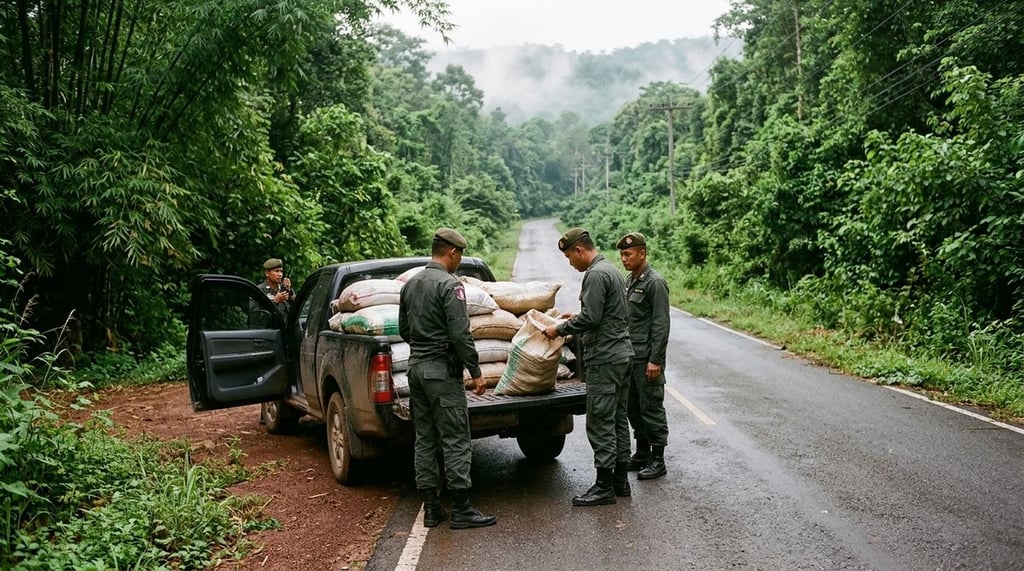
Thai security personnel operating along the southern fringe of the Lao frontier intercepted a customized transport pickup carrying 5.2 million methamphetamine tablets in Ubon Ratchathani late Friday night. The high-volume interdiction occurred on a remote unlit connector between Ban Bok and Ban Nong Paen in Huai Kha subdistrict, Buntharik district, where tactical patrols cornered the vehicle before the driver abandoned the illicit cargo and escaped into dense forest scrub.
The seizure marks one of the largest single synthetic drug busts recorded along the lower northeastern border in recent weeks. Operating under the unified command of the Second Army Region and the regional counter-narcotics task force known as NBYOS 24, combined teams from Huai Kha Police Station, Border Patrol Police Special Task Force 225, and Buntharik district administrative officers deployed mobile interception units after intelligence sweeps signaled an imminent cross-river shipment from Champasak province in southern Laos.
Tactical Interception on the Huai Kha Corridor
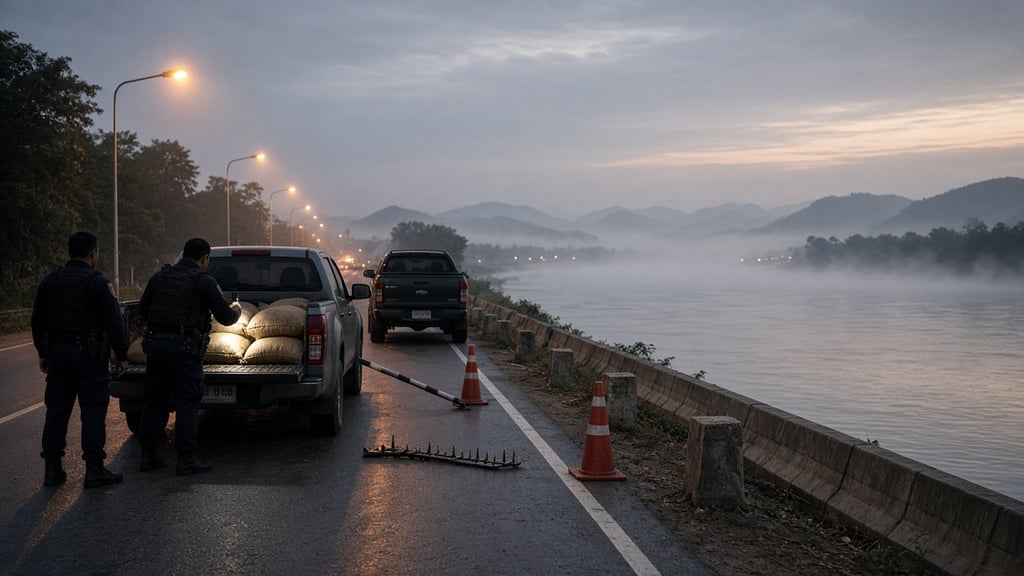
The operational confrontation developed shortly after 22:30 when a roving patrol car from Huai Kha Police Station encountered the black four-door Mitsubishi Triton traveling westward toward Highway 24. Spotting patrol headlights on the narrow secondary road, the driver attempted an abrupt three-point turn to reverse direction back toward the international border. With roadside drainage ditches restricting vehicle maneuvering, the chassis became wedged sideways across both asphalt lanes, blocking transit in both directions.
Realizing that the vehicle could neither turn nor reverse, the driver leaped from the cab into the pitch-black brushland flanking the roadway. Supporting units from Border Patrol Police Task Force 225 cordoned the perimeter, but the dense secondary growth and proximity to unmonitored border tracks allowed the suspect to slip across the forested terrain. Forensic specialists secured the abandoned pickup to lift latent fingerprints, extract geolocation breadcrumbs from onboard electronic systems, and match registration serials.
A systematic search of the cabin and bed revealed 26 heavy-duty woven fertilizer sacks stuffed with rectangular packets wrapped in yellow wax paper and branded waterproof film. Seven sacks rested in the rear bed under a strapped blue tarp, while another nineteen sacks filled the rear seating bench and front passenger footwell up to the window glass. The total haul contained approximately 5.2 million tablets, known locally as yaba, carrying an estimated wholesale street value of 15 million baht and an ultimate retail distribution yield several multiples higher.
Shifting Logistics in the Lower Mekong
The Buntharik seizure highlights an ongoing tactical shift by transnational drug syndicates operating across Southeast Asia. Intensified enforcement under military-led task forces in upper northern provinces such as Chiang Rai and Chiang Mai has forced trafficking cartels to diversify secondary transit corridors. While industrial manufacturing remains concentrated in rebel-held enclaves of Myanmar's Shan State, bulk shipments increasingly circumvent northern checkpoints by traveling down the length of the Mekong River or traversing eastern Lao provinces before crossing into Thailand's Isan heartland.
Ubon Ratchathani presents an attractive alternative gateway for logistics coordinators. The province shares hundreds of kilometers of frontier with southern Laos, blending riverine crossings along the Mekong and Mun rivers with rugged overland terrain abutting Champasak. Districts like Buntharik, Sirindhorn, and Khemarat feature networks of agricultural feeder roads where commercial farm traffic provides natural cover for couriers attempting to ferry shipments toward storage warehouses around Khon Kaen, Nakhon Ratchasima, and metropolitan Bangkok.
Provincial police leadership and interior ministry officials noted during the weekend briefing that regional interdiction totals have surged dramatically. Over the preceding two months, coordinated checkpoints across Ubon Ratchathani have removed more than 23 million yaba tablets and in excess of 2,000 kilograms of crystal methamphetamine from circulation. The sustained frequency of multi-million tablet hauls suggests that illicit supply chains continue to push massive volumes through eastern border crossings despite continuous surveillance.
The Mechanics of Synthetic Drug Overproduction
The sheer scale of synthetic drug consignments moving across Thailand reflects structural changes in regional narcotics manufacturing. Reports compiled by the United Nations Office on Drugs and Crime document how industrial chemical synthesis has decoupled regional drug cartels from traditional agricultural crop cycles. Transnational crime syndicates procure precursor and non-controlled chemicals through regional commercial supply lines, allowing clandestine laboratory complexes in Shan State to manufacture methamphetamine at near-zero marginal production costs.
This hyper-abundance of supply has crashed wholesale prices across the Mekong region. Wholesale tableting rates have dropped to historic lows, transforming yaba into an inexpensive commodity distributed through layered supply pyramids. Major syndicates insulate top organizers by contracting freelance couriers, commonly termed pilot drivers, who receive nominal payments to navigate predetermined highway waypoints. If an interception occurs, syndicates absorb the product loss as a routine operational expense while the courier bears the legal consequences.
To counter this decentralized network, Thai security commands have integrated real-time automated license plate readers, overhead aerial reconnaissance, and inter-agency intelligence pooling across the northeastern border. Command structures such as NBYOS 24 operate jointly with provincial governors and district administrations to establish flexible, roving choke points that disrupt established courier transit schedules rather than relying exclusively on permanent highway inspection stations.
What This Means for Expats in Thailand
While cross-border narcotics trafficking rarely impacts foreign tourists or long-term expatriates directly, major interdiction operations generate tangible security and regulatory ripple effects across the country:
- Provincial Road Checkpoints and Document Checks: Motorists driving through northeastern provinces, particularly along Highway 24, Highway 217, and arterial roads leading into Nakhon Ratchasima, should anticipate heightened military and police checkpoints. Drivers should always carry an original passport, valid Thai driving license, and vehicle registration documents to avoid delays during routine inspections.
- Cross-Border Travel via Chong Mek: Commercial tourism and immigration formalities at the official Chong Mek border checkpoint to Pakse operate normally. However, travelers should maintain strict custody over personal luggage, decline requests to carry parcels across the border for acquaintances, and inspect rental vehicles thoroughly prior to departure.
- Community Dynamics and Rural Safety: The widespread availability of cheap synthetic stimulants remains a leading driver of localized social friction and property offenses in provincial districts. Expatriates residing in rural or semi-rural northeastern communities should maintain sensible residential security practices, including perimeter lighting and secure gates.
- Strict Narcotics Legislation: Thailand enforces zero tolerance for narcotics trafficking and distribution under the Narcotics Code. Penalties for commercial possession or transit involve mandatory long-term incarceration or capital sentencing, reinforcing the importance of avoiding any association with unregulated logistics or courier arrangements.
Comment verification
Step 1 of 3
Verify your email once to publish your comment. Your email is never shown publicly.
Enter the 6-digit code sent to .
Choose the display name shown next to your comments.